الوسم: dark matter

  • Ancient Dark Stars’ Gravitational Waves Could Hold Hidden Secrets

    Ancient Dark Stars’ Gravitational Waves Could Hold Hidden Secrets

    Mysterious Gravitational Waves May Be Echoes of Ancient Dark Stars
    Credit: Unsplash+.

    A faint gravitational-wave signal drifting through the cosmos might hold secrets about enigmatic stars that existed over 13 billion years ago, new research suggests.

    Scientists from Colgate University have explored whether some of the earliest supermassive black holes could be responsible for much of the ultra-low-frequency gravitational-wave background we observe today.

    Their research raises an intriguing possibility: some of these ancient black holes might have originated from objects known as Dark Stars.


    Gravitational waves are ripples in spacetime caused by massive objects in motion. Researchers can detect extremely slow gravitational waves by observing pulsars—rapidly spinning neutron stars that emit regular radio signals toward Earth.

    Because pulsars send out signals with incredible precision, they act like cosmic clocks. When a gravitational wave passes between a pulsar and our planet, it can cause a slight variation in the arrival time of those pulses. By monitoring numerous pulsars over years, scientists have detected a faint “hum” of gravitational waves permeating the universe.

    The leading theory is that this background signal mainly results from pairs of supermassive black holes gradually orbiting each other before merging. Black hole pairs with combined masses exceeding about a billion times the Sun are thought to contribute most significantly.

    This leads to another question: how did these black holes grow so massive?

    Astronomers using advanced observatories, including the James Webb Space Telescope, have found surprisingly large black holes in the early universe. They’re now trying to understand how the initial “seed” black holes formed and grew so rapidly.

    Researchers Sohan Ghodla and Cosmin Ilie studied two potential origins for these initial black hole seeds: direct-collapse black holes and black holes stemming from collapsing supermassive Dark Stars.

    Dark Stars are hypothetical stars that might have existed shortly after the Big Bang. Unlike traditional stars like our Sun, which generate energy through nuclear fusion, Dark Stars could have been powered mainly by heat produced by dark matter.

    Some theories propose that these unusual stars could have remained relatively cool and enormous while continuing to accumulate material. Over time, some might have grown to over a million times the Sun’s mass before collapsing into massive black holes.

    The researchers modeled how these black holes could grow within their galaxy environments, form pairs, and eventually produce gravitational waves.

    Their simulations suggest that if supermassive Dark Stars were common in the early universe, the black holes they left behind could account for a large—or even dominant—portion of the gravitational-wave background we detect today.

    In contrast, direct-collapse black holes, which were considered in their models, were predicted to be rarer, leading to a weaker gravitational-wave signal.

    This work also offers a new way for scientists to test theories about the early cosmos. If too many massive black-hole seeds formed, their descendants would generate more gravitational waves than current observations show. So, existing measurements help set limits on how common such objects could have been.

    The study doesn’t claim that Dark Stars definitely existed, but it shows that modern gravitational-wave data could help evaluate their possible role in cosmic history.

    As pulsar timing improves, the faint gravitational-wave background surrounding us might reveal extraordinary clues: remnants of objects born during the universe’s earliest moments, preserved over more than 13 billion years of cosmic evolution.
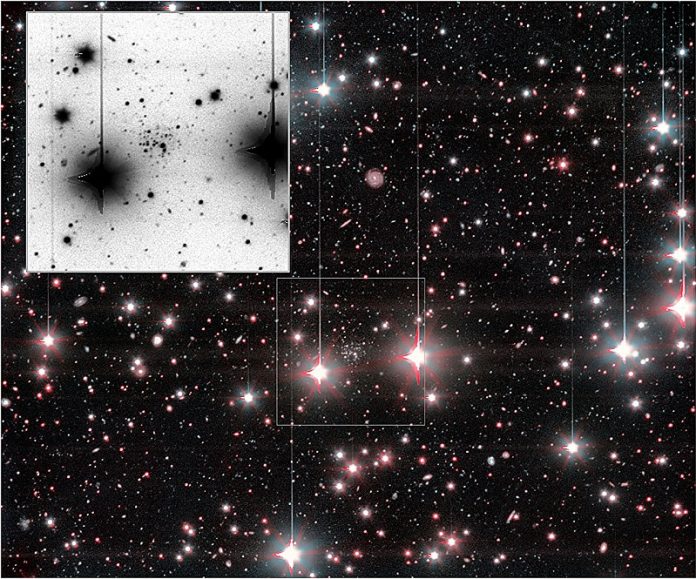


  • Ancient 12.5-Billion-Year Galaxy Near Andromeda Discovered as Cosmic Fossil

    Ancient 12.5-Billion-Year Galaxy Near Andromeda Discovered as Cosmic Fossil

    Astronomers have identified one of the faintest galaxies ever observed near the Andromeda Galaxy. Known as Andromeda XXXVI (And XXXVI), this small galaxy is estimated to be around 12.5 billion years old, positioning it among the oldest galaxies in our local universe. This discovery presents a rare opportunity for scientists to study the conditions of the universe shortly after the Big Bang.

    The research was featured in the journal Astronomy & Astrophysics. The Andromeda Galaxy is approximately 2.5 million light-years from Earth and is the closest large spiral galaxy to our own Milky Way. Like the Milky Way, Andromeda hosts numerous smaller satellite galaxies bound by its gravitational pull. And XXXVI falls into the category of ultra-faint dwarf galaxies—these are the tiniest and dimmest galaxies known, containing very few stars and emitting minimal light, which makes detection exceptionally challenging.

    It is widely believed that these ultra-faint dwarf galaxies formed in the universe’s earliest days. Since they have changed little over billions of years, they are often considered cosmic fossils, offering insights into the formation of the first galaxies. Joanna Sakowska, the study’s lead researcher from Spain’s Instituto de Astrofísica de Andalucía, stated that the galaxy is extremely ancient with a scarcity of heavy elements like iron and oxygen. Such elements are produced inside stars over time, so their absence suggests that And XXXVI formed before many stellar generations had enriched the universe.

    Further observations are needed to pin down its exact age, distance, and chemical composition. Advanced space telescopes, such as the Hubble Space Telescope, could provide more detailed data.

    This discovery also addresses a longstanding question in astronomy. The widely accepted Lambda Cold Dark Matter (ΛCDM) model predicts that large galaxies like Andromeda should be surrounded by hundreds of tiny satellite galaxies. Currently, only around 40 satellites have been identified around Andromeda, and merely 15 are ultra-faint dwarf galaxies. Scientists suspect many more remain hidden because they are too faint for current detection methods.

    Isabel Santos-Santos from the Leibniz Institute for Astrophysics in Potsdam emphasized that each new ultra-faint galaxy found helps test theories of galaxy formation and enhances our understanding of dark matter—the elusive substance that constitutes most of the universe’s matter but cannot be directly observed.

    Interestingly, And XXXVI was initially spotted by amateur astronomer Giuseppe Donatiello while examining images from the Pan-Andromeda Archaeological Survey. Once identified as a potential galaxy, professional astronomers utilized the Gran Telescopio Canarias, one of the world’s largest optical telescopes, to capture deeper images. Despite the telescope’s capabilities, studying And XXXVI remained difficult; only around 46 stars belonging to the galaxy could be identified.

    Although this galaxy is tiny and nearly invisible, it could offer critical clues about the origins of early galaxies and the dark matter that influenced the universe’s evolution. Each new discovery like And XXXVI contributes to a clearer understanding of the universe’s birth over 13 billion years ago.

  • Dark Force Might Suppress Cosmic Structure Growth

    Dark Force Might Suppress Cosmic Structure Growth

    Dark matter remains one of the biggest mysteries in science. It can’t be seen directly because it doesn’t emit, absorb, or reflect light. Despite this, scientists are confident it exists because its gravity influences galaxies and other cosmic objects. In fact, dark matter is believed to constitute about 85% of all matter in the universe.

    For many years, the common assumption was that dark matter is relatively straightforward. The prevailing theory suggests that dark matter particles interact with the rest of the universe—and with each other—mainly through gravity. But what if there’s another hidden force at play?

    A recent study published in the Journal of Cosmology and Astroparticle Physics examined this idea. Surprisingly, the researchers found that such a force could actually slow the growth of large cosmic structures rather than accelerating it.

    Interest in a potential “dark force” has grown recently because some of the most detailed observations of the universe don’t perfectly align. Different methods of measuring the universe—such as tracking its expansion or studying galaxy formation—sometimes produce slightly conflicting results. These discrepancies, while small, suggest there might be missing pieces in our understanding of cosmology.

    One hypothesis is that dark matter particles might interact through an additional force that affects only themselves—a “dark force” that we can’t detect directly with current instruments. Researchers from the Perimeter Institute for Theoretical Physics developed models to explore this possibility and compared their predictions with actual observations.

    Initially, it seemed logical that if dark matter particles attract each other more strongly, they would cluster more efficiently. Larger dark matter clumps could then lead to faster formation of galaxies and structures. But the calculations revealed an unexpected result.

    While this additional force did promote clustering among dark matter particles, it also altered their behavior as the universe expanded. In the models, the particles effectively became lighter over time. This change proved to be crucial, because it reduced the overall effect of the force on the growth of cosmic structures. Instead of leading to denser formations, the combined effects often suppressed their development.

    This research indicates that the universe’s behavior may be more complex than our initial intuition suggests. Simply adding an attractive force doesn’t necessarily produce more structure; different physical effects can interact in surprising ways, sometimes even canceling each other out.

    The findings could also aid scientists in evaluating other theories meant to explain puzzling observations from extensive sky surveys, including recent data from the Dark Energy Spectroscopic Instrument (DESI). As new telescopes and observatories gather more precise data, researchers hope to learn even more about the mysterious nature of dark matter. Studies like these help narrow down which ideas are plausible and which are not.

    Ultimately, this work serves as a reminder that the universe often behaves in unexpected ways, and uncovering its deepest secrets may require going beyond our usual assumptions and thinking creatively.

  • How Dark Matter Might Have Spawned Early Massive Black Holes After the Big Bang

    How Dark Matter Might Have Spawned Early Massive Black Holes After the Big Bang

    Astronomers have long been intrigued by the presence of massive black holes in the early universe. Some of these black holes, discovered less than a billion years after the Big Bang, are as large as a billion times the mass of our Sun. Traditional theories suggest there wasn’t enough time for these giants to form through standard growth processes. However, a recent study offers a potential explanation involving dark matter.

    Led by researchers at the University of California, Riverside, the study proposes that a gradual “decay” of dark matter particles might have created favorable conditions for rapid black hole formation. This research was published in the Journal of Cosmology and Astroparticle Physics.

    Dark matter, which accounts for approximately 85% of all the matter in the universe, remains one of science’s greatest mysteries. It doesn’t emit or reflect light, making it invisible to telescopes. Yet, its gravitational pull influences galaxy formation and the large-scale structure of the cosmos. In this new investigation, scientists examined what could happen if dark matter particles slowly release tiny amounts of energy as they decay over time.

    While each particle would emit an incredibly small amount of energy—far too little to influence everyday devices—this energy might have had a significant impact in the early universe. At that time, galaxies primarily consisted of simple hydrogen gas, which is highly responsive to even minimal energy changes.

    Typically, this hydrogen gas cools and forms stars. The researchers found that if the decay of dark matter adds just enough energy, it can alter the gas chemistry in a way that hinders star formation. Instead, large amounts of gas could directly collapse into black holes—a process known as “direct collapse”—which accelerates the formation of black holes far beyond the normal timeline.

    The discovery of unexpectedly large black holes by the James Webb Space Telescope in the early universe has challenged traditional models. The new research suggests that dark matter decay could have increased the frequency of direct collapse events, helping to explain these observations.

    Using sophisticated computer simulations, the team analyzed how gas would behave under the influence of decaying dark matter. They identified specific ranges of dark matter particle masses that could produce the ideal conditions for direct collapse, adding an important piece to the puzzle of how the first galaxies and black holes emerged.

    This idea also bridges different areas of physics, linking cosmology and particle physics. It demonstrates how tiny effects at the atomic level could have driven the evolution of the universe as a whole.

    Though further research is necessary to confirm this hypothesis, the findings present a compelling new perspective on one of astronomy’s most profound mysteries. If proven correct, it would mean that dark matter not only shaped galaxies through gravity but also directly contributed to the creation of some of the universe’s earliest and most massive objects.