الوسم: Critical Minerals

  • Australia, India, Japan, US to collaborate on port and critical minerals deal

    Australia, India, Japan, US to collaborate on port and critical minerals deal

    The foreign ministers of Australia, India, Japan, and the United States convened to agree on collaborating on a port project in Fiji and to sign agreements related to critical minerals and energy security. This meeting marked the third gathering of the Quad since September 2024.

    During the brief session, the ministers from Australia (Penny Wong), India (Jaishankar), Japan (Toshimitsu Motegi), and the U.S. (Secretary of State Marco Rubio) announced their first joint infrastructure initiative—a port in Fiji. Rubio highlighted that their partnership would focus on port infrastructure, especially addressing the limited port capacity in Pacific Islands, with Fiji as a key collaborator.

    The Quad had experienced some slowdown last year after missing a leaders’ summit, partly due to tensions between U.S. President Donald Trump and Indian Prime Minister Narendra Modi over tariffs and other issues. However, Rubio expressed optimism, stating, “We’re beginning to see real progress. We are deeply committed to this partnership, which is a vital part of our global strategy as a nation.”

    The ministers agreed to initiate programs on Indo-Pacific energy security and developing a framework for critical minerals. Rubio explained that the minerals framework aims to leverage economic tools and coordinate investments to fortify supply chains, including mining, processing, and recycling of critical minerals. This could be particularly impactful for Japan, which faces disruptions after China ceased shipments of certain minerals vital for aerospace, defense, and semiconductor sectors.

    While there’s been advocacy for a high-level visit by Trump to India—potentially linked to a Quad summit—international analysts have questioned whether the absence of a leader-level summit diminishes the group’s significance. The foreign ministers did not comment on plans for a summit this year, but Rubio mentioned that diplomats are working toward scheduling one later this year.

    Melbourne-based Asia Society Australia senior policy fellow Premesha Saha noted, “The lack of a leaders’ summit has introduced doubts, but that doesn’t necessarily mean the Quad has lost relevance. If it continues to make progress through ministerial and working-level engagements, it can stay pertinent even without frequent leader-level signals.”

  • Brazil and India Tackle Critical Minerals Deal Amid Summit

    Brazil and India Tackle Critical Minerals Deal Amid Summit

    India’s Prime Minister Narendra Modi (on the right) walks hand-in-hand with Brazil’s President Luiz Inacio Lula da Silva during their pre-meeting walk at Hyderabad House in New Delhi on February 21, 2026. — AFP

    Modi and Lula are engaged in discussions in New Delhi focused on cooperation around critical minerals. An agreement is anticipated as the supply chains for rare earth elements diversify, with India actively seeking alternatives to China for these resources.

    Brazil holds the world’s second-largest reserves of critical minerals, essential for building electric vehicles, solar panels, smartphones, jet engines, and missile technology. India, aiming to reduce reliance on China as its primary supplier, has been expanding its domestic extraction and recycling capabilities while exploring new sourcing options.

    Lula, leading a delegation including over a dozen ministers and business executives, arrived in New Delhi earlier this week for a global summit. After a ceremonial reception and paying homage to Mahatma Gandhi, India’s independence leader, the leaders proceeded to their bilateral talks.

    Officials indicate that Modi and Lula plan to sign a memorandum on critical minerals and discuss ways to strengthen trade relations. Currently, India is the 10th largest market for Brazilian exports, with bilateral trade exceeding $15 billion in 2025. Both nations aim to reach a trade volume of $20 billion by 2030.

    Amid China’s near-monopoly on rare earth production, countries like India are looking for alternative sources. Rishabh Jain from the Delhi-based Council on Energy, Environment and Water stated that India’s cooperation with Brazil complements recent supply chain efforts involving the U.S., France, and the EU. These partnerships not only provide India with advanced technologies and financing but also help secure diversified resource access through South-South alliances, which shape the future of global trade.

    Modi and Lula are also expected to discuss global economic challenges and issues within multilateral trade systems, especially after both countries faced U.S. sanctions in 2025. These issues have prompted calls for increased collaboration. Washington recently announced plans to lift tariffs on Indian goods as part of a trade deal.

    A Brazilian diplomat, Susan Kleebank, emphasized that the leaders would exchange views on improving multilateralism and international trade. Brazil is India’s largest partner in Latin America, exporting sugar, crude oil, vegetable oils, cotton, and iron ore. The rising demand for iron ore in India is driven by rapid infrastructure development, as the country is on track to become the world’s fourth-largest economy.

    India’s Foreign Minister Subrahmanyam Jaishankar expressed confidence that Lula’s discussions with Modi would inject renewed momentum into their relationship, praising Lula’s warmth and strategic guidance. Additionally, Brazilian companies, such as Embraer and the Adani Group, are expanding operations in India, with plans announced last month to produce aircraft locally.

    Lula also addressed the AI Impact Summit in Delhi, advocating for a multilateral, inclusive framework for global AI governance. Following Delhi, he is scheduled to meet South Korean President Lee Jae Myung and participate in a business forum.

  • Trump and Xi Speak Amid Tense Trade Relations

    An undated photo of US President Donald Trump waving while walking with Chinese President Xi Jinping.
    An undated photo of US President Donald Trump waving while walking with Chinese President Xi Jinping. — Reuters/File

    • Trump initiated a phone call amid tense trade relations.
    • The conversation takes place as accusations arise over essential minerals.
    • The fragile 90-day tariff rollback agreement faces challenges with ongoing accusations.

    On Thursday, Chinese President Xi Jinping engaged in a phone conversation with US President Donald Trump, according to China’s state news agency, Xinhua. This discussion comes as trade tensions between the two nations continue to mount.

    The call was made at Trump’s request, but Xinhua did not disclose any specifics about their discussion.

    The White House has yet to provide a comment on the matter.

    This highly awaited conversation occurs against a backdrop of blame traded between Washington and Beijing regarding essential minerals in a conflict that threatens to unravel a delicate ceasefire in their ongoing trade war.

    On May 12, the two nations agreed to a 90-day deal that would reduce some of the retaliatory tariffs imposed against one another since Trump took office in January.

    While the stock market reacted positively, the provisional agreement failed to address broader issues that have strained their relationship, including the illegal fentanyl trade, the status of Taiwan, and US grievances about China’s state-controlled, export-oriented economic model.

    Since his return to the White House in January, Trump has consistently threatened various punitive measures against trading partners but has often walked back those threats at the last moment. This erratic behavior has left global leaders and business executives bewildered, with many stating that the unpredictability complicates market forecasting.

    In April, China halted exports of several critical minerals and magnets, causing disruptions for automakers, chip manufacturers, and military contractors across the globe.

    Beijing views mineral exports as leverage; curtailing them could generate domestic political pressure on the Republican president if economic growth slows due to production delays for mineral-dependent products.

    The 90-day tariff rollback agreement remains precarious. Trump has accused China of violating the terms and has imposed restrictions on chip design software and other shipments destined for China, while Beijing has refuted these claims and threatened to retaliate.

    Trump has long sought a call or a meeting with Xi, but China has resisted, adhering to its traditional practice of resolving details before involving the leaders.

    The US president and his advisors believe that direct conversations between leaders are essential to overcoming the deadlock that has hindered lower-level negotiators.

    The last known contact between the two leaders remains unclear.

    Investors are closely monitoring the situation, concerned that a chaotic trade war could impact corporate profits and disturb supply chains in the crucial months leading up to the holiday shopping season. Trump’s tariffs are also currently under dispute in US courts.

  • Over 50% of Countries Introduce New Critical Minerals Policies

    Over 50% of Countries Introduce New Critical Minerals Policies

    The Growing Importance of Critical Minerals

    In an era marked by a rapid transition to renewable energy and advanced technologies, critical minerals have emerged as vital components in various industries. These minerals are essential for the production of batteries, electric vehicles, solar panels, and other technologies driving the green economy. As the demand for these resources increases, countries are implementing policies to regulate their extraction and recycling, ensuring a sustainable future.

    Recent Developments in Critical Minerals Policy

    According to the International Energy Agency (IEA) Critical Minerals Policy Tracker, the last two years have witnessed a surge in new policies globally concerning critical minerals and their recycling. This trend reflects the increasing awareness among governments about the strategic importance of these resources.

    Policies Across Different Regions

    Europe

    European countries have emerged as frontrunners in establishing comprehensive policies surrounding critical minerals. They have focused on defining clean energy minerals, developing strategic plans, and regulating trade. The emphasis on sustainability and recycling has been a critical aspect of these policies, aiming to reduce reliance on foreign minerals and enhance energy security.

    North America

    In North America, particularly the United States, policies are implemented across multiple subsectors. The U.S. government is taking active steps to support the domestic production of critical minerals, thereby reducing dependency on imports. Initiatives include investment in research and development, as well as measures to encourage environmentally sustainable mining practices.

    Asia

    Asian countries, particularly India and China, are also developing strategic plans for critical minerals. India’s policy initiatives include defining critical minerals, while China has focused on public investment strategies to boost its domestic production of these resources. Both nations recognize the importance of securing stable supplies of critical minerals for their technological and economic aspirations.

    South America

    South America is not lagging behind either, with several countries implementing policies that address critical minerals. Richer nations tend to develop comprehensive frameworks that cover investments and stockpiling strategies, while other nations focus on defining the minerals and developing strategic plans. Bolivia and Mexico are notable examples of countries with established investment policies related to critical minerals.

    The Importance of Standardized Definitions

    The IEA emphasizes that standardizing definitions across borders can significantly ease the organized trade of critical mineral recyclables. Consistent definitions facilitate clearer trade agreements and can enhance international cooperation on critical mineral issues. This uniformity not only promotes trade but also helps protect the interests of nations regarding their critical mineral resources.

    International Coordination Mechanisms

    In tandem with standardized definitions, international coordination mechanisms are essential for optimizing the exchange of critical minerals. By fostering collaboration between countries, these mechanisms can ensure that nations protect their interests while also contributing to global supply chains. The introduction of such frameworks encourages transparency and can lead to more robust partnerships in the critical minerals sector.

    Stockpiling for Energy Independence

    One of the primary motivations behind countries’ policies on critical minerals is the need for energy independence. Stockpiling critical minerals can serve as a buffer against supply disruptions, ensuring that nations maintain the necessary resources for their energy and technological needs. This strategic approach has been highlighted in policies implemented by both the United States and the European Union, which aim to bolster their respective energy security.

    United States and European Union Policies

    The United States has established policies across four distinct subsectors, matching the European Union’s comprehensive approach. Both regions recognize the significance of having robust supply chains for critical minerals, which are integral to renewable energy technologies and national security. By implementing forward-thinking policies, both the U.S. and the EU aim to lead in the global transition toward a more sustainable future powered by clean energy technologies.

    Conclusion

    As the global economy continues to pivot toward cleaner energy solutions, the role of critical minerals in shaping sustainable growth remains paramount. Countries worldwide are increasingly recognizing the strategic importance of these resources, leading to enhanced policies that not only regulate their extraction and recycling but also seal their energy independence and foster international cooperation.

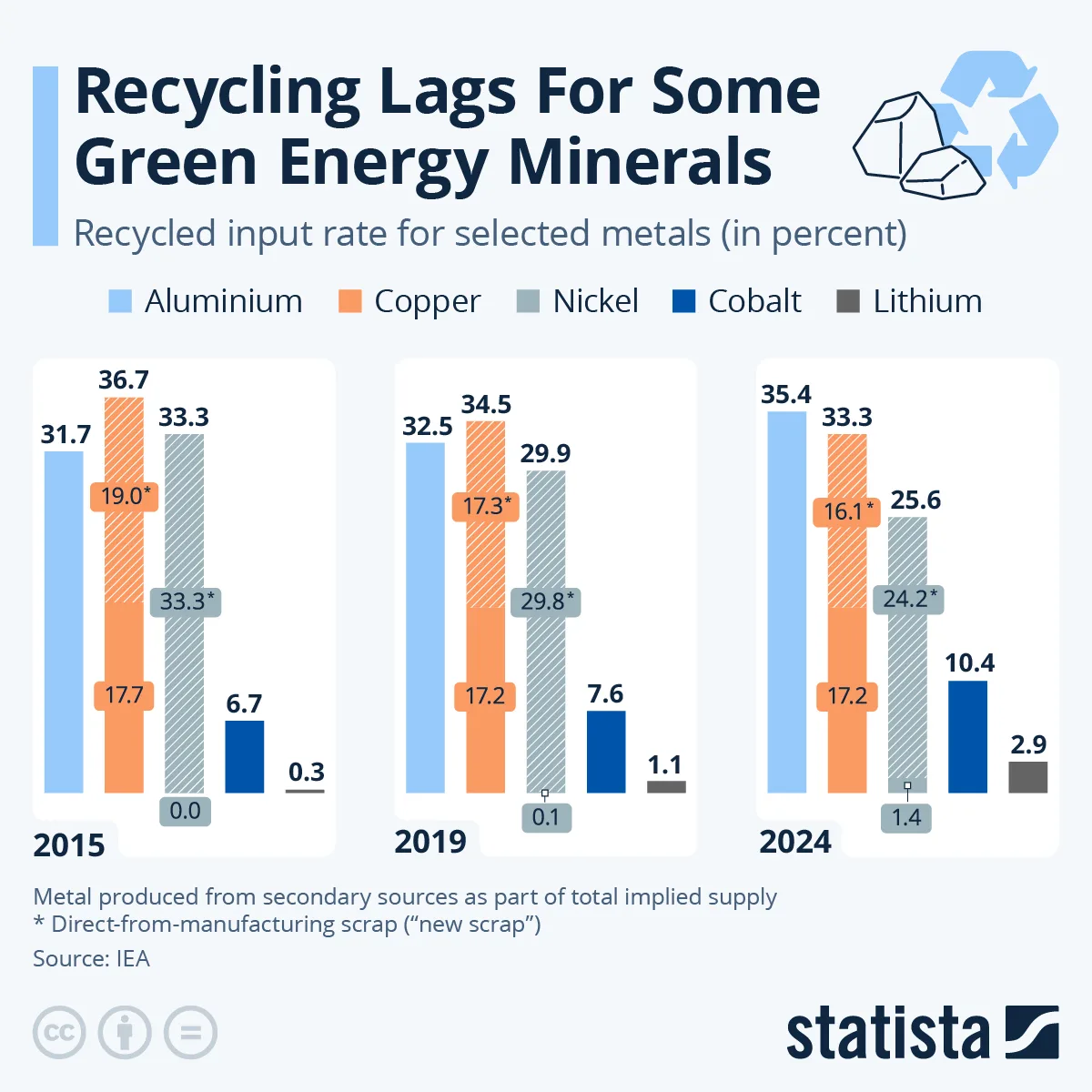
  • Recycling Rates: Cobalt 10.4%, Lithium 2.9%, Nickel 1.4%

    Recycling Rates: Cobalt 10.4%, Lithium 2.9%, Nickel 1.4%

    The Current State of Recycling in Green Energy Minerals

    The transition to a green energy future is heavily reliant on specific minerals that are critical for the production of energy-efficient technologies, including electric vehicles (EVs) and renewable energy systems. However, recent reports from the International Energy Agency (IEA) reveal a concerning trend: recycling rates for these essential metals are alarmingly low, presenting significant challenges for sustainability and supply.

    Key Findings on Recycling Rates

    The IEA’s report showcases the current recycling rates of various clean energy minerals. Critical metals such as cobalt, lithium, and nickel have stagnant recycling practices, with less than optimal rates observed in 2023.

    • Cobalt: The recycled input rate stands at a mere 10.4%.
    • Lithium: An even lower 2.9% of lithium is currently recycled.
    • Nickel: The recycling rate for nickel hovers at just 1.4%.

    This inadequate recycling is a pressing issue as the demand for these materials continues to escalate, driven primarily by the growing electric vehicle market and advancements in electronics.

    The Implications of Low Recycling Rates

    The IEA has voiced strong concerns about the long-term sustainability of mineral supply chains, warning that without enhanced recycling processes, the availability of these crucial materials could dwindle in the near future.

    Projected Supply Challenges

    By 2035, it is estimated that only 70% of copper demand will be fulfilled if current recycling practices are maintained. This potential shortfall underscores the urgent need for increased recycling initiatives.

    The Challenge of Battery Recycling

    As electric vehicles gain popularity, the challenge of recycling materials from aging batteries becomes more prominent. China has been at the forefront of developing solutions for this pressing issue.

    • Future Potential: By 2050, it’s projected that battery recycling could meet an impressive 20-30% of the lithium, nickel, and cobalt demand.

    This estimation highlights not only the need for innovation in recycling practices but also the economic and environmental benefits associated with improved resource recovery.

    The Importance of Cobalt, Lithium, Copper, and Nickel

    Cobalt and lithium have swiftly risen to prominence within the global economy due to their integral roles in electric vehicle batteries and various electronic devices. Meanwhile, copper and nickel also support numerous green energy applications, alongside their long-standing industrial uses.

    Recycling Rates Comparison

    While cobalt and lithium suffer from low recycling rates, copper’s scenario is slightly more optimistic. The recycling rate for end-of-life copper is approximately 17.2%. However, there are dimensions to copper and nickel recycling that reveal variations in success.

    • Current Practices: A significant portion of copper and nickel is recycled directly from production scrap, known as "new scrap." This has maintained a relatively good recycling uptake, yet classic end-of-life recycling—where products at the end of their lifecycle are recycled—is lagging behind.

    Trends in Recycling Practices

    Despite some progress, the overall recycling rates for copper and nickel have declined since 2015. The rise in end-of-life recycling does not offset the decline in new scrap recycling, signaling a need for more effective strategies.

    The Case for Aluminum

    In contrast to copper and nickel, aluminum showcases a much more robust recycling landscape, boasting rates exceeding 33% of total supply coming from recycled sources. This success can serve as a benchmark for improving recycling practices in other critical minerals.

    Striving for Sustainability in Green Energy

    The low recycling rates of vital minerals critical for the green energy transition present a multifaceted challenge. The implications reach into economic, environmental, and security domains. As efforts accelerate towards meeting energy demands sustainably, the focus on enhancing recycling infrastructure and processes will be paramount.

    To align with the increasing demand for sustainable resource utilization, it is imperative that industries, governments, and innovators collaborate to boost recycling rates and develop sustainable practices.