الوسم: concerns

  • ارتفاع قلق الدول ذات الدخل العالي بشأن فقدان الوظائف وتزايد عدم المساواة بنسبة 55% و35%

    القلق من فقدان الوظائف وتزايد عدم المساواة مرتبطين بالاعتماد المتزايد على الذكاء الاصطناعي

    مقدمة عن التباينات بين الدول ذات الدخل المرتفع والمتوسط

    تشهد الدول ذات الدخل المرتفع نسبًا أعلى من الوعي بالتطورات في مجال الذكاء الاصطناعي، مما يؤدي إلى انتشار أوسع للمخاوف المتعلقة بنتائج هذا التقدم التكنولوجي. وفقًا لمسح شمل 36 دولة أجراه مركز بيو للأبحاث، يظهر أن هناك قلقًا متزايدًا من أن الذكاء الاصطناعي سيؤدي إلى تقليل فرص العمل وزيادة الفوارق الاقتصادية بين الأثرياء والفقراء.

    التوقعات بخصوص تأثير الذكاء الاصطناعي على سوق العمل

    تشير البيانات إلى أن نسبة المتوقعين بانخفاض فرص العمل عبر العشرين عامًا القادمة تتجاوز النصف في الدول ذات الدخل المرتفع، بمتوسط 55 بالمئة. بالمقابل، في الدول ذات الدخل المتوسط، تتوقع حوالي 36 بالمئة من الناس أن يؤدي الذكاء الاصطناعي إلى تراجع فرص العمل، مما يعكس مدى تأثير مستوى الوعي والتوقعات الاقتصادية والاجتماعية على مدى الشعور بالقلق.

    المخاوف من زيادة الفوارق الاقتصادية وعدم المساواة

    بالنسبة لتوقعات التفاوت الاقتصادي، يعتقد 35 بالمئة من المستطلعين في الدول ذات الدخل المرتفع بأن الفجوة بين الأغنياء والفقراء ستتسع خلال العشرين عامًا القادمة. أما في الدول ذات الدخل المتوسط، فهذه النسبة تكون أقل، حوالي 22 بالمئة، ما يعكس تباينًا في تصور وتقييم المخاطر المحتملة من الاعتماد المتزايد على التكنولوجيا.

    وأهم أسباب ارتفاع مستوى الوعي بالمخاطر في الدول ذات الدخل المرتفع

    الوعي الإعلامي وتوافر المعلومات

    توضح البيانات أن نسبة الأفراد الذين سمعوا أو قرأوا الكثير عن الذكاء الاصطناعي تقترب من الضعف في الدول ذات الدخل المرتفع مقارنة بالدول ذات الدخل المتوسط. يفسر ذلك جزئيًا ارتفاع مستوى القلق، حيث أن ارتفاع مستوى الوعي يعلّم الناس عن المخاطر المحتملة أكثر مما يزيد من شعورهم بعدم اليقين بشأن مستقبل سوق العمل والتوزيع الاقتصادي.

    حجم عدم اليقين بشأن تأثير الذكاء الاصطناعي على الوظائف

    تُظهر نتائج الاستطلاع أن 34 بالمئة من أفراد الدول ذات الدخل المتوسط غير متأكدين من تأثير الذكاء الاصطناعي على وظائف بلادهم، بينما كانت تلك النسبة أقل، 22 بالمئة، بين المستطلعين في الدول ذات الدخل المرتفع ذات المعرفة الأوسع بالتكنولوجيا. كما أن 28 بالمئة من الأشخاص في الدول ذات الدخل المتوسط لم يسمعوا شيئًا يذكر عن الذكاء الاصطناعي، مما يعكس ضعف الوعي ويعطي تفسيرًا إضافيًا لوجود قدر كبير من عدم اليقين في تقييم الآثار المستقبلية.

    الآثار الاجتماعية والاقتصادية لانتشار الذكاء الاصطناعي

    مع تزايد اعتماد الدول على الذكاء الاصطناعي، تظهر مخاوف متزايدة من أن تؤدي هذه التكنولوجيا إلى تراجع في فرص العمل وزيادة الفوارق الاجتماعية. يُعد مستوى الوعي والتثقيف الاقتصادي من العوامل المهمة التي تؤثر على كيفية تصدي الأفراد والمجتمعات لهذه التحديات، حيث أن زيادة الوعي يمكن أن تسهم في تبني سياسات أكثر توازنًا ومرونة لضمان الاستفادة من مزايا التكنولوجيا مع معالجة آثارها السلبية.

  • مخاوف من فقدان 40% من الوظائف بسبب الذكاء الاصطناعي

    مخاوف الناس من صعود الذكاء الاصطناعي وتأثيره على سوق العمل

    هل يقلق الناس من تأثير الذكاء الاصطناعي على وظائفهم؟
    عادةً، يُعد فقدان الوظائف من أبرز المخاوف المرتبطة بصعود الذكاء الاصطناعي. عندما يُسأل الناس عن أهم مخاوفهم بشأن التقنية، تبرز مسألة فقدان ملايين الوظائف كأحد أبرز المخاوف، إذ يعتقد 47% من المقيمين في المملكة المتحدة، و41% من المواطنين في الولايات المتحدة، و37% من الألمان أن الذكاء الاصطناعي قد يسبب استبدال ملايين الأشخاص في وظائفهم.

    فارق الإدراك بين المجموعتين
    ومع ذلك، عند النظر إلى الخوف من استبدال الوظائف الشخصية، تقل النسب بشكل كبير؛ حيث يخشى 22% من البريطانيين، 23% من الأمريكيين، و18% من الألمان أن يحل الذكاء الاصطناعي محل وظائفهم بشكل خاص.

    هذه الفجوة بين التصور العام والقلق الشخصي تبرز بشكل واضح، إذ يرى الكثيرون أن الذكاء الاصطناعي قد يعيد تشكيل سوق العمل على مستوى واسع، لكنهم في الوقت ذاته يشعرون بأنهم محصنون إلى حد ما من هذا التأثير، على الأقل في الوقت الراهن.

    تفسير الفجوة: ماذا تعني؟
    يمكن تفسير هذا الفارق بعدة طرق، فبعض يرى أن ذلك مؤشر على تفاؤل مفرط، أو اعتقاد أن عملهم معقد جدًا بحيث يصعب أتمتته، أو ربما يعكس حالة من عدم اليقين حول قدرات الذكاء الاصطناعي الحقيقية.

    ما هو مصدر القلق الحقيقي للمجتمع؟
    تشير الأرقام إلى أن القلق الأكبر لا يركز على فقدان الوظيفة بشكل شخصي فحسب، بل على التأثيرات الأكبر على المجتمع والاقتصاد. إذ أن خوف الجمهور يتجه أكثر نحو ما قد تترتب عليه الأتمتة الجماعية من تداعيات مجتمعية واقتصادية، وليس مجرد خوف فردي من فقدان العمل.

    المخاوف من الذكاء الاصطناعي بحسب السوق

    الوظائف ليست المهدد الوحيد من قبل الذكاء الاصطناعي
    بالنظر إلى المخاوف الأكثر انتشارًا المرتبطة بالذكاء الاصطناعي، تأتي مخاوف فقدان الوظائف في المركز الثالث في كل من الأسواق الثلاثة المشمولة بالبحث.

    المخاوف الأكبر: المعلومات المضللة والتلاعب
    أما المخاوف التي تتصدر القائمة فهي المعلومات المضللة والتلاعب. فهذه المخاوف مرتبطة بشكل وثيق، وتشكل تهديدًا حقيقيًا في عالم يتعامل فيه الناس مع قدرات الذكاء الاصطناعي بشكل لم يعتادوا عليه بعد. فصعوبة التمييز بين الحقيقة والكذب الذي تولده تكنولوجيا الذكاء الاصطناعي تؤدي إلى فقدان الثقة، وتزيد من صعوبة الحكم على صحة المعلومات المنتشرة.

    توافق خبراء الذكاء الاصطناعي مع المجتمع
    وفقًا لاستبيان سابق أجرته جمعية البحوث بيو، يتفق خبراء الذكاء الاصطناعي بشكل عام على أن مخاطر المعلومات المضللة والتلاعب أكبر بكثير من المخاوف المتعلقة بفقدان الوظائف. ومع ذلك، فإن خبراء التقنية يظهرون تقلص تلك المخاوف، حيث لا يُعد فقدان الوظائف مصدر قلق كبير لديهم بشكل مماثل.

    الختام
    توضح الأرقام والرؤى أن الخوف من تأثيرات الذكاء الاصطناعي يتفاوت بين الصورة العامة والتأثير الشخصي، مع تزايد الاهتمام بمخاطر المعلومات والتلاعب أكثر من مخاطر فقدان الوظائف المباشر. وبينما يظل الذكاء الاصطناعي قوة تغيرية ضخمة، يبقى من الضروري مراقبة تداعياته والعمل على وضع سياسات تضمن حماية المجتمع من أوجه التهديد المحتملة.

  • 60% of Europeans Fear War Amidst Rising Geopolitical Tensions

    60% of Europeans Fear War Amidst Rising Geopolitical Tensions

    Understanding VE Day and Its Significance

    VE Day, or Victory in Europe Day, is commemorated on May 8, marking the formal surrender of Nazi Germany in 1945. This monumental event symbolizes the end of nearly six years of devastating conflict in Europe during World War II. The day is observed not only to celebrate the return of peace but also to honor the immense courage and sacrifice of those who fought and died during the war.

    The Historical Context of VE Day

    In May 1945, Europe was in turmoil. The Allied forces, having pushed back against the Axis powers, finally achieved victory in a long, arduous struggle. VE Day marks a pivotal moment in history, serving as a reminder of the resilience and determination demonstrated by countless individuals. The celebrations that ensued were filled with joy, relief, and a profound hope for a peaceful future.

    The 80th Anniversary: Echoes of Concern

    As we recognize the 80th anniversary of VE Day, the sense of peace that once seemed unshakeable is now perceived as fragile. The ongoing conflict in Ukraine, initiated by Russia’s invasion, has raised alarm bells across the continent, renewing fears of instability. This unsettling reality serves as a stark reminder of how quickly the landscape of security can shift.

    The Growing Fear of War in Europe

    Current Landscape of Anxiety

    Recent surveys have highlighted a significant rise in concerns regarding military conflicts among Europeans. According to Ipsos’ monthly "What Worries the World" report, war has emerged as one of the top three concerns for individuals across various nations. This shift in sentiment underscores an increasing unease about geopolitical tensions that could escalate into broader conflicts.

    Poland: A Case Study of Proximity and Fear

    Poland, due to its geographical proximity to Ukraine, exhibits a heightened sense of concern. Given its direct border and the ongoing hostilities, it’s not surprising that war ranks high on the list of worries for Polish citizens. The shockwaves of conflict in neighboring Ukraine reverberate through Poland, intensifying fears about regional security.

    Wider Trends Across Europe

    Beyond Eastern Europe, nations such as the Netherlands, Germany, and France are also experiencing a noticeable surge in concerns about the prospect of war. These sentiments signify a collective anxiety spanning the continent, revealing that fears of military conflicts are increasingly pervasive.

    Global Perspectives on Armed Conflict

    When comparing these concerns with other parts of the world, a distinct disparity emerges. On average, only 12% of respondents from 29 different countries express war as a major concern. In South America, for instance, fears of armed conflict are notably minimal, with less than 5% of respondents in countries like Brazil, Chile, and Argentina highlighting war as a top priority.

    The Impact of Political Dynamics

    United States: A Shifting Role

    The role of the United States in international affairs has historically influenced global peace dynamics. Under the Trump administration, perceptions of the U.S. as a reliable partner diminished, exacerbating concerns among European nations. As the transatlantic alliance appears to fray, the unpredictability of Russia’s actions further complicates the political landscape.

    Russia’s Influence on European Security

    Russia’s aggressive posture and unpredictable behavior pose significant challenges to European security. The invasion of Ukraine has not only altered the balance of power but has also reignited fears of potential escalations in military engagement across Europe.

    The Future of Transatlantic Relations

    As the situation evolves, the need for a cohesive approach among European nations and their allies becomes ever more critical. The potential for military conflict looms large, urging leaders to reassess their strategies and strengthen alliances to ensure collective security.

    By understanding the historical context of VE Day and examining current concerns about military conflict in Europe, we can better comprehend the delicate balance between peace and the escalating fears of warfare that shape today’s geopolitical environment.

  • 47% of AI Experts Excited, 51% of Public Concerned

    47% of AI Experts Excited, 51% of Public Concerned

    The Divergence Between AI Experts and the General Public

    The conversation around artificial intelligence (AI) continues to generate both enthusiasm and apprehension across different demographics. While AI specialists express a significant degree of optimism regarding the technology’s integration into everyday life, the general populace exhibits measurable concerns, particularly about its implications. This blog delves into the nuances of these contrasting perspectives, drawing insights from engaging survey data by the Pew Research Center.

    AI Experts: Optimists at Heart

    Rising Excitement Among Experts

    Survey data reveals that nearly half (47%) of AI experts are more excited than concerned regarding the proliferation of AI in daily activities. This optimism stems from their comprehensive understanding of AI’s capabilities and potential benefits. Experts perceive transformative opportunities across various sectors, confident that AI can enhance productivity, creativity, and innovation. The excitement largely reflects a hopeful vision of what AI can achieve, including advancements in healthcare, finance, education, and environmental sustainability.

    The Risks Acknowledged

    Despite their general optimism, experts are not blind to the potential risks associated with AI. There is a notable consensus on the threats posed by misinformation and its propagation through AI systems. The ability of AI to generate content—be it text, images, or even deepfakes—raises concerns about the authenticity of information. AI experts share the general public’s worry about technology misused to impersonate individuals, posing severe ethical and security challenges.

    Concerns Shared Across the Board

    Misinformation Takes Center Stage

    While there is enthusiasm for AI, experts and the public alike are particularly worried about its role in disseminating inaccurate information. With AI’s capabilities to create and manipulate content, whether through social media, news articles, or deep synthesis of voices and images, the potential for misinformation is a serious concern that resonates across demographics.

    Personal Data and Privacy

    Another common concern is about AI’s handling of personal data. Both AI experts and average Americans recognize that with increased data processing capabilities come vulnerabilities related to privacy and security. The potential for data leaks or misuse could compromise individual privacy and erode trust in digital systems. The ethical implications surrounding personal data handling remain a point of contention.

    Disparities in Concerns: Job Losses and Human Connection

    Job Displacement: A Mismatch of Worries

    One of the stark contrasts between AI experts and the general public lies in the perception of job displacement due to AI automation. A significant 56% of U.S. adults are extremely or very concerned about AI-related job losses. In contrast, only 25% of AI experts express similar concerns. This disparity may stem from the experts’ understanding of AI as a tool that complements human capabilities rather than merely replacing them.

    Impact on Human Relationships

    AI’s influence on human relationships is another area where opinions diverge. A substantial 57% of U.S. adults worry that AI might lead to diminished interpersonal connections. However, only 37% of AI experts share this concern. This difference may reflect a belief among experts that AI can facilitate communication and connection, particularly through applications that bridge distances or enhance collaborative efforts.

    Positive Outlook on AI’s Future Impact

    Optimism for the Next Two Decades

    Despite concerns, a majority of AI experts (56%) predict a net positive impact of AI in the U.S. over the next 20 years. This perspective contrasts sharply with the 17% of the general public who hold a similar belief. Such a gap highlights the varying levels of familiarity and understanding of AI technology.

    Bridging the Knowledge Divide

    The disparity in perceptions may underscore the necessity for greater public education on AI technologies. Efforts should focus on demystifying AI, emphasizing both its benefits and risks. By fostering transparency and enhancing understanding, there may be a shift towards a more positive outlook among the general population.

    The Future of AI: Insights and Implications

    The ongoing dialogue surrounding AI underscores a vital need for collaboration between experts and the public to maximize the benefits of this transformative technology while addressing its risks. Through informed discussions and education, society can navigate the complexities of AI more effectively, ultimately harnessing its potential for positive change.

  • 91% of Americans Consider Inflation a Serious Concern

    91% of Americans Consider Inflation a Serious Concern

    Inflation: America’s Primary Concern

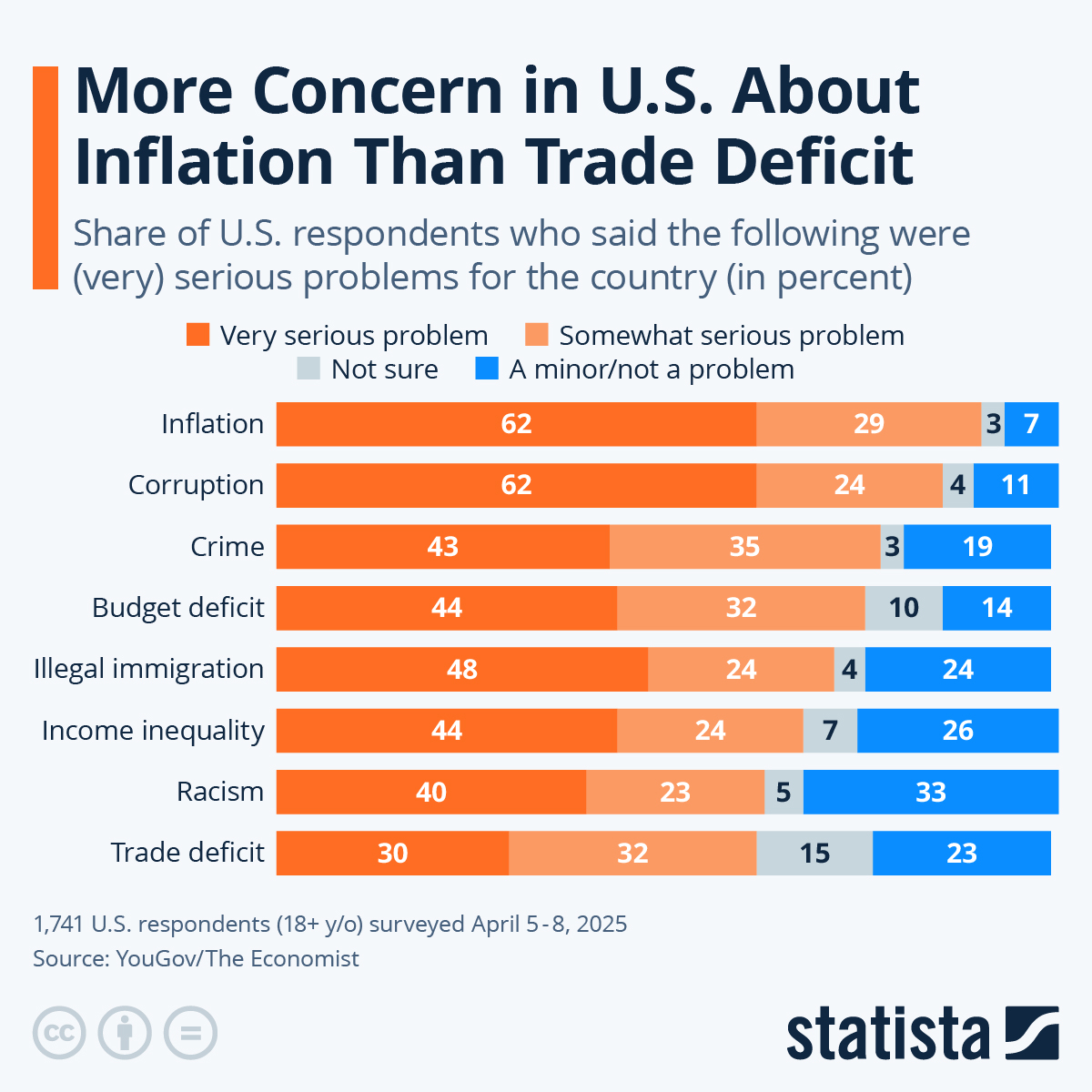
    In the current economic landscape, inflation stands out as the foremost concern for many Americans. A recent survey conducted by YouGov and The Economist highlighted that a staggering 91% of respondents consider inflation to be a very serious or somewhat serious problem. This figure underscores the rising anxiety surrounding inflation, surpassing fears about corruption and crime, which were cited by 86% and 78% of respondents, respectively.

    The Current State of Inflation

    As of March, the official statistics indicated that inflation had cooled to 2.3%. Despite this seemingly positive development, the apprehension surrounding inflation remains prevalent, largely influenced by ongoing political and economic factors. The memory of the tariffs imposed during the Trump administration has led to a lingering fear of inflationary pressures reemerging, as these tariffs potentially disrupt global supply chains and increase the cost of goods.

    Impact of Tariffs on Consumer Sentiment

    The introduction of significant tariffs in January sparked immediate concerns among consumers. Many began to alter their spending habits in anticipation of economic instability, showcasing a notable decrease in consumer confidence. While some recovery in spending was seen in February, there remains a palpable uncertainty regarding future economic conditions.

    Tariff Influence on Inflation Expectations

    Economic analysts have pointed out that the effects of tariffs are twofold: while they can drive domestic prices higher, they also create a ripple effect that can influence global markets. As tariffs continue to exert pressure on industries such as steel, aluminum, and automobiles, consumers and economists are wary of potential price increases that could counter the reported decrease in inflation rates.

    Concerns Beyond Inflation

    While inflation captures the most attention, other economic issues are also causing concern among Americans. The U.S. government budget deficit, for instance, is viewed as a serious issue by 76% of survey respondents. This signifies that while inflation is at the forefront, other fiscal matters are also eliciting significant anxiety.

    The Trade Deficit: A Less Pressing Issue

    Curiously, the trade deficit is perceived as a less urgent problem, with only 62% of respondents regarding it as serious. This contrasts sharply with the considerable attention and media coverage that trade imbalances typically garner during election cycles or economic downturns. The survey results may suggest that Americans are currently more focused on the immediate impacts of inflation and government fiscal policies rather than long-term trade issues.

    The Budget Deficit Debate

    The ongoing discussions among Republican lawmakers regarding the 2025 budget spotlight the complexities surrounding the budget deficit. The proposed budget could either exacerbate the deficit by trillions of dollars or prompt significant cuts to essential services, such as Medicaid and the Supplemental Nutrition Assistance Program (SNAP). The implications of these discussions are profound, potentially affecting millions of Americans who rely on these programs for sustenance and health care.

    Conclusion

    While this blog does not include a conclusion, it is evident that inflation remains a pivotal issue for Americans. The interplay of tariffs, government fiscal policy, and consumer sentiment paints a complex picture of the current economic climate and highlights the multifaceted nature of the challenges that lie ahead.

  • AI Worries Could Extend Ongoing Video Game Acting Strike

    AI Worries Could Extend Ongoing Video Game Acting Strike

    Since July 2024, members of SAG-AFTRA (Screen Actors Guild — American Federation of Television and Radio Artists) have been striking over the usage of their performances and likenesses in video games. Recent communications suggest that new issues may prolong the strike. Union leaders highlighted “concerning loopholes” that could expose members to potential misuse by artificial intelligence, as reported by Eurogamer.

    Yuri Lowenthal, the voice behind Spider-Man, addressed the situation in an interview with Variety earlier this month. He stated, “It really comes down to three key issues for me. Firstly, there’s consent: we don’t want the data we’ve provided to be used to create performances without our approval. Secondly is compensation: if our work is being repurposed, we should receive compensation for that. Otherwise, actors will find themselves unpaid, which could spell the end of our careers. Lastly, we need control—being able to monitor how our work is utilized and where it goes.”

    The situation is intricate, with various components and perspectives at play. Lowenthal’s comments encapsulate the guild’s primary concerns. Many voice actors, including Jennifer Hale, known for her role as female Shepard in Mass Effect, share these sentiments.

    The exterior of the SAG-AFTRA building.
    Wikimedia Commons / SAG-AFTRA

    In response to SAG-AFTRA’s concerns, Audrey Cooling, a spokesperson for the video game industry, issued a statement indicating, “We have put forward an offer that includes salary increases of over 15 percent for SAG-AFTRA members in the gaming sector, along with enhanced health and safety measures, leading industry standards for the use of AI-generated replicas in games, and additional earnings for any actor’s performance utilized in other titles.”

    SAG-AFTRA has not made a public response to this latest proposal. As negotiations progress, the strike is likely to continue until a mutually agreeable solution is reached. The union has encouraged members who aren’t affiliated with other groups to decline work until video game studios agree to their stipulations.

    This isn’t the first instance where voice actors have taken a stand for their rights. A prior strike lasting from late 2016 into 2017 occurred due to demands for fair compensation, which led to a resolution in September 2017.

  • Privacy Concerns with ChatGPT Ads: What Users Should Know

    Privacy Concerns with ChatGPT Ads: What Users Should Know

    In an increasingly digital world, privacy concerns are on the rise, especially concerning the use of artificial intelligence platforms like ChatGPT. Understanding the implications of advertisements generated by such platforms is essential for users who want to protect their personal information and online activity.

    Understanding the Relationship Between ChatGPT and Advertisements

    ChatGPT is a powerful language model that interacts with users through text-based conversations. As it becomes integrated into various applications, the potential for targeted advertising grows.

    How Ads Are Generated

    • Data Mining: Many platforms collect user data to better understand preferences and behaviors, which can be used to tailor advertisements.
    • AI Algorithms: Advanced algorithms analyze conversations and user interactions to suggest relevant products or services.
    • User Profiles: Information gathered from user interactions may contribute to creating profiles that advertisers use to target specific audiences.

    Privacy Implications for Users

    Users should be aware of several privacy concerns related to ChatGPT and its advertising capabilities.

    Data Collection

    • Extent of Data Collected: ChatGPT may store user interactions, which can include personal information inadvertently shared during conversations.
    • Consent: Users often consent to data usage through vague terms of service, not fully understanding the extent of data collection.

    Data Security

    • Risk of Breach: Any system that collects and stores data is susceptible to breaches, exposing user information.
    • Encryption Issues: Not all platforms guarantee that data will be encrypted, leaving some information vulnerable.

    Targeted Advertising: Pros and Cons

    While targeted advertising can lead to a more personalized experience, it raises several privacy concerns users should consider.

    Pros of Targeted Advertising

    • Relevance: Users are more likely to see products or services that match their interests.
    • Efficiency: Marketers can reach specific audiences, leading to better conversion rates for businesses.

    Cons of Targeted Advertising

    • Invasive Nature: Targeted ads can feel intrusive, often leading users to feel like their privacy is compromised.
    • Profile Accuracy: The algorithms may misinterpret behavior, leading to irrelevant or misleading advertisements.

    User Protections and Best Practices

    Even though privacy concerns are significant, there are steps users can take to mitigate risks associated with ChatGPT ads.

    Review Privacy Settings

    • Check Permissions: Regularly review and adjust privacy settings on platforms that utilize ChatGPT.
    • Limit Data Sharing: Opt-out of data-sharing options whenever possible to reduce the amount of personal information collected.

    Be Cautious with Information Sharing

    • Avoid Personal Details: Refrain from sharing sensitive personal information during conversations with AI platforms.
    • Educate Yourself: Stay informed about how platforms use data and their privacy policies to make better decisions.

    Use Privacy Tools

    • Ad Blockers: Utilize ad-blocking software to reduce targeted ads.
    • VPNs: Consider using virtual private networks to mask online activity and enhance privacy.

    The Future of ChatGPT and Advertising

    As technology evolves, so do the challenges surrounding privacy in the realm of AI-generated advertising. Understanding these issues is crucial as more platforms rely on tools like ChatGPT to operationalize their marketing strategies. Users must remain vigilant and proactive in protecting their personal data against potential breaches and unauthorized use.

  • Global Education Challenges: 33% Cite Ideological Bias in U.S.

    Global Education Challenges: 33% Cite Ideological Bias in U.S.

    Global Challenges Facing Education: Insights from Recent Survey Data

    Overview of the Ipsos Study

    A recent Ipsos report, based on a survey of more than 1,000 respondents from 30 countries, sheds light on the various challenges facing educational systems around the globe. Conducted between June 21 and July 5, 2024, the survey reveals a rich tapestry of perspectives on the state of education, highlighting both concerns and areas of optimism among different nations.

    Key Concerns in the United States

    Ideological Bias in Education

    In the United States, respondents expressed significant concerns regarding ideological bias within the educational system. An alarming 33 percent identified this as the foremost challenge, reflecting a growing anxiety about how educational content is influenced by political or ideological viewpoints. This sentiment was echoed by respondents from Hungary and Poland, both reporting a similar level of concern at 30 percent.

    Child Safety and Security

    Another pressing issue for U.S. respondents was the safety and security of children in educational settings. Approximately 31 percent of those surveyed indicated that concerns over child safety were paramount. This issue resonated similarly in France (30 percent), India, Mexico, and Brazil (each at 24 percent), underscoring a universal anxiety about the well-being of students in schools.

    Challenges in Indonesia: Access and Infrastructure

    In Indonesia, the concerns diverged significantly from those in the U.S. Here, an overwhelming 60 percent of respondents identified unequal access to education as the most significant issue facing their schooling system. This highlights the stark disparities in opportunities available to various student demographics.

    Inadequate Infrastructure

    In addition to access issues, 36 percent of respondents in Indonesia pointed to inadequate infrastructure as a critical challenge. This reflects broader concerns about the physical environment of schools, which can significantly impact the quality of education offered.

    Technology Utilization

    Furthermore, 30 percent lamented the insufficient usage of technology in education, pointing to the need for modernization and integration of digital tools to enhance learning experiences.

    The United Kingdom: Funding Concerns

    The survey results from the United Kingdom presented a different set of challenges, with 40 percent of respondents indicating a lack of public funding as the main issue facing their educational institutions. This was the highest figure recorded among the 30 countries surveyed, emphasizing the urgent need for financial investment in education.

    Comparisons with South American Countries

    Similar funding concerns were echoed across South America, where respondents in Colombia (37 percent), Chile (36 percent), and Brazil (35 percent) recognized limited financial resources as a significant hurdle. This pattern indicates a broader trend in which educational institutions struggle to maintain quality due to insufficient funding.

    Perceptions of Education in Asia

    While many countries grapple with significant challenges, the survey revealed a more optimistic view of educational systems in several Asian nations.

    Positive Outlook in India and Southeast Asia

    In India, an impressive 72 percent of respondents believed that the education system is contributing to reducing social inequalities. This optimism extended to other Southeast Asian nations, including Singapore (68 percent), Thailand (66 percent), Indonesia (64 percent), and Malaysia (63 percent). These figures suggest that many see education as a vital tool for social mobility and advancement.

    Negative Sentiments in Turkey and Hungary

    Conversely, respondents from Turkey (34 percent) and Hungary (30 percent) expressed a more pessimistic view regarding the effectiveness of their educational systems in addressing social inequalities. This stark contrast highlights the varying degrees of trust in education as a mechanism for societal improvement.

    Conclusion

    The Ipsos report paints a complex picture of global educational challenges and perceptions. While certain regions display significant concerns over ideological biases, funding shortages, and safety issues, others express hopefulness about the role of education in mitigating social inequalities. As countries navigate these diverse challenges, the insights gathered from this survey will be vital for policymakers and educators alike.

  • 16% of Republicans Concerned About Trump’s Radical Ties

    16% of Republicans Concerned About Trump’s Radical Ties

    ## The Political Landscape in 2024: Concerns About Radical Ties

    As the political atmosphere intensifies leading into the 2024 elections, public opinion plays a crucial role in shaping the narrative around key figures. A recent Gallup poll has shed light on the perceptions surrounding ex-President Donald Trump and Vice President Kamala Harris, particularly concerning their associations with what many perceive as radical elements. The findings reveal significant insights into voter sentiment and party identification that merit further exploration.

    ### Public Concerns About Radical Associations

    The Gallup poll conducted in October 2024 indicates that a significant portion of the American populace harbors concerns regarding the political alignments of both Trump and Harris. Around 55% of respondents express they are either “very” or “somewhat” worried about Trump’s connections to radicals. Interestingly, Harris also draws scrutiny, with 49% of participants voicing similar concerns regarding her affiliations.

    ### Republican Perceptions of Trump

    Investigating the data further, it becomes clear that even within Trump’s own party, there exists a notable faction of dissent. Approximately 16% of self-identified Republicans acknowledge a worry that Trump aligns too closely with extremist views. In stark contrast, only 6% of Democrats express the same level of concern about Harris.

    ### Independent Voter Insights

    The opinions of independent voters, who often play a pivotal role in election outcomes, reveal profound unease. Roughly 61% of independents are apprehensive about Trump’s extremist ties, while around half express concerns regarding Harris’s associations. This data illustrates that the hesitance surrounding both political figures transcends party lines, indicating broader anxieties about their potential impact on the political landscape.

    ## Trump’s Continued Hardline Agenda

    Despite the evolving political dynamics, Trump’s platform remains largely consistent with his 2016 campaign. His commitment to prioritizing American economic needs is underscored by proposals to impose tariffs ranging from 10% to 60% on imported goods. This hardline approach appeals to a segment of the population that feels overlooked by previous administrations, even as it raises alarms regarding his associations with radical ideologies.

    ### Kamala Harris’s Shift in Positioning

    Conversely, Kamala Harris appears to be recalibrating her political stance. Recent reports suggest she is distancing herself from more liberal perspectives that could tie her to the political left. Notably, Harris’s decision not to ban fracking and to enforce existing border policies more strictly has contrasted sharply with the initial Biden-Harris platform of 2020. This shift could be an acknowledgment of the shifting political tide and an attempt to solidify her standing among voters wary of radical affiliations.

    ## Comparing Past and Present Concerns

    When juxtaposed with sentiments from 2020, the current Gallup poll results reveal a striking continuity in public opinion. Four years ago, a comparable 54% of Americans feared Trump’s connections with radicals, while 47% expressed the same concern regarding Biden. This consistency suggests that voter opinions may often be informed more by personal biases and less by objective analysis of candidates’ policies and associations.

    ### The Role of Personal Bias in Political Perception

    The Gallup findings raise an essential question about the nature of political perception among voters. With Harris distancing herself from previous policy positions on issues like climate change and immigration, yet still facing significant scrutiny, it indicates that perceptions may be deeply entrenched in individual voter biases rather than an accurate reflection of candidates’ ideologies. This emphasizes a critical component of the voter experience—how past actions, political alignment, and policy decisions intersect to shape public opinion.

    ### Implications for the 2024 Election

    As the 2024 election approaches, the implications of these findings will likely reverberate through campaign strategies. Candidates must navigate the complex web of voter concerns while addressing the underlying perceptions about their political ties. For Trump, maintaining a strong stance on economic nationalism while combating perceptions of radical ties will be crucial. For Harris, realigning public perception may require a delicate balance of reaffirming liberal values while also appealing to a broader, more centrist audience.

    The dynamics surrounding Trump’s and Harris’s political ties illustrate a critical aspect of contemporary American politics: the importance of perception in shaping electoral outcomes. As both candidates prepare for the upcoming election, understanding voter concerns will be paramount to their campaign strategies and overall success.