الوسم: Civilization 7

  • Himiko, Wa’s Queen: A Comprehensive Guide for Civ 7 Players

    Himiko, Wa’s Queen: A Comprehensive Guide for Civ 7 Players

    The Queen of Wa version of Himiko is notably more targeted in her approach within Civilization 7 compared to other leaders. While some civilizations can significantly influence gameplay, it’s often best to enhance her strengths rather than masking any weaknesses.

    Himiko shines in the realm of science, boasting exceptional scientific potential. When paired with civilizations that also focus on this area, she can rapidly advance through technology trees, setting her up for a Science victory.

    Himiko, Queen of Wa Overview


    As previously noted, Queen of Wa Himiko has an impressive ability to generate significant amounts of science each turn. While she can capitalize on this in any scenario, her science output dramatically increases when she effectively fosters friendships with the majority of other civilizations in the game.

    Himiko’s inherent bonuses are:

    • A unique effort that provides a 25 percent increase in science generation for her and her allies.
    • Bonus science per era for each leader she is friendly or allied with.
    • Ability to support endeavors at no cost, saving influence points.
    • Unlocks the option to utilize Meiji Japan in the Modern Age.

    For Himiko, aligning with multiple civilizations is key to her success. Selecting the right partnerships is crucial to avoid getting entangled in unwanted conflicts.

    Without allies, you risk not maximizing Himiko’s potential, and if wars arise, you’ll find yourself without any support.

    While it’s entirely feasible to pursue a victory type outside of Science for Queen of Wa Himiko, other victory methods are less likely to utilize her strengths effectively.

    Best Civilizations to Pair with Himiko, Queen of Wa


    Every civilization option in the Antiquity Age in Civilization 7.

    Given Himiko’s specialized strengths and winning strategy, her optimal civilization choices are limited.

    Maya (Antiquity Age)

    The Maya civilization will enhance Queen of Wa Himiko’s science capabilities over the long term, making it a superior choice if you’re set on pursuing science victories.

    The most valuable bonuses from the Mayans include:

    • The Palace earns 0.5 science production for every adjacent vegetated terrain.
    • The Hul’Che, a unique combat unit designed for success in vegetated areas.
    • The Uwaybil K’uh, a unique quarter that grants a production boost for each technology researched.
    • The K’uh Nah, a unique building providing a tremendous amount of additional science, particularly effective when built on vegetation.

    The Mayans rely heavily on specific terrain, and lack of vegetation can hinder their performance significantly. However, if played to their strengths, the Mayans enhance Himiko’s core capabilities splendidly.

    In the quest for a science victory during the Antiquity Age, aim to acquire ten scientific codices. Given your rapid progression through technology and production boosts, you’ll achieve this quickly.

    Abbasid (Exploration Age)


    The Abbasid civilization in Civilization 7.

    Several formidable options exist in the Exploration Age for a leader focused on science, and the Abbasid is among them. While they have a strong emphasis on science, they also provide some gold bonuses.

    Key bonuses from the Abbasids include:

    • A gold bonus linked to your rural population whenever you create a specialist.
    • Production bonuses for the House of Wisdom.
    • The Ulema, a unique quarter that boosts science generation based on the number of specialists in the city.
    • The Madrasa, a unique building that offers a substantial boost to science production.

    Both the Abbasids and the Mayans can significantly enhance science generation, maximizing your advancements during the Exploration Age.

    Ming (Exploration Age)


    The Ming civilization in Civilization 7.

    If you’re looking for a more consolidated strategy, Ming provides a compact approach. They focus on enhancing science production in their capital, though they incur a penalty on any social policy currently active.

    Their most significant bonuses include:

    • 50 percent additional science generation in the capital.
    • -15 science generation for each social policy in effect.
    • The Mandarin, a unique merchant capable of setting up a trade route to import resources while generating a gold bonus through road establishment.
    • The Ming Great Wall, a unique defensive structure that strengthens defenders’ combat abilities.

    While the Ming may have fewer unique structures compared to the Abbasids, their 50 percent increase in capital science generation can be extremely valuable, depending on your city’s development.

    In the face of potential threats, the Ming Great Wall can be essential for protecting your civilization.

    Meiji Japan (Modern Age)


    The Meiji Japan civilization in Civilization 7.

    In terms of scientific advancements during the Modern Age, few civilizations rival Meiji Japan. Their effective combination of defensive units, production enhancements, and science boosts can help carry you to a scientific victory, especially when building on the strengths of previous civilizations mentioned.

    Key bonuses from Meiji Japan include:

    • A science boost with each time you overbuild a structure.
    • The Mikasa, a unique naval unit that respawns upon its first destruction at the closest settlement.
    • The Zero, a unique aircraft unit with enhanced range and strength against enemy air units.
    • The Jukogy, a unique building that significantly increases production, particularly when placed near coastlines or wonders.

    Meiji Japan presents substantial potential for rapid technological advancement in the Modern Age through consistent overbuilding, while also offering a stronger defense compared to other civilizations with their specialized units.

    Pursuing a science victory can attract attention from rival leaders, so it’s beneficial to have defensive capabilities to protect your lead.

    Maintaining Himiko’s unique endeavor throughout the ages is crucial— that 25 percent bonus will have a substantial impact as your base science value increases. By the Modern Age, the significance of this bonus will be immense.

  • Ultimate Beginner’s Guide to Civilization 7

    Ultimate Beginner’s Guide to Civilization 7

    Civilization 7 marks a significant shift in the series, especially with its revamped age system. This new feature radically alters the gameplay dynamic: you start the game by selecting a leader, and then you progress through different ages, transitioning from the Exploration Age to the Modern Age, each time choosing a new civilization. This fresh approach to the historical evolution of your civilization introduces a plethora of new strategies, units, global events, and more.

    Our goal is to provide you with a comprehensive guide to all the basics of Civilization 7, while also delving into some of the innovative mechanics. We’ll navigate through the game, age by age, for a thorough walkthrough.

    Starting the Game

    Before you dive into gameplay, there are crucial decisions that can significantly influence your progress.

    Choosing Your Leader and Civilization

    In a departure from previous games, leaders and civilizations are now separate entities. This means, for example, that you could lead Augustus while playing as the Ming Dynasty. At first, this might seem historically inaccurate, but this flexibility adds a fascinating layer to the game.

    Each leader provides unique advantages that are applicable throughout all three ages: Antiquity, Exploration, and Modern. Thus, choosing the right leader holds substantial importance.

    Leaders tend to favor specific victory conditions, so it’s wise to have a victory strategy in mind before you begin your game. As you advance, civilizations themselves can evolve. For instance, you might start as Rome, gaining benefits in infantry production and culture, but transition to a different civilization during the Exploration Age, which could shift your game’s direction. If you’ve focused on building wonders and cultural structures as Rome, you might want to adjust your strategy for the Exploration Age to align with a civilization that excels in cultural growth.

    Once you’ve decided on your leader and civilization, consider Mementos.

    Understanding Mementos

    Mementos are a fresh addition in Civilization 7, serving as part of the game’s meta-progression system. These rewards are obtained through gameplay, leveling up different leaders, and accomplishing various challenges.

    At the start of the game, you can select two Mementos to enhance your play. They can provide boosts ranging from additional attribute points for your leader to extra gold for every 50 tiles revealed.

    You can also switch out Mementos between Ages.

    Typically, Mementos are color-coded, offering insights into which type of victory condition they support—gold for economic victories, red for military, and so forth.

    As you progress, you can earn more Mementos by reaching level thresholds and completing specific challenges—like defeating the game itself. Additionally, leveling up the Civilization pass will also earn you Mementos.

    Getting Started in the Antiquity Age

    You’ve chosen your leader, civilization, and Mementos—now it’s time to establish your first city.

    In contrast to earlier Civilization games, Settlers won’t always directly establish a city. Initially, new settlements will be Towns, which require conversion into cities using gold later on. However, your first Settler is a special unit called a Founder, which can instantly establish a city.

    Choosing your first city is a critical decision. While the options may seem straightforward, the right pick isn’t always obvious. Use the Settler lens feature to check for game suggestions.

    A few key points about cities in Civ 7:

    • Cities can access resources within a three-tile radius of their city hall.
    • Cities will immediately grow by one population, which allows you to unlock a new tile.
    • Unlike previous entries, growing a city on a tile will immediately enhance that resource or tile—no builder is necessary.

    Fresh Water

    Settling your initial city (and subsequent towns) benefits from the new Fresh Water system. Historically, settling near water has had its advantages, such as exploring coastal areas, developing fertile land, and constructing specific World Wonders.

    In Civilization 7, the advantages of Fresh Water aren’t explicitly outlined. However, it typically provides an initial happiness boost for settlements founded near fresh water.

    Types of Income: Culture, Gold, Science, Happiness, and Influence

    Your empire generates five types of income: Culture, Gold, Science, Happiness, and Influence—visible on the top left of your screen.

    • Culture: Contributes to civic research. Earn more culture by constructing cultural buildings like the Monument, utilizing policy cards, or taking advantage of leader or civilization bonuses.

    • Gold: Comes from trade routes, gold-generating buildings, resources, and policy cards. Establish trade routes with friendly civilizations and city-states for extra gold, or benefit if other empires use trade routes within your territory.

    • Science: This metric influences your tech research. Enhance your science output with buildings like the Library or collaborating with friendly AI players.

    • Happiness: Represents the total happiness of all your settlements combined. While positive happiness is beneficial, it’s vital to maintain it across individual settlements to unlock Celebrations that grant new social policy slots.

    • Influence: One of the trickiest resources to accumulate, especially in the early game. However, it’s invaluable, providing bonuses to your empire interactions with both friendly and unfriendly AI, such as boosting early-game science through research collaborations or befriending city-states.

    Starting Strategies

    The early turns in Civilization 7 are pivotal, particularly with the new Discovery system that has replaced traditional goodie huts or barbarian villages. Discoveries are special locations on the map that yield powerful rewards upon arrival with a unit.

    It’s crucial to gather as many Discoveries as possible, but you’ll have to compete with other civilizations to do so. This is why we recommend the Scout rush strategy.

    Early Scout Rush

    The strategy is to generate at least two scouts as quickly as you can. Prioritize production tiles to expedite the production of scouts. Once operational, you can use the Search feature to reveal a large radius that highlights Discoveries even obscured by fog of war. Opt for this instead of the Lookout function, which won’t reveal Discoveries.

    Prioritize Luxurious Encampments along your path, as they often present the best rewards.

    If you have sufficient production, consider going for a triple-scout rush to uncover a wealth of Discoveries, Independent Powers, and other nearby civilizations.

    Production is Key

    In the early game, prioritize boosting Production in your capital by acquiring production-oriented buildings like the Saw Pit and Brickyard. Consider researching Animal Husbandry and Pottery for a boost in production.

    You can rely on towns to provide food to your capital, so focusing on food-producing structures in your main city isn’t immediately urgent.

    Independent Powers, Diplomacy, Warfare

    Conflict is a natural part of Civilization 7 as you encounter Independent Powers and other civilizations. Independent Powers function as city-states, which can be categorized as either Hostile or Friendly. You can identify their type through the icons next to their names, such as a coin for economic powers or a flask for scientific ones. Establishing friendly relations with an Independent Power typically costs 170 Influence.

    In the early game, the AI will aggressively present you with Influence-related opportunities—these could be research collaborations, local festivals, or military bonuses. However, sometimes it might be wiser to decline these offers in order to save Influence for befriending Independent Powers.

    On higher difficulty settings like Immortal and Deity, Independent Powers can be particularly aggressive. If you find yourself in close proximity to multiple hostile powers, investing in military units early can prove essential.

    Diplomacy

    Civilization 7 has significantly revamped its diplomacy system. Now, you earn Influence each turn, which you can utilize for diplomatic engagements and potential sanctions with or against other players. The AI will offer various proposals from the onset—accepting valuable ones, like research collaborations, could give your early game a boost.

    Playing diplomatically is increasingly viable, especially on higher difficulty levels. Generating enough Influence can allow you to deter enemy aggression by rejecting their hostile sanctions.

    Warfare

    Game maps in Civilization 7 seem to shrink rapidly, placing you in closer proximity to neighboring civilizations sooner than expected. AI tends to adopt a more aggressive stance, which necessitates military development for your survival.

    Fortunately, there are various strategies for both offense and defense, with the new Army Commander unit playing a pivotal role.

    Army Commanders

    The introduction of Army Commanders enhances combat mechanics. These units reduce micromanagement by enabling the stacking of multiple units on a single tile and moving them together, while also providing significant boosts through promotions.

    Units in Civilization 7 don’t receive promotions—Commanders absorb all experience and promotion benefits, maintaining their levels through Ages, making them critical assets.

    Army Management

    Army Commanders offer various promotions, including the Assault promotion, allowing units to move immediately after being deployed, or the Fortification tree, beneficial for defensive strategies. They can also deliver buffs and bonuses to cities and districts.

    Mastering Army Commanders’ functions may take time due to the new mechanics involved.

    Cheesing the Peace Negotiation

    AI opponents are often eager to concede cities during peace negotiations. If you find yourself in an intense battle with an enemy, propose peace and see if you can secure one or two of their cities as part of the deal.

    While the specifics of this mechanic can be unclear, it’s commonly observed that those with a significant military advantage are more likely to see this tactic succeed.

    Exploration and Modern Age Commanders

    As you start training Army Commanders in the Antiquity Age, you’ll then unlock Fleet Commanders in the Exploration Age and Squadron Commanders in the Modern Age.

    Religion Doesn’t Fully Develop Until the Exploration Age

    In Civilization 7, religion plays a limited role in the early game. You can construct Altars and select a pantheon, but founding a religion with a Great Prophet is not the focus initially.

    Religion becomes more relevant in the Exploration Age, where you will need to research the Piety civic, paving the way for temples and the ability to produce missionaries for spreading your faith.

    Religion can yield substantial benefits, such as bonuses to gold and culture, and is essential for achieving a cultural victory by gathering relics, predominantly obtained through your religious efforts.

    Civilization Change and Stacking Bonuses

    A crucial innovation in Civilization 7 is the ability to transition to a new civilization between Ages. This practice is prompted by the game and may suggest historical or geographical connections, yet you retain complete control over your choices.

    For instance, in one military-focused game, I initially began with Rome, conquered a large portion of the continent, and then switched to the Mongolian Empire during the Exploration Age to unleash a horde of Keshigs against the remaining opponents.

    Always maintain an awareness of your upcoming victory condition. If you’ve spent the previous Age developing a scientific base, continue with that in the next Age. The diversity of variables makes determining the “best Civilization” a nuanced and complex question.

    Victory Conditions – What Should You Aim For?

    Different leaders and civilizations favor distinct victory conditions. Keep in mind that each Age has its unique objectives, and your civilization choice should naturally align with these.

    For example, starting as Amina in the Antiquity Age and achieving an Economic Golden Age means that Gold can carry forward into a Science victory condition as the game progresses into the next Age.

    Conversely, if you pursued a military victory with Rome in Antiquity, it’s logical to continue capitalizing on that military strength in the following Age. Understanding which leaders and civilizations excel in achieving specific victory conditions is vital.

    The Age System – Crisis and Transition

    The game unfolds across three Ages: Antiquity, Exploration, and Modern.

    Antiquity revolves around establishing your empire and striving for a golden age victory. At this era’s conclusion, expect to navigate a crisis, such as a devastating plague or hostile independent city-states emerging near your territory.

    The Exploration Age allows for deep ocean exploration, facilitating contact with civilizations from other continents and the collection of Treasure Fleet resources. Religion also becomes integral during this Age, and another crisis will arise at its end.

    Finally, the Modern Age serves as the climax of your game, where you can achieve immense military expansion, engage in scientific space races, and attain cultural dominance through artifact management.

    City Management and Resources

    As your empire expands, so too do your borders, enabling the settling of new towns. However, towns don’t have a conventional production queue and must be upgraded to cities, a process that incurs a gold cost reduced by the number of buildings you’ve constructed in the town.

    Town specialization is essential since the yields generated from towns revert to your cities. For instance, if you establish a new town near a fertile river, that town should focus on agriculture, while towns located in resource-rich areas should be oriented around mining.

    Resource Management

    In Civilization 7, resources function differently. During the Antiquity Age, there are three resource categories: city resources, bonus resources, and empire resources.

    City resources fit within slots on the resource management screen, Bonus resources can be placed anywhere, and Empire resources benefit your entire civilization without needing to occupy a slot.

    As you progress into the Exploration Age, you’ll gain access to Treasure Fleet resources, which can spawn Treasure Fleets when connected to a city after researching Shipbuilding.

    In the Modern Age, you unlock Factories and corresponding factory resources that must be assigned within a Factory. After placing one factory resource, you can fill remaining slots with similar resources, significantly enhancing the specialization of your cities and towns.

  • Winning Strategies for Friedrich, Oblique in Civilization 7

    Winning Strategies for Friedrich, Oblique in Civilization 7

    In Civilization 7, Friedrich appears in two different forms, with Friedrich, Oblique adopting a more militaristic perspective than his Baroque counterpart. If you’re looking to play as Oblique, you’ll combine a strong military focus with a passion for scientific advancement. This combination can be quite effective if utilized correctly.

    This guide to Friedrich, Oblique will explore his strengths, why he could be an excellent choice for your campaign, and which civilizations pair well with his style. Join us as we share insights from our own experiences with this notable leader and offer some unique strategies.

    Leader Overview: Friedrich, Oblique


    Friedrich, Oblique is skilled at both expanding his territory and fostering a robust scientific agenda. This duality serves him well, especially since staying ahead in military technology is crucial for dominating opponents, particularly those who might threaten him with their own military might.

    Leader Attribute

    Details

    Combat Strength

    Army Commanders begin with the Merit Commendation, granting them +1 Command Radius.

    Military

    Receive an Infantry unit each time you build a Science building.

    Understanding Friedrich’s Attributes

    At first, Friedrich, Oblique’s Attributes may not seem particularly impressive. However, they are still quite effective. After all, you need Science buildings to quickly advance military technologies.

    1. Science Leads to Dominance – Any leader who can rapidly produce free Military Units has a clear strategic advantage. As noted, Friedrich, Oblique benefits from a solid interplay between gaining new unit upgrades and investing in Science Buildings.
    2. Engage Enemies on Your Terms – Unlike leaders who perform better when formal wars are declared against them, with Oblique, you shouldn’t feel restricted. Challenge your opponents when you’re prepared, ideally after building a significant Infantry force.

    Best Civilizations for Friedrich, Oblique


    Friedrich Image Alternative

    Friedrich, Oblique has a solid variety of options. His seemingly limited leader abilities may be misleading, as he actually gains significant benefits from civilizations that provide Military or Scientific enhancements.

    Ultimately, you should prioritize a civilization that emphasizes his military strength.

    Antiquity Civ

    Details

    Persia

    Persia’s Immortals are widely regarded as the best Infantry unit in Antiquity, and you’ll enjoy a +3 Combat Strength bonus for Infantry when attacking. A significant advantage for Friedrich.


    The 30 percent Production boost to construct the Gate of All Nations Wonder grants you +2 War Support in any conflict, helping to offset the negative impacts from the many wars you may initiate against rivals.

    Stay tuned for more updates in the future!

  • Mastering Isabella’s Strategies in Civilization 7

    Historically, Queen Isabella of Spain was known for her expansionist tendencies and strong leadership, traits that are reflected in Civilization 7. If you’re new to Civ 7 or looking for a solid leader to start your campaign, Isabella is an excellent option for both beginners and experienced players.

    Before you jump in, it’s important to grasp her gameplay style. What civilizations complement Isabella best? What types of victories should you aim for while leading with her? This guide will provide you with everything you need to effectively play as Isabella and steer your empire toward success.

    Overview of Isabella as a Leader

    Isabella's leader attributes screen in Civilization 7.

    In historical context, Isabella was recognized for her intelligence and decisiveness, alongside her expansionist ideology. Her unique abilities and traits favor an aggressive expansionist and economic approach, though she can adapt to other strategies as well.

    Isabella’s Attributes Details
    Natural Wonder Gold

    Receive 300 Gold whenever you discover a Natural Wonder. This amount doubles if you find the Wonder in remote regions.

    Natural Wonder Yields

    Enjoy +100% tile yields from Natural Wonders.

    Naval Units Buff

    Gain +50% Gold towards purchasing Naval Units.

    Naval Units Cost Reduction

    -1 Gold maintenance for Naval Units.

    Understanding Isabella’s Attributes

    Isabella excels during the Exploration Age, due to her capacity to purchase and sustain Naval Units more efficiently than other leaders, while discovering Natural Wonders significantly benefits her.

    Remember these strategies as you take on the role of Isabella:

    • Expand Strategically – Focus on establishing settlements in distant lands to grow your empire.
    • Develop a Robust Navy – A powerful naval force is crucial and should be prioritized.
    • Embrace Cultural and Environmental Projects – Isabella’s advantages with Natural Wonders make cultural initiatives and geographic expansions particularly effective.

    Which Civilizations Pair Well with Isabella?

    The civilization selection screen in Civ 7 for the Modern Age.

    Isabella is adaptable, making it easy to find many civilizations that complement her abilities. Below are some of the best options to consider starting with in the Antiquity Age.

    Civilization Key Effect Details
    Egypt Increased Production

    Egypt is a great choice for Isabella due to production bonuses for building Wonders like the Pyramids. They also offer unique districts that enhance gold and culture, complementing Isabella’s strengths.

    Greece Additional Gold and Culture

    Greece provides the Hoplite, an effective military unit for early conquests. The Acropolis boosts gold from the Parthenon when you become a Suzerain of a City-State, aiding in economic victories.

    Rome Military and Economic Bonuses

    While slightly less synergistic, Rome is still useful as you gain access to the Legion, a powerful unique infantry unit. Additionally, the Basilica provides gold and influence for cultural projects and Wonders, which can support various victory paths.

    Civilization Choices for Exploration and Modern Ages

    As you progress beyond the Antiquity Age, you’ll have more civilization options to select for the Exploration and Modern Ages. Here’s a look at which civs to pair based on your Antiquity Age selections, though other combinations can also be successful.

    Antiquity Age Civ Exploration Age Civ Modern Age Civ
    Egypt Abbasid France or Mexico
    Greece Spain or the Normans Russia or Mexico
    Rome Spain America, Prussia, or France

    Best Strategies for Playing Isabella

    Diplomacy between Ben Franklin and Isabella in Civ 7.

    Isabella’s versatility as a leader makes her adaptable to various victory strategies. However, for a smoother experience, consider focusing on one of the following victory types:

    1. Military
    2. Economic
    3. Cultural

    Alternative victories such as Science, Domination, and Points are always options, but Isabella’s starting bonuses and synergy with specific civilizations will make the military, economic, and cultural paths easier to pursue.

    How to Achieve a Military Victory

    A settler selecting a tile in Civ 7.

    As you begin your journey with Isabella during the Antiquity Age, you should prioritize unit production, beginning with the following:

    • Scouts
    • Military Units
    • Settlers

    In the Antiquity Age, aim for 12 settlements to unlock a Golden Age.

    Focus on developing scouts early to connect with Independent Powers, explore land for future settlements, and spot enemy positions more swiftly.

    Even if you’re not targeting a Scientific Victory, maintaining a high scientific output is beneficial for creating stronger units.

    After these initial steps, your overarching strategy should follow these guidelines throughout the ages:

    1. Maintain Science Production
    2. Work on Developing a Strong Navy
    3. Engage in Conquests When Possible
    4. Establish a Religion
    5. Pursue an Ideology in the Modern Age

    By following these steps as Isabella, all while tracking down Natural Wonders and leveraging your naval strengths, you’ll be set up for success.

    How to Secure an Economic Victory

    Player selecting a tile to improve in Civilization 7.

    Aiming for an Economic Victory can also yield rewarding results for Isabella, although it may prove more challenging in certain aspects.

    During the Antiquity Age, work towards achieving 20 resources within your empire. Focus on developing two types of units:

    Deploying scouts early will help you discover more Independent Powers and competing Civilizations first, setting a solid foundation for the Exploration Age.

    Regardless of the victory type, it’s crucial to prepare to create a powerful navy, so prioritize technologies like Shipbuilding when accessible.

    In the Exploration Age, achieving an Economic Victory centers on expanding your territory and acquiring Treasure Fleets. Utilize your navy to explore the world and bring these fleets back home.

    In the Modern Age, leverage your wealth to construct Rail Stations and invest in studying Industrialization.

    Keep an eye out for Natural Wonders, and use Isabella’s unique attributes to enhance your funds, allowing for rapid town expansion and establishing a stronghold as a Railroad Tycoon.

    How to Achieve a Cultural Victory

    The Notre Dame Wonder being constructed in Civ 7.

    Last but not least, Isabella also has the potential to achieve a Cultural Victory, although this route is undoubtedly the most challenging, especially during the Antiquity Age.

    Since many of Isabella’s buffs do not directly enhance cultural output, constructing Wonders may be a struggle during this period.

    Nonetheless, Isabella truly excels during the Exploration and Modern Ages, where your main focus will be on spreading religion and fostering a strong Geographic Society.

    In the Antiquity Age, prioritize building Scouts and Settlers to adequately prepare for the following ages.

    Once in the Exploration Age, concentrate on:

    • Studying Piety
    • Founding a Religion
    • Spreading Your Religion

    With Antiquity Age civilizations like Egypt or Rome supporting your cultural capabilities, you’ll be positioned well to achieve a Golden Age during the Exploration phase.

    Moreover, in the Modern Age, your Scouts will hopefully have positioned you favorably to explore diverse continents, enabling you to unearth various artifacts and house them within your empire.

  • Understanding Celebrations in Civilization 7

    Understanding Celebrations in Civilization 7

    In the world of Civilization 7, Celebrations add an exciting new dimension to the gameplay by rewarding you for fostering happiness within your empire. Whether you’re a seasoned player or new to the franchise, you might be curious about how Celebrations function and how you can make the most of them, especially during the initial 100 turns.

    This guide has got you covered. While Civilization 7 includes tutorials that explain the fundamentals of Celebrations, we’ll share additional tips and strategies to help you optimize your Celebrations for greater benefits. Here’s everything you need to know.

    What Are Celebrations?

    During your journey in Civilization 7, your cities and citizens will produce happiness, which triggers a Celebration once you reach a specific level.

    After you start receiving Celebrations, click on the Social Policies icon located at the top left of your screen to check how many turns remain until your next Celebration is ready.

    Celebrations offer various bonuses, which we’ll outline below.

    How Do Celebrations Work?

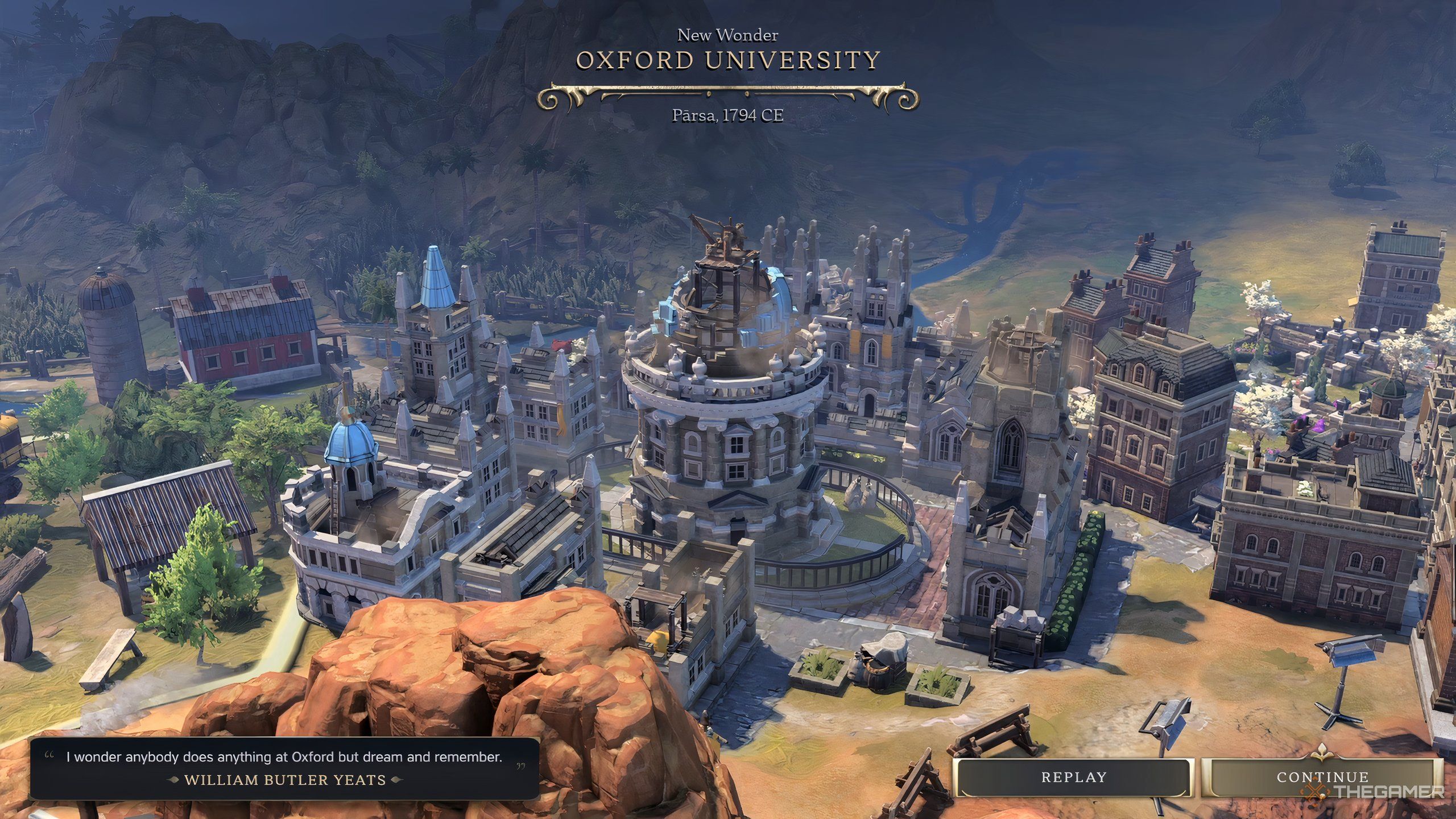
    The Oxford University Wonder being constructed in Civilization VII.

    When you earn a Celebration, a pop-up will appear allowing you to choose between two temporary bonuses that last for a maximum of ten turns.

    Some leaders have specific agendas related to Celebrations. When you engage in diplomacy, be sure to find out if the civilization you’re interacting with appreciates your Celebrations.

    Here is an example of a celebration you can earn early in the game if you have the right government type.

    We Love The Assembly Day!

    +20% Culture for 10 turns.

    +15% Production for constructing Wonders over 10 turns.

    The buffs you receive depend on your active government type, so it’s wise to try different government configurations in various playthroughs.

    In addition to earning Celebrations, you will also unlock a Social Policy slot, enabling you to implement new policies that can amplify your civilization’s outputs and yields.

    How To Get More Celebrations

    The Civilization 7 Happiness tutorial explanation.

    Each time you achieve a Celebration, the cost of obtaining the next one will increase gradually throughout your campaign.

    The key to continuously earning Celebrations is to maintain happiness across your empire.

    Happiness is crucial, especially in later stages of the game, as it helps maintain productivity and keeps specialists active in your cities.

    How To Earn Happiness

    There are several methods to boost happiness throughout your Civilization 7 playthrough. The most reliable way to increase happiness is to build specific structures and enhance tile resources.

    Here are examples of structures and tile improvements that can boost your happiness:

    • Altars
    • Villas
    • City Parks
    • Dates
    • Horses
    • Wine

    This list is not exhaustive and includes only some structures and tiles that yield happiness. When expanding your cities or towns, pay attention to the happiness icon to identify those that contribute positively to your Celebrations.

    You can also implement social policies to enhance happiness within both cities and towns. Here are a few examples of such policies:

    Social Policy

    Details

    Avant Gard

    Increases Culture and Happiness from showcased Great Works.

    Constitution

    Increases food and happiness for maintaining specialists.

    Divine Right

    Boosts happiness and influence in your capital.

    Implementing any of these policies can decrease your happiness requirements in your empire or enhance your current yields, thereby allowing you to achieve Celebrations more quickly.

    Finally, stationing Army Commanders in areas with low happiness can help improve overall contentment. This should be a last resort, particularly in settlements at risk of rebellion.

  • Understanding Religion’s Role in Civilization 7

    Understanding Religion’s Role in Civilization 7

    In Civilization 7, while religion isn’t the sole path to victory anymore, it remains a vital component that players must understand to succeed over the span of about 500 turns. The religion system has been made more straightforward compared to previous versions, yet there are specific steps you’ll want to take to lead your civilization to prominence.

    Whether you’re aiming to fulfill the Cultural Legacy path or simply seeking to enrich your society with various benefits through religious structures and units, mastering religion is crucial. This guide will provide you with everything you need to establish a flourishing theocracy in Civilization 7.

    What Is Religion In Civ 7?


    As in earlier entries of the series, Religion plays a significant role in gameplay and must be developed from the Antiquity Age onward.

    In contrast to previous versions, the focus on religion is now much clearer. The religious combat system from Civ 6 has been removed, and your main responsibility will revolve around using Missionaries to convert both your cities and those of other civilizations.

    Here are some key aspects of Religion to consider as you advance through the ages:

    1. Focus on the Right Civics – To establish a religion, you will need to study specific civics (explained below).
    2. Prepare to Produce Missionaries – In the Exploration Age, invest time in producing or purchasing plenty of Missionaries for success.
    3. Look Out for Bonuses – In the Antiquity Age and beyond, you can gain bonuses from collecting Reliquaries (crucial later) and for founding a selected Pantheon. Keep an eye on these to enhance your religious strategy.

    How Religion Works In The Antiquity Age


    Queen Isabella's Starting Screen in Civilization 7.

    Your journey toward founding a religion in Civ 7 starts in the Antiquity Age by establishing a Pantheon, an action that can be taken fairly early in the game. Pantheons provide various passive bonuses, which should be chosen based on your play style.

    Pantheons are key to how Religion plays out in the Antiquity Age, and they lay the groundwork for religious practices in the upcoming Age of Exploration.

    Here are some examples of effective Pantheons.

    Pantheon

    Effect

    God of the Forge

    +10% production toward constructing buildings in cities with an altar.

    Monument to the Gods

    +10% production toward constructing Wonders in cities with an altar.

    Fertility Rites

    +10% Growth Rate in cities with an altar.

    City Patron Goddess

    +3 Influence on the altar.

    God of the Sun

    +1 Culture, Food, Gold, Happiness, Production, and Science on the altar.

    How To Found A Pantheon

    To establish a Pantheon, you must first research the Mysticism Civic, which is available early on in the game. Focus on this research task as soon as it’s unlocked.

    While establishing a Pantheon is important, remember that the Antiquity Age is not heavily centered on Religion.

    Feel free to prioritize other Legacy Paths and win conditions during this period if you are looking for a more balanced civilization.

    How Religion Works In The Exploration Age


    The menu screen stating that the Exploration Age has begun in Civ 7.

    The Exploration Age is where Religion truly begins to flourish in Civ 7 and represents the most crucial age for faith development.

    If you’re aiming for a Culture Victory, and you have tutorials enabled, your Cultural Advisor will provide tips on leveraging Religion to your advantage.

    As this age commences, you will receive specific objectives. Once you complete these two tasks, you can establish a religion that will provide a range of bonuses.

    1. Study the Piety Civic
    2. Construct a Temple

    If you’re focusing on a Culture Victory, prioritize completing these objectives over anything else. Don’t waste valuable turns!

    How To Found A Religion


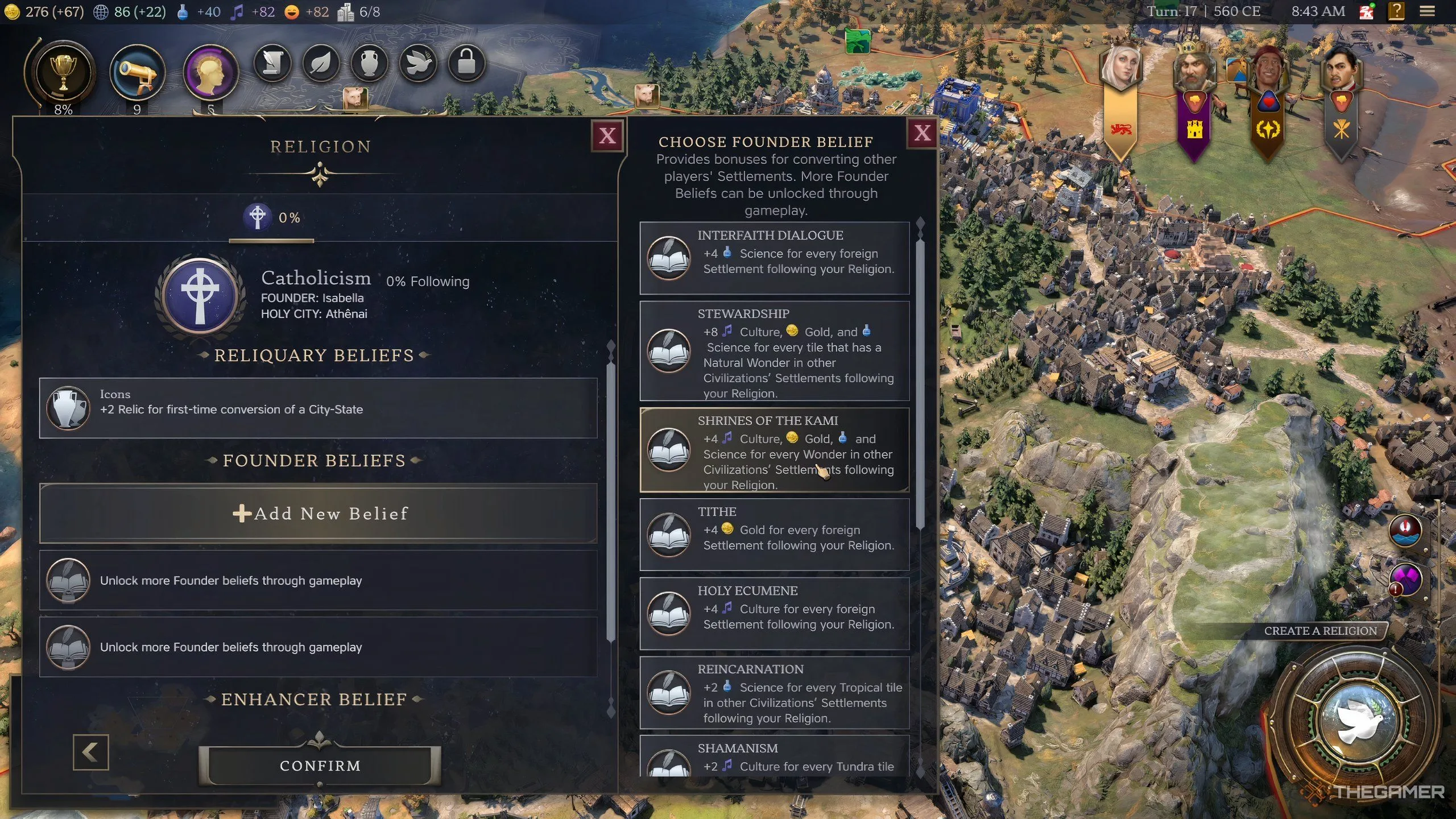
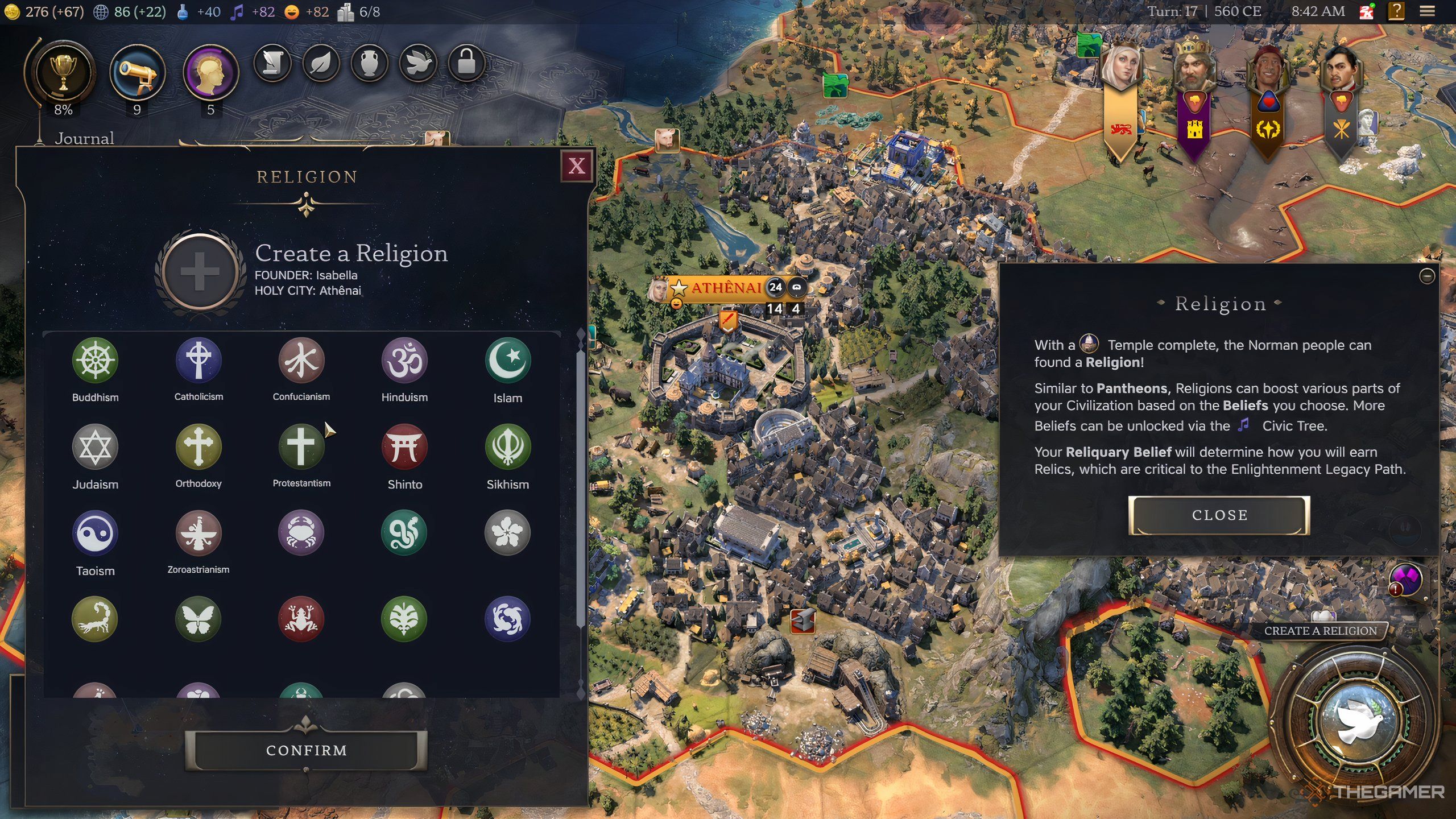
    The UI screen for founding a religion in Civ 7.

    After completing your temple, you’ll be prompted to establish a religion where you can select several bonuses detailed below.

    Belief

    Effect

    How to Unlock

    Reliquary

    Provides bonuses and new methods for obtaining Reliquaries, which are essential for Legacy Paths.

    This is a unique benefit you receive upon founding a religion.

    Founder

    These buffs increase as your religion spreads.

    Unlocked at the time of founding your religion; you can gain more by expanding your faith.

    Enhancer

    Offers even greater buffs for gameplay.

    Unlocked through studying the Theology Civic.

    How To Spread Your Religion

    Once your Religion is established, you should aim to spread your faith worldwide. The primary method to achieve this is by producing Missionaries and dispatching them to other civilizations.

    Once you’ve created a Missionary, you can use it to convert your cities or those of another civilization to your faith. Follow these steps:

    1. Send your Missionary into the borders of the settlement.
    2. Select the Convert Action to convert the city (required for first-time conversions).
    3. If the city is already following a religion and has both rural and urban populations, you’ll need to perform two Convert Actions to convert both groups.

    When trying to convert a city with both rural and urban populations, ensure you execute the Convert Action once on an urban tile and once on a rural tile to convert the entire city successfully.

    How To Earn Relics


    The Legacy Path screen showing Relics in Civ 7.

    During the Exploration Age, earning and showcasing 12 relics is essential as part of the Cultural Legacy Path. Gaining relics through Religion and other respects is crucial for achieving a Cultural Victory before the game’s conclusion.

    There are several ways to obtain Relics during this period.

    Method

    Details

    Use Your Reliquary Belief

    The Reliquary Belief selected when founding a religion will provide unique ways to acquire Relics.

    Research Civics or Technologies

    Certain Civics or Technologies, such as Theology or Education, can provide Relics.

    Narrative Events

    Randomized narrative events may grant you a Relic.

    Construct Wonders

    Building certain Wonders will yield Relics.

    When you earn Relics, ensure you display them properly. Make sure to construct Temples and Wonders that support displaying Relics. You can manage Relic display options in the Great Works menu.

    How Religion Works In The Modern Age


    The Civ 7 Modern age selection screen, in which players pick a new civ to play as.

    While Religion is influential throughout all three ages, it is particularly significant in achieving legacy points during the Exploration Age. In the Modern Age, although Religion remains a factor in gameplay, it is not the central focus.

    If you effectively spread your Religion during the Exploration Age, you will continue to reap benefits from your Reliquary, Founder, and Enhancer beliefs, as well as from your Pantheon beliefs during the Modern Age.

    The Legacy Points obtained in prior ages from advancing your religion can significantly aid in achieving victory in the Modern Age.

  • Ultimate Leader Guide: Benjamin Franklin in Civilization VII

    Ultimate Leader Guide: Benjamin Franklin in Civilization VII

    Benjamin Franklin stands out as a remarkable leader in Civilization 7, particularly for his strengths in science, production, and Influence-based gameplay. His bonuses emphasize enhancing production buildings, which also yield additional science, alongside granting extra science for each Age as you embark on new Endeavors.

    During the Antiquity Age, it’s crucial to focus on gaining Influence first and foremost. This strategy will set you up for a significant science boost when you transition into the Exploration Age. You can earn Influence through building various wonders and allocating attribute points, which we will discuss in detail below. This guide will also highlight the most effective civilization combinations for Franklin, ideal Mementos, and other tips.

    Overview of Benjamin Franklin


    Franklin’s gameplay centers on Influence and diplomatic Endeavors, both of which are very powerful mechanics in Civilization 7. Early in the game, opportunities such as research collaborations and local festivals can dramatically boost your food, science, culture, and other resources, sometimes even doubling your initial outputs.

    Diplomacy is key for Franklin. Cultivating good relationships with other civilizations is essential, as maintaining friendly ties allows you to send Endeavors frequently when they become available.

    Early Strategy for Benjamin Franklin

    Early Strategy with Benjamin Franklin

    Franklin is a flexible leader with multiple paths to victory, particularly during the Antiquity Age. Thanks to your high science outputs and production capabilities, you can easily pursue both culture and science victories, and you’re also positioned well to form trade networks with friendly civilizations, setting you up for an economic win.

    It’s also important not to overlook Franklin’s military capabilities. Although his approach often leans toward diplomacy, he can convert strong production into military might should the need arise. Your Influence can be strategically utilized to impose sanctions and carry out espionage against competitors.

    Early Pantheon

    Securing the Mysticism civic early on is wise, as achieving the City Patron Goddess Pantheon grants you an impressive +3 Influence boost right from the start.

    Early Production

    Building a Monument is a smart early choice for Franklin since it also increases your Influence. Additionally, consider constructing buildings like the Saw Pit and Brick Yard to enhance your early science output. Starting with Animal Husbandry is a solid option as well, although it depends on the resources near your capital.

    Diplomacy

    Ben Franklin Diplomacy Output

    Franklin’s early science advantage illustrated.

    Immediately construct at least two Scouts to explore your surroundings and discover neighboring civilizations. Engage with other civs quickly and utilize Franklin’s unique Research Collaboration Endeavor, which is enabled by his classification as a scientific civilization, to rapidly increase your science production. While this will provide benefits to your rivals as well, initiating multiple collaborations can help you exceed their science output significantly.

    Best Resources and Great Starts for Franklin

    Benjamin Franklin Great Barrier Reef

    Incense proves to be an excellent resource for Franklin, providing a 10% increase in science from the designated city. Other useful early resources like Cotton and Sheep can enhance food and production. The ultimate starting point for Franklin is near the Great Barrier Reef, one of the most productive science Natural Wonders in the game.

    Top Mementos for Benjamin Franklin

    Benjamin Franklin Mementos

    Franklin’s Unique Mementos

    Franklin unlocks unique Mementos, which are exceptionally advantageous:

    • Bifocals – Earn 50 Influence each time you research a Mastery in Tech or Civic.

    This enables you to swiftly accumulate Influence, which will compound as your science production grows increasingly stronger throughout the game. By the Modern Age, with optimal use of adjacencies, you can achieve hundreds of science points each turn and rapidly navigate the tech tree, unlocking more Influence.

    • Kite & Key – +10% science towards mastering Tech.

    This Memento is fun because it reduces the overall science cost for all tech research, giving you a competitive edge over the AI.

    • Glass Armonica – Grants +10% science and happiness for you and your ally while in an alliance.

    If you pursue a peaceful strategy with Franklin, the Glass Armonica can yield significant returns, allowing you to gain a remarkable 10% science boost per alliance. On a standard map, you could ally with several players, potentially providing an additional 20% science production on top of your already impressive science bonuses.

    Complementary Mementos for Franklin

    In conjunction with his unique Mementos, there are numerous other options:

    • Treaty Of Kadesh – +1 Bonus Diplomatic Attribute point.

    This straightforward Memento is available from the game’s onset and is perfect for new players opting for Franklin. It grants an additional point in the Diplomacy Attribute tree. To see what the attribute trees offer, you can check the information provided in-game.

    • Golden Seal Stone – Unlocked by leveling up Himiko, Queen of Wa to level 2. This grants an extra +1 Influence per Age on science buildings.

    Since you’re focused on science with Franklin, it’s beneficial to have a Memento that specifically aligns with his diplomatic and scientific strategy.

    • Globus Cruciger – Grants 50 Influence whenever you allocate an Attribute Point in the Diplomatic Attribute tree. Unlocked by leveling up Charlemagne to level 5.

    This handy Memento synergizes well with the base +1 Diplomatic Attribute point Memento, allowing you to kickstart your game with an extra 50 Influence. While this may appear minor, it could prove vital in establishing early city-state suzerainty or fostering a positive relationship with nearby civilizations.

    Top Civilization Combinations for Benjamin Franklin

    Benjamin Franklin and Greece

    As you begin your journey with Benjamin Franklin in the Antiquity Age, you’ll select your initial civilization to pair with him.

    Greece

    Greece aligns perfectly with Benjamin Franklin’s strengths. It offers a base +3 Influence on the Palace right from the beginning, which is invaluable since Influence can be challenging to acquire early in the game.

    The Parthenon, part of Greece’s unique quarter, contributes +2 Influence if placed in rough terrain. Additionally, when you construct the unique quarter, the Acropolis, you’ll generate a Logios, which further enhances the Influence of your Palace tile. These bonuses collectively benefit Franklin’s diplomatic-oriented strategy.

    Greece also boasts advantageous policies within their civic tree, such as Xenia, which makes it cheaper to befriend city-states, Ekklesia Mastery offering +2 Culture for each Endeavor initiated, and Symmachia Mastery, which provides a 30% reduction in costs for Endeavors and Sanctions.

    Rome

    If you prefer a more militaristic approach, consider choosing Rome. The Roman bonus of extra production in the capital for each town complements Franklin’s production focus to enhance science generation. Pairing this production boost with the scientific advantages linked to military technologies—such as early access to Bronze Working—will provide you substantial leverage over your rivals.

    Utilize Roman Legions to overwhelm your foes.

    However, Rome isn’t limited to military success. The unique building, the Basilica, gives +1 Influence adjacency for Culture buildings and Wonders. This amplifies the effectiveness of your Monument and enhances early adjacency boosts from important wonders like the Great Stele. With sufficient production in the capital, you’ll likely secure several wonders, even at higher difficulty levels.

    Franklin Rome Civics

    Though Rome may not provide the best Influence civics compared to Greece, it still includes some of the most powerful policies available. For instance, the Cursus Honorum policy offers 25% of the production cost for Infantry units as culture whenever you produce an Infantry unit, allowing you to simultaneously focus on military development and culture.

    Benjamin Franklin in the Exploration Age and Modern Age

    Franklin in the Modern Age

    Transitioning into the Exploration and Modern Age with Benjamin Franklin prompts a significant choice regarding your new civilization. This decision is heavily influenced by your current game situation. It wouldn’t be accurate to claim there’s a universally best or worst choice when it comes to civilization pairings.

    Instead, tailor your decision based on your gameplay style. For military-focused Franklin players, considering the Normans might be beneficial.

    Normans in the Exploration Age

    The game suggests opting for the Normans for Franklin due to a perceived cultural link (the specifics of which are unclear). However, only choose the Normans if you’ve developed a militaristic approach with Rome in the prior Age.

    Norman Civics

    The Normans can adopt both aggressive and defensive military strategies during the Exploration Age. If you’ve laid the groundwork for a strong military presence and science economy in the previous Age, harness the powerful Chevaler unique unit to fortify your borders, build up your defenses, and then unleash your scientific advantages or pursue conquest.

    Options in the Modern Age

    When you reach the Modern Age, the array of civilization options is vast, making it impossible to declare one the definitive best. Your choice should align with how your game has unfolded so far. America is often viewed as a default selection, and Franklin would greatly benefit from the substantial production increases offered by the Railyard and Steel Mill.

    Alternatively, you might find success with civilizations like France or Meiji Japan if you’re focusing on military victories.

  • How to Establish Trade Routes in Civilization 7: A Comprehensive Guide

    How to Establish Trade Routes in Civilization 7: A Comprehensive Guide

    Managing your civilization in Civilization 7 can be a complex task with many strategies to consider. One crucial element for long-lasting prosperity is establishing trade routes with other leaders. Even if your ultimate goal is military conquest, tapping into the resources of neighboring civilizations before launching your attack is a smart strategy. While trade routes have been a staple of the series, their mechanics have evolved, relying less on diplomatic negotiations. Fortunately, we’re here to give you all the details you need to set up trade routes without any cost.

    2K Games

    How to Create Trade Routes

    To set up trade routes, you will need to connect your cities with those of another leader. This connection opens up access to the natural resources found in their territories, providing you with significant benefits that may otherwise be out of reach. Here’s how to get started:

    Step 1: Begin a new game and locate at least one other civilization on the map.

    Step 2: While exploring, be sure to consult the Civic Tree and focus on researching the Code of Laws.

    Step 3: After completing your research on the Code of Laws, you can either construct or purchase a Merchant unit.

    Step 4: Click on your Merchant unit, and it will display all the potential trade routes, indicating which ones are feasible and the resources you could acquire from each.

    Some trade routes may be inaccessible if the Merchant cannot physically reach the destination or if your relationship with the other leader is strained.

    Step 5: Choose a viable trade route, and the map will direct you to that location.

    Step 6: Guide your Merchant unit to travel to that city or town.

    Step 7: Allow the Merchant the necessary number of turns to reach their destination.

    Step 8: Upon arrival, click the icon representing two arrows pointing in opposite directions to finalize the trade route. This action will use up your Merchant unit.


  • How to Earn Legacy Points in Civilization 7: A Comprehensive Guide

    How to Earn Legacy Points in Civilization 7: A Comprehensive Guide

    Civilization 7 brings exciting advancements to this classic 4X series, necessitating a fresh approach to strategies and gameplay. The most significant update involves the introduction of Ages, complemented by the more intricate Legacy Points system. These points play a critical role in not only transitioning to new Ages but also in granting various buffs and bonuses as your civilization progresses. While acquiring Legacy Points can be challenging, they are essential for achieving victory. Below is a concise explanation of how these unique points function, as the tutorial may not provide all the necessary details.

    Unlocking Legacy Points

    2K Games

    Legacy Points are achieved as you reach milestones within each of the four main Legacy Paths. In essence, Legacy Paths track your progress—and that of your opponents—toward one of four victory conditions: Culture, Economics, Military, and Science. Each path contains three milestones that each grant you one Legacy Point before resetting with the arrival of the next Age.

    In addition to providing substantial contributions to your overall Age progress, completing each milestone earns you one Legacy Point. These milestones vary for each Legacy Path and differ across Ages as well. For instance, an early Science milestone may have involved researching writing and constructing a library, whereas in the current Age, it requires researching education and assigning four specialists. You can monitor your task progress in the Legacy Path interface, as depicted above, but they also appear as primary objectives on the top left side of your screen.

    You can earn Legacy Points across multiple paths simultaneously, but to ultimately secure victory, you must focus on completing just one path. Spreading your efforts too thin among several paths for too long can leave you vulnerable in the competition.


  • Ultimate Guide to Policy and Crisis Cards in Civ 7

    Ultimate Guide to Policy and Crisis Cards in Civ 7

    Policy cards are back in Civilization 7, functioning much like they did in Civilization 6. However, the introduction of the new ages system alters how these cards transition between ages. Additionally, Civ 7 features Crisis Cards, a new mechanic that introduces challenges at the end of each age that can affect your empire, regardless of how well you performed during that age.

    These updates create fresh strategies for using policy cards. Below, we’ll explore some of these strategies to help you optimize your civic tree.

    How Do Policy Cards Work?

    At the start of the game, you’ll have access to two policy cards, which you can assign to your empire as soon as you finish your first civic research.

    These early game decisions are extremely important in Civilization 7. Will you prioritize extra culture, or perhaps more science and production? Your choices will essentially shape the trajectory of your empire from the very first turns.

    Policy cards are unlocked through the tech or civic trees and often provide bonuses that enhance your empire, such as increased production for units or improved happiness levels.

    Think seriously about the type of victory you want to pursue. This consideration should begin when you select your leader and civilization before the game starts. Explore both the tech and civic trees to identify policy cards that can help you achieve your victory condition.

    Crisis Cards

    Civilization 7 Crisis

    As you near the end of an age—be it Antiquity or Exploration—a crisis will be activated at approximately 70 percent of the age’s completion.

    You will need to select a Crisis Card, starting with one card initially. As the age progresses and the crisis escalates, you’ll have to choose additional cards. It’s mandatory to incorporate these crisis cards. Ignoring them won’t prevent the impending turmoil.

    For instance, if a plague spreads through your cities, you can choose cards that might mitigate the effects—like gaining extra culture from infected towns that possess an Altar.

    The selection of crisis cards is crucial. For example, during a plague crisis in the Exploration Age, you will need to quickly manage infected cities to stop them from rebelling.

    Being aware of when your empire is on the brink of chaos is vital. For instance, if you are engaged in a prolonged battle with a neighboring empire, and then a plague crisis arises, your opponent’s cities may start losing troops stationed there due to the infection.

    Conversely, if a hostile city-state is adjacent to your capital and attacking, knowing which crisis cards to select can either save or doom your civilization.

    Tradition And Policy Cards

    Civilization 7 Tradition and Policy Cards

    Civilization 7 includes two main types of policy cards: Tradition and Policy Cards.

    Tradition cards are obtained through your civilization’s civic tree and carry over between ages, whereas regular policy cards reset and change with each new era.

    This distinction calls for strategic planning—is there a particular tradition card from your civilization that will serve you well in future ages? Since you can only research one new civic at a time, this can limit your access to unique civics.

    Generally, it’s wise to tackle basic civic research before zeroing in on your civilization’s specific tree.

    Culture Generation

    Civilization 7 Culture Generation

    Most policy cards can be found in the civic tree, which acts like a tech tree but focuses on cultural development.

    Civilization 7 requires you to find a balance between various victory types—economic, cultural, scientific, and military—while striving for a golden age in at least one category.

    Many players have overlooked culture in the past, only to regret it when they find themselves without any Tradition cards ready for the next age.

    Even basic cultural initiatives, like constructing monuments, can significantly impact your culture generation to help unlock your civilization’s traditions.

    Whenever you enter a significant celebration, you can slot in an additional Policy or Tradition card.

  • Ultimate Resource Handbook for Civilization 7

    Ultimate Resource Handbook for Civilization 7

    Overview of Resources in Civilization 7

    In Civilization 7, the resource system has undergone a significant transformation. Resources are now categorized and these categories evolve as civilizations progress through different Ages. Management of these resources is crucial and can be handled through the Resource Management screen. Resources play a vital role in enabling specialization within towns and cities. This need for resource management intensifies with the arrival of the Exploration Age, marking the introduction of Treasure Resources, and further expands in the Modern Age with the emergence of Factory Resources.

    This guide delves into the resources available in each era and offers insights on optimizing your empire’s resources, including additional slots, Treasure Fleets, and Factory specialization.

    Resources in the Antiquity Age

    In the Antiquity Age, there are three distinct types of resources: City Resources, Bonus Resources, and Empire Resources.

    City Resources

    City Resources are designated for specific city slots in the Resource Management screen.

    • Jade
    • Kaolin
      • Provides +2 food to the capital, and +4 food to other cities.
    • Incense
    • Silk
    • Camels
      • Grants +2 extra resource slots.
    • Salt
      • Offers +20% production boost for training units.
    • Gypsum
      • Increases production by +2 in the capital and +4 in additional cities.
    • Pearls
      • Adds +2 happiness to the capital and any other city.

    Bonus Resources

    Bonus Resources can be allocated in any town or city slot.

    • Fish
    • Sheep
      • Provides +2 production and +2 happiness.
    • Cotton
      • Increases food and production by +2.
    • Dates
      • Grants +2 food and +2 happiness.
    • Hides
      • Adds +3 production.
    • Dyes
      • Provides +3 happiness.

    Empire Resources

    Empire Resources don’t occupy slots within settlements but provide bonuses applicable to your entire empire.

    • Gold
      • Grants a +20% increase in gold for purchasing buildings.
    • Silver
      • Provides a +20% increase in gold for purchasing units.
    • Ivory
      • Increases production by +10% for wonders in tropical, plains, and desert terrains.
    • Marble
      • Boosts production by +10% for wonders in grassland, tundra, and marine terrains.
    • Horses
      • Offers cavalry units +1 combat strength, with an additional +1 against infantry units.
    • Iron
      • Increases infantry unit strength by +1.
    • Wine
      • Grants +2 happiness in the capital and a +10% culture boost during celebrations.

    Resources in the Exploration Age

    The Exploration Age introduces new resources, including specific Treasure Fleet resources located in Distant Lands—typically islands between the continents if you’re using the recommended Continents Plus map type.

    This era adds some new City and Bonus resources.

    New City and Bonus Resources

    • Incense
      • Provides 100% production increase for missionaries and temples.
    • Niter
      • Siege and naval units receive a +1 combat strength per Niter.
    • Truffles
      • Grants +20% production for units.
    • Whales

    Treasure Fleet Resources

    These resources serve as Treasure Fleet resources until the Modern Age.

    Resources in the Modern Age

    The Modern Age brings in Factory Resources, which can be placed in a Factory slot within your cities or towns. After constructing a factory, you can utilize more of the same factory resource in any open slots. Many existing resources undergo changes in this era.

    New City, Bonus, and Empire Resources

    • Oil
      • Boosts heavy naval and cavalry units with +1 combat strength, plus an additional +1 against infantry units.
    • Coal
      • Grants light naval units +1 combat strength and +100% production boost for constructing Rail Stations.
    • Rubber
      • Increases infantry and air units’ strength by +1.
    • Sugar
      • Provides +6 food.
    • Ivory
      • Adds +4 happiness and +4 production.
    • Pearls
      • Grants +6 happiness in the capital and +3 in any other city.
    • Silk
      • Offers +6 culture in the capital and +3 in any other city.
    • Furs
      • Provides +6 happiness in cities with a Rail Station, and +3 happiness elsewhere.
    • Tobacco
      • Grant +6 production in cities with a Rail Station and +3 production in others.

    Factory Resources

    These include:

    • Fish
      • +5% growth rate for settlements.
    • Kaolin
      • +3% culture boost.
    • Cocoa
      • +3% happiness boost.
    • Coffee
      • Increases production towards buildings and wonders by +5%.
    • Tea
      • Adds +3% science production.
    • Quinine
      • Units heal +1 HP.
    • Citrus
      • +5% production towards naval units.
    Resource Slots

    The number of resource slots in your cities is limited and influenced by different factors. Resources like camels provide early expansion options for your slots, with more opportunities arising from wonders, social policies, and research as the game progresses.

    With these insights, you can effectively manage resources and enhance your empire in Civilization 7.

  • Ultimate Guide to the Exploration Era in Civilization VII

    Ultimate Guide to the Exploration Era in Civilization VII

    The second age in Civilization 7, called the Exploration Age, focuses on discovering new territories, gathering fresh resources, and establishing your own religion. When the game transitions to this age, many things reset: cities turn into towns, armies are downsized and moved back to your city and town tiles, and all currently existing wars are forgotten. However, relationships with AI civilizations continue to persist between ages.

    Exploring the oceans and uncovering Distant Lands—any area beyond your starting continent—is always beneficial. New resources can lead to powerful advantages for new settlements, and some civilizations thrive by focusing on this approach.

    Win Conditions

    Similar to the Antiquity Age, four primary win conditions exist in the Exploration Age: cultural, scientific, economic, and military.

    Cultural Victory – Toshakhana

    Showcase 12 relics within your empire.

    A cultural victory requires collecting and showcasing relics, usually obtained through converting other religions. You may also receive relics through story events or by becoming the suzerain of city-states. Building Temples and wonders is essential to create enough slots for displaying these relics.

    If you successfully display 12 relics by the end of the age, you’ll enter a Cultural Golden Age, allowing you to carry your religion’s foundational beliefs into the next era.

    This win condition centers on creating missionaries to spread your religion. To succeed, you might need to prioritize exploring Distant Lands less and focus on acquiring the early Piety civic to promptly establish your Temples. Combining this with the boost in wonder construction from the Inspiration civic will help you set up your relic wonders quickly.

    Economic Victory – Treasure Fleet

    Accumulate 30 Treasure Fleet Points by returning treasures from Distant Lands.

    This victory is centered on establishing new towns and cities in Distant Lands—essentially, any islands or continents that differ from your initial settlements.

    You can settle in areas where you discover resources like Sugar and Cocoa. Once you’ve researched Shipbuilding, Treasure Fleets will begin to appear. Returning these treasures to your homeland’s coast not only nets you gold but also boosts your Treasure Fleet points.

    If you gather 30 points worth of Treasure Fleets, you will achieve an Economic Golden Age, ensuring all towns remain as cities and adding two extra population to any cities in Distant Lands during the new age.

    Preparation is essential for an economic victory. Construct several naval units to begin exploring the islands swiftly, and have Settlers ready to leave the coastline once you’ve researched Cartography. Speed is crucial, as the AI (especially on higher difficulties) may settle new islands quickly.

    As you explore, you’ll encounter city-states on nearby islands. You must decide whether to become their suzerain to incorporate them into your empire for access to Treasure Fleet resources or destroy them and settle in their stead.

    Military Victory – Non Sufficit Orbis

    Earn 12 points from settlements in Distant Lands—1 point for each settlement (double the points if conquered or if they follow your religion, quadruple if both apply).

    If you succeed in reaching the Golden Age for this victory, all your Distant Land settlements will gain an extra Infantry and Ranged unit in the Modern Age.

    Scientific Victory – Enlightenment

    Establish five districts (not including the City Center) that yield at least 40 total resources.

    The Scientific Victory focuses on maximizing the number of specialists and their slots in your cities. Specialists provide substantial extra yields from tiles in addition to the base yield, helping you achieve that 40 yield target. Researching Education is crucial to increase the number of specialists allowed per tile. Growth and scientific advancement are vital for this victory condition.

    Successfully reaching a 40 yield in five distinct districts will grant you a Scientific Golden Age, turning universities into Golden Age institutions in the Modern Age.

    Exploring Distant Lands


    The Exploration Age emphasizes the importance of venturing beyond your home continent. To facilitate this, you should prioritize researching Astronomy and Cartography.

    If you aim for a strong economic strategy to claim new territories, focusing on Exploration Age resources like Sugar, Cocoa, and Tea means that researching Cartography first is essential, enabling your Settlers to navigate Deep Ocean tiles.

    Deep Ocean refers to any ocean tile that isn’t near the coast. Prior to researching Shipbuilding, any units that end their turn in Deep Ocean will take damage. It’s wise to plot your course to new islands by staying close to the shore as much as possible—you risk losing units that attempt long voyages over the ocean.

    Your goal should be to quickly reach Shipbuilding. To do so, research the first three techs (Machinery, Astronomy, and Cartography), along with Heraldry and Feudalism.

    Securing access to Shipbuilding early gives you a significant edge in naval exploration, allowing units to avoid damage when crossing Deep Ocean tiles. This also unlocks the first advanced ship, the Carrack, providing vital advantages in upcoming naval conflicts.

    Shipbuilding also opens the door to Treasure Fleets, which are essential for achieving an Economic victory in the Exploration Age.

    New Resources And Treasure Fleets


    Civilization Exploration Age Cocoa

    During the Exploration Age, several new resources become available, including Incense (which offers additional production for religious buildings and units but isn’t a Treasure Fleet resource), Cocoa, Tea, Sugar, and Spices.

    These resources will only trigger Treasure Fleets once you have researched Shipbuilding, and then they’re on a turn timer. The points earned for each fleet are directly based on the number of Treasure Fleet resources the settlement possesses. For instance, if you have a town that produces two Cocoa and one Sugar, you will receive three points each time you return that fleet to your homeland.

    Religion


    Civilization Religion In Exploration Age

    Religion undergoes a transformation in the Exploration Age. Instead of merely granting benefits through your Pantheon, you can actively spread your faith to other settlements by training missionaries.

    Religion can offer powerful advantages for your entire civilization—beliefs such as Tithe can generate +4 gold per settlement adhering to your faith, while Holy Ecumene does the same for Culture.

    Selecting your religion is a critical aspect of the Exploration Age, even if you don’t intend to pursue a religion-centric strategy.

    This is important because turmoil and discontent can lead to revolts in Settlements, favoring whoever holds a religious majority. Allowing religious settlements to remain unhappy can lead to chaos during the Wars of Religion crisis, which may occur in the later stages of this age.

    While managing religion isn’t overly complex, it should still be on your radar. Keeping your settlements aligned with your own faith is generally a wise strategy, but various strategies, narrative events, and unique civilization traits may influence your approach.

    Exploration Age Crises

    As the Exploration Age draws to a close and more players achieve victory conditions, a worldwide crisis will emerge. Typically, this will be a Plague or a religious war.

    Plague

    The Plague can be extremely harmful to your empire, especially if you neglect infected settlements. Discontent amongst citizens can lead to riots that destroy buildings, and if serious enough, revolts can shift allegiance to other nearby civilizations.

    Fortunately, a new unit—the Physician—will appear to help your settlements recover from the plague faster. This unit activates as soon as the Plague crisis starts. Shifting production to create Physicians right away is generally a good move.

    Similar to other crises, the Plague Crisis can hold potential benefits if handled correctly—certain crisis cards may offer extra culture when a Physician is assigned to a Hospital tile. Even during dire times, clever choices can help you gain the upper hand in Civilization 7.

    Religious War

    In contrast to the Plague, the Religious War crisis can creep up on you quietly. Depending on your crisis card choices, having settlements aligned with different religions can be detrimental. You’ll also face several narrative choices involving religious tolerance or isolation.

    Your strategy here largely depends on how well you’ve managed your religious affairs thus far. Embracing tolerance may weaken your religion’s dominance and helpfulness. Choosing isolation, however, requires that your faith is prevalent in your settlements, or you’ll run the risk of significant discontent and uprisings.

    Choose Your End-of-Age Government

    As the age concludes, you’ll have the opportunity to select from three potential new governments, each offering various bonuses to your win conditions, such as increased science and culture, enhanced military production, and other benefits.