Tag: chips

  • Top Chips in Raccoin: Completing and Solving Them All

    Top Chips in Raccoin: Completing and Solving Them All

    In Raccoin, you’ll find various items to help you improve your gameplay, including Clips, Prizes, special coins, modifiers, and other unique items. These tools increase your chances of surviving longer and advancing faster. One notable item is Chips, which you can attach to your Cards to gain permanent boosts and advantages for upcoming rounds.

    The game features over 100 different Chips, many of which depend on your character or build, making it tricky to determine which ones are best for your strategy. To help, here are some of the top Chips in Raccoin for different situations.

    Police Light
    Bad Coins can seriously harm your runs—especially in later rounds where tougher enemies appear. While having a special coin in your arsenal helps, Police Light is a handy alternative. When you know a Bad Coin round is coming (this info appears in the shop), this Chip stops any enemy from making noise, though you will lose Police Light as a trade-off. It’s a fair exchange to prevent chaos during critical moments.

    Piggy Bank
    You can spot Piggy Bank early in the game, usually through the Trader or Manager. It’s especially useful for those classes. Essentially, it allows you to save every regular coin you don’t spend. With some luck, you can clear early rounds using only your special coins, then start later rounds with dozens of coins saved up, giving you a significant advantage. Whether you’re building a strategy around having as many coins as possible or pushing your lines, Piggy Bank is a valuable item worth watching.

    Engineerat
    This simple but powerful Chip grants +3 Score Rate for each Gadget you have in play. While early on it might be rare to have many Gadgets, as the game progresses and you unlock items like UFO callers or Cooking Pots, the bonus stacks up quickly. Using the Sketch Card to duplicate Gadgets can further boost Engineerat’s effect, making it a strong choice for higher scores.

    Folding Screen
    Folding Screen’s usefulness comes into play in longer rounds. It functions as a map that works best when there are more turns, allowing you to score extra coins on specific sides. Building around this Chip involves accumulating as many coins or effects as possible to maximize its potential—potentially offering around +15 Score Rate with proper setup, especially in advanced rounds.

    Furry Clip
    If you’re playing as the Biologist, you deal with Animal and Plant coins. The Furry Clip enhances your Score Rate by 0.4 for each Animal Coin in your Clip, which can rapidly increase your points if managed well. Reaching a high number of rounds with your Clip already expanded—without using all collected special coins—is possible with this Chip’s help.

    Landlord
    Landlord assists with your in-game currency, specifically Tickets. When you find this Chip early or mid-run, avoid spending Tickets immediately to let its effect boost your savings. For managers, starting with six Exchanges means +9 Score Rate, and with the Paper Card, you can take that up to 10.5, greatly benefiting early and mid-game phases.

    Hamster
    Hamster is rarer but valuable, especially for those who want to scale Prize gains. Instead of Gadgets, it increases your Score Rate based on the Prizes you earn—via the Spin Wheel or other sources. Combining it with the Prize Card for extra slots and bonus Prizes lets you maximize its potential, making your Prize collection grow quickly.

    Raccoon Economics
    Managing Exchanges is a common aspect of Raccoin, but you can reduce their need by acquiring strong special coins and items. For each Exchange you don’t use, you gain a +1.5 Score Rate. Playing as the Manager, starting with six Exchanges gives +9 SR; adding the first Paper Card grants one more, totaling 10.5 SR, giving you a substantial boost in early and mid rounds.

    Bad Encyclopedia
    Dealing with Bad Coins is inevitable. Bad Encyclopedia rewards you with +2 Score Rate for each Baddie you clear, and notably, this boost is permanent for the entire run. Unlike other SR Chips, it doesn’t reset after rounds, providing ongoing benefits as you progress.

    Treasury
    Treasury is the only Epic Chip chosen in this list, and it’s valuable despite the rarity. It grants +0.1 SR for each coin you hold, which might seem small initially. But if you collect this alongside the Piggy Bank and save a good number of coins, your total Score Rate can skyrocket—making it an essential tool for maximizing your points.

  • Laser Chips Promise Faster Greener Indoor Wireless

    Laser Chips Promise Faster Greener Indoor Wireless

    Indoor wireless connectivity is reaching its physical limits as more devices congest the same frequency band. Streaming, video conferencing, and smart home devices are placing greater demands on networks, while power consumption continues to increase. A new type of laser chip offers an alternative by transmitting data via light.

    Researchers have developed a compact optical link capable of providing ultra-fast indoor connections with reduced energy consumption. Instead of broadcasting signals in all directions, it directs data through controlled infrared beams, increasing available capacity and minimizing interference in densely populated environments.

    At the heart of this system is a chip featuring 25 tiny lasers, each transmitting its own data stream. Operating simultaneously, these lasers significantly boost data throughput compared to a single source. Experimental tests over a two-meter distance showed individual lasers delivering between 13 and 19 gigabits per second, with the combined system reaching an impressive 362.7 gigabits per second—among the quickest results for chip-scale optical links so far.

    The performance improvement isn’t solely about speed; power efficiency also sees a notable boost, providing a more sustainable way to manage growing data needs.

    Performance is driven by a 5-by-5 array of vertical-cavity surface-emitting lasers, each functioning as a high-speed communication channel.

    Each laser’s beam is shaped into a specific square pattern, which limits overlap and allows multiple links to operate side by side without interference. The system’s receiver hardware restricts the speed limits, suggesting that future enhancements in hardware could push these speeds even higher.

    Light offers advantages over radio signals in crowded indoor spaces where interference and bandwidth limitations are common. Instead of scattering signals everywhere, the system creates a grid of precisely targeted beams with minimal spillover, ensuring stable coverage across the area—even when multiple devices are connected simultaneously.

    This approach operates at a power level of about 1.4 nanojoules per bit—roughly half the energy used by comparable Wi-Fi setups. However, it is currently optimized for short-range use with a clear line of sight, which limits its distance capabilities.

    Looking ahead, this technology aims to work alongside existing wireless networks by handling high-traffic situations indoors. The hardware is fabricated on a tiny chip using standard manufacturing techniques, making integration into existing fixtures or access points feasible, though commercial availability remains in the future.

    As network demands continue to grow, combining traditional radio links with laser-based systems could become a standard solution, with light-based technology managing the most data-intensive tasks.

  • Complete Guide to Coins, Chips, and Prizes in Raccoin

    Complete Guide to Coins, Chips, and Prizes in Raccoin

    When playing Raccoin, you have several features at your disposal to help you progress and possibly beat your highest score. These include Coins, Prizes, and Chips. Since there are many items to choose from and limited slots each turn, it’s important to understand what each item does.

    Within these categories, you’ll find a variety of options. Some are specific to certain characters, and others only activate under certain conditions. You can earn some power-ups during gameplay, but the ones you control directly are the ones you buy from the shop between rounds.

    ### Special Coins Will Make the Difference Between Winning and Losing

    As a coin pusher game, coins are the most critical element. The basic coin, called the copper coin, appears in every round and makes up most of what you collect. In addition to these, there are special coins that have unique effects.

    Depending on which Raccoin character you pick at the start, certain coins, prizes, and chips are more likely to appear or might be exclusive to that character. You can see the special power-ups for each character on the character select screen.

    At the shop between rounds, you can buy any of the coins offered. You’re limited to holding a set number at a time, so if you want a larger variety, you’ll need to buy more coin clips.

    It’s recommended to buy coin clips that store different coin types first. Adding clips that hold multiple of the same coin can come later. Most coins tend to interact with each other—multiplying value, transforming into different coins, or requiring other specific coins to activate benefits. For example, Bunny Coins need other Bunny Coins, and Wolf Coins require prey like Chicken Coins to be present.

    Purchased coins can be used anytime during a round by selecting them from your clip, but they don’t just drop straight down. Instead, they come out of the middle of the machine at the angle you drop them. While coins might seem simple, they greatly influence your score. Many players focus on prizes, as they often collect numerous coins, but modifier coins that convert nearby coins can make your score skyrocket and help remove bad coins from play.

    ### Prizes Can Help You Top That High Score

    Prizes are also bought between rounds, but you’ll mostly find them through Prize Balls earned during gameplay. When you see a Prize Ball drop, just knock it off to collect it. It will then automatically go to your prize slots.

    It’s usually better to use Prize Balls right away rather than holding onto them, unless you’re waiting for a specific prize like a Tower Stack. You have two prize slots, and collecting more prizes during the round is beneficial. Cluttering your slots delays earning new ones. Most prizes help by absorbing or collecting coins, which boosts your score and can remove undesirable coins from the game.

    Some prizes only activate under certain conditions, such as a Saucer Figurine that summons a UFO. If you wait too long to place it, you might miss the chance to meet its requirements. Others can remain in play and be powered up again, so using them early can be advantageous.

    Additionally, at the end of some rounds, you’ll receive a Keychain. These grant permanent boosts for the rest of your run but cannot be purchased in the shop.

    ### Chips Offer Passive Benefits That Could End Up Saving Your Run

    Chips are different from coins and prizes because they are not discarded after one use. Instead, they act as permanent modifiers that impact your game until you choose to sell or replace them. You can buy Chips between rounds and hold up to five at a time.

    Chips typically influence big-picture aspects of the game, such as increasing the number of coins you start with each round, changing the rarity of items available in the shop, or triggering special events when you go bankrupt. Since they are passive effects, it’s usually a good idea to fill all five slots with Chips, especially because you can always sell them later if you find better options.

    However, some Chips come with risks or drawbacks. Not all rewards are worth the potential downsides, so it’s smart to consider whether a Chip’s benefits outweigh its penalties. While Chips aren’t likely to boost your score from a thousand to a million on their own, they can be very helpful for giving you that extra push to reach higher rounds.

  • How to Earn Rip Chips Quickly in Skateboarding Through Completing and Solving

    How to Earn Rip Chips Quickly in Skateboarding Through Completing and Solving

    Rip Chips are essential for progressing in skateboarding games, helping you unlock new content and keep your gameplay smooth. Sometimes the chips don’t come fast enough, and if you’re just skating around without a plan, you might be stuck grinding for a long time.

    Knowing how to farm Rip Chips effectively makes a big difference. By focusing on the right challenges, spending your time in the city wisely, and teaming up with friends when possible, you can turn a slow trickle of chips into a steady flow. If you want to maximize your earnings without burning out, here’s what you need to know.

    How To Farm Rip Chips

    Not all challenges are equal. Main mission challenges give you significantly more Rip Chips — up to five times more than daily challenges. Daily challenges are easy to find, marked with a small white clock icon on their orange marker. While they’re good for quick gains, your main goal should be to focus on main missions if you want to accumulate chips quickly. Be sure to complete every objective within a mission, including optional ones, as each one rewards you with extra Rip Chips.

    You can find these challenges in the Missions tab on the menu or directly on your map, so keep an eye out and try to prioritize them whenever possible.

    Another way to increase your Rip Chips is through co-op play. Joining with friends, sending invites in your current game, or finding a buddy on Discord can give you access to co-op challenges. Completing these challenges rewards you with an additional 20 Rip Chips each.

    If you’re farming chips, this bonus adds up quickly, making cooperative play one of the most efficient methods.

    Finally, Rip Chips are also earned by leveling up your Rip Score. Doing tricks around the city, chaining combos, and completing map activities all raise your Rip Score. As your score increases, you’ll regularly receive extra chips on top of your mission rewards.

  • Qualcomm’s New Snapdragon G Chips Boost Handheld Gaming

    Qualcomm’s New Snapdragon G Chips Boost Handheld Gaming

    Qualcomm is updating its series of mobile gaming processors with the launch of three new chips designed for Android handheld gaming devices. Leading the pack is the Snapdragon G3 Gen 3, crafted for hardcore gaming enthusiasts.

    In the upcoming weeks, this high-end chip will debut in handheld consoles from brands like Ayaneo and Onex. The mid-range Snapdragon G2 Gen 2 is optimized for gaming at 144fps, while the Snapdragon G1 Gen 2 is aimed at entry-level devices prioritizing cloud-based gaming.

    Ayaneo Pocket S2 handheld gaming console.
    Qualcomm

    Kicking off with the flagship Snapdragon G3 Gen 3, this chip is a successor to the Snapdragon G3x Gen 2 that powered devices like the Ayaneo Pocket S. It features an octa-core configuration, comprising a single prime core, five performance cores, and two efficiency cores to manage demanding tasks.

    Qualcomm touts a 28% increase in graphics performance compared to its predecessor, along with support for hardware-accelerated ray tracing. It integrates the Snapdragon Game Super Resolution technology and the Adreno Frame Motion Engine 2.0, ensuring a fluid visual experience.

    Making strides in game technology, it is also the first in the Snapdragon G series to support Unreal Engine 5’s Lumen system for advanced handling of light and reflections in video games. On the hardware front, it can power devices with up to a QHD+ display and features a peak refresh rate of 144 Hz.

    OneX Sugar 1 handheld gaming console.
    Qualcomm

    The Ayaneo Pocket S2 will be the first device to utilize this chip, launching later this month with enhanced thermal management and an improved input design. While the design is similar to the original Pocket S, the internals feature several important upgrades.

    Additionally, the forthcoming Ayaneo Gaming Pad, scheduled for release in May, will also be powered by this processor, as will the OnexSugar Sugar 1, touted as the world’s first dual-screen Android gaming handheld.

    Low-End Market Considerations

    Qualcomm Snapdragon G series processors.
    Qualcomm

    Targeting the mid-tier category, the Qualcomm Snapdragon G2 Gen 2 is an octa-core processor featuring a single prime core for heavy-duty tasks, four performance cores, and three efficiency cores.

    It promises an impressive 2.3x increase in CPU performance, with graphics performance seeing a generational leap of 3.8x. Like its flagship counterpart, it can also support a QHD+ display at 144Hz and will soon appear in a Retroid handheld device.

    Retroid Pocket handheld gaming console.
    Qualcomm

    Lastly, the Snapdragon G1 Gen 2 chip features a 6+2 core layout without a prime core, comprising two mid-range performance cores and six lower-end efficiency cores.

    Qualcomm claims an 80% enhancement in CPU performance with this chip, along with a 25% improvement in graphics capabilities, thanks to the Adreno A12 GPU. It can manage displays with up to full-HD+ resolution and 120Hz refresh rates.

    Retroid is set to be among the first to adopt this low-power gaming processor, with the Retroid Pocket PR Classic launching soon, featuring the Snapdragon G1 Gen 2 chip alongside an OLED display, a 5,000 mAh battery, and active cooling.

  • Trump Admin Seeks US To Create ‘Most Powerful’ AI Chips

    Trump Admin Seeks US To Create ‘Most Powerful’ AI Chips

    You can see JD Vance's eyeliner from here.
    LiveNOW from FOX

    JD Vance addressed the audience at the Paris AI Action Summit on Wednesday, proclaiming that, “The United States is at the forefront of AI development and our administration intends to maintain that position.”

    Vance articulated, “The United States has all the necessary components needed for the entire AI framework, including cutting-edge semiconductor design, advanced algorithms, and groundbreaking applications.” He emphasized the importance of computing power, stating that the Trump administration is committed to ensuring that the most powerful AI systems are developed in the U.S. using domestically designed and manufactured chips.

    During his speech, Vance criticized the European Union’s current regulations regarding AI and technology, particularly citing the Digital Services Act and GDPR as “burdensome international rules” that impose heavy legal costs on smaller enterprises and hinder free speech by restricting access to information deemed as misinformation by the government. He noted that American lawmakers are already working towards eliminating overly restrictive regulations in this field and encouraged other nations to take a similar approach.

    “The Trump administration is alarmed by reports suggesting that some foreign governments may impose stricter regulations on U.S. technology companies with global operations,” Vance said. “The United States will not stand for that.”

    He further elaborated on the energy demands of AI technologies, asserting that these evolving systems require reliable electricity and high-quality semiconductors. He lamented that many nations are opting to remove stable power sources from their energy grids. Vance also cautioned against forming partnerships with authoritarian nations, arguing that such alliances could lead to unfavorable long-term outcomes.

    “Some of us here have learned the hard way that collaborating with such regimes can tether your nation to an authoritarian ruler seeking to gain control over your information infrastructure,” Vance warned. “If an offer sounds too good to be true, remember the adage from Silicon Valley: ‘If you’re not paying for the product, you are the product.’

  • AMD Next-Gen Gaming Laptop Chips Might Have Leaked

    AMD Next-Gen Gaming Laptop Chips Might Have Leaked

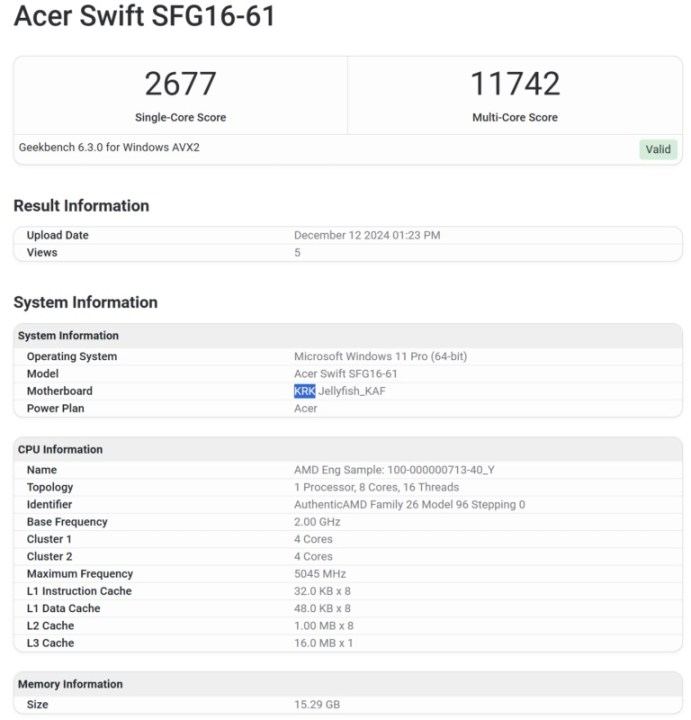
    AMD is gearing up to launch its Strix Point Halo and Krackan Point APUs, with a release expected in January at CES 2025. Recently, details emerged about an Acer Swift Go 16 laptop featuring one of these new AMD chips, identified through a Geekbench listing.

    The disclosed information reveals that this laptop is equipped with an engineering sample of the Krackan Point processor, carrying the OPN Code “100-000000713-40_Y,” likely corresponding to the Ryzen AI 7 350. This chip comprises eight cores structured into two clusters of four, employing both Zen 5 and Zen 5c designs. It has a base frequency of 2GHz and can achieve a maximum boost frequency of 5.05GHz, along with 16MB of L3 cache and 8MB of L2 cache.

    Leaked Geekbench 6 scores of upcoming AMD Krackan Point Ryzen AI 7 350.
    Geekbench

    The Acer laptop with the Ryzen AI 7 350 achieved scores of 2677 in single-core and 11742 in multi-core evaluations via Geekbench 6.3. According to Tom’s Hardware, the Krackan CPU is set to compete against Intel’s Lunar Lake chips, notably the Core Ultra 7 258V, and outperforms AMD’s own Hawk Point-based Ryzen 7 8845HS. However, it’s worth noting that it falls short of the Ryzen AI 9 HX 370 in multi-core performance, as the Strix Point CPU boasts a total of 12 cores.

    Additionally, this APU is anticipated to incorporate the Strix Point’s XDNA 2 NPU (Neural Processing Unit), which is capable of 50 tera operations per second (TOPS). It will also feature a Radeon 860M RDNA 3.5 integrated GPU with 8 compute units. Meanwhile, the high-performance Strix Halo range is expected to introduce the Ryzen AI Max branding, potentially delivering an even more powerful integrated GPU to rival Nvidia’s RTX 4060 in laptops.

    Subscribe for weekly insights on the tech behind PC gaming


    Check your inbox!

    While these details haven’t been confirmed, they align with previous leaks from Zhangzhonghao, a leaker known for sharing information about upcoming releases. AMD is set to present a variety of next-generation processors, which includes the Krackan Point APUs and Ryzen AI Max CPUs for laptops featuring RDNA 3.5 graphics.

    The high-performance Strix Halo models could comprise the Ryzen AI Max+ 395 (16 cores), 390 (12 cores), and 385 (8 cores). New Fire Range CPUs, based on the Zen 5 architecture, will specifically target gaming laptops.

    AMD may also unveil X3D laptop CPUs, alongside next-gen Ryzen Z2 chips for handheld gaming devices, promising improved performance over the already successful Ryzen Z1 Extreme.

  • Intel’s Upcoming Laptop Chips May Feature A Secret Advantage

    Intel’s Upcoming Laptop Chips May Feature A Secret Advantage

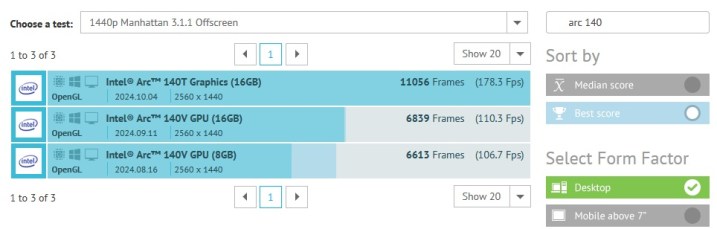
    A new graphics solution from Intel, known as the Intel Arc 140T, has surfaced on GFXBench, and it’s generating buzz due to its impressive performance metrics. Notably, it shows a significant performance edge compared to the Xe2-based Arc 140V integrated GPU, which was recently integrated into Intel’s new Lunar Lake mobile CPUs.

    Michael (@miktdt) highlights the GFXBench results for the Arc 140T in comparison to two variants of the Arc 140V— one with 16GB of memory and the other with 8GB. The Arc 140V with 8GB managed to achieve 6,613 frames at an average of 106.7 frames per second (fps), while the 16GB model scored 6,839 frames at 110.3 fps. In stark contrast, the 16GB Intel Arc 140T achieved a remarkable 11,056 frames with an average of 178.3 fps, surpassing the 16GB Arc 140V by a staggering 62%, even though both GPUs house eight Xe cores.

    While Intel has yet to make an official announcement regarding the specifics of the Arc 140T, its naming convention and core configuration hint that it is likely another integrated graphics solution, as opposed to a discrete GPU like the Arc A770 or A750. It is expected that the 140T will serve as the integrated GPU for Intel’s forthcoming Arrow Lake-H/HX mobile platform, which is designed for enhanced performance, unlike Lunar Lake, which prioritizes power efficiency.

    Leaked GFXbench benchmark scores of Intel Arc 140T.
    Michael (@miktdt) on X

    The Intel Arc 140T’s superior performance is likely attributed to its use of high-power transistors. In contrast to the Lunar Lake Xe2 integrated GPU, which utilizes low-power transistors, Arrow Lake’s architecture employs standard or high-power transistors. This design choice enables the Arc 140T to achieve higher clock speeds, resulting in substantial performance gains over the Arc 140V.

    While Intel is anticipated to unveil its Arrow Lake-H/HX chips in early 2024, the emergence of the Arc 140T hints at significant enhancements in Intel’s mobile graphics capabilities. Should these early benchmarks hold true, the Arc 140T could redefine the performance standards for integrated GPUs, potentially rivaling entry-level dedicated graphics solutions. However, keep in mind that these conclusions are based on preliminary data, and it is advisable to await Intel’s official announcement for confirmation.