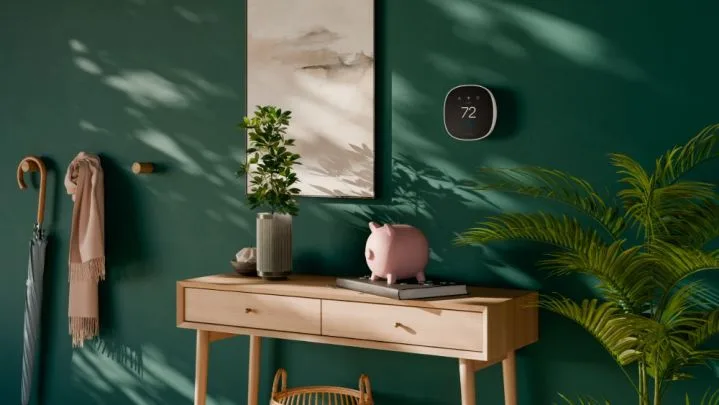
After gaining attention at CES 2025, the Ecobee Smart Thermostat Essential is now available for purchase. Priced lower than both the Enhanced and Premium models, the Essential provides an economical way to upgrade your home with smart features, including compatibility with Apple HomeKit and vacation scheduling options.
The Smart Thermostat Essential is designed for user-friendliness, featuring a large, colorful touchscreen display for quick access to frequently used functions. Its standout feature is its ability to learn and adapt, gradually optimizing settings for your home’s specific needs. For instance, it can gauge how long it takes to heat or cool your space, enabling it to create a routine that keeps you comfortable no matter the outdoor temperature. Additionally, when paired with Ecobee Smart Sensors, the thermostat can monitor occupancy and modify settings accordingly.
According to the manufacturer, using the Essential could lead to savings of up to 23% on annual heating and cooling bills. Depending on your home’s size, this $130 device could effectively pay for itself in as little as six months. Smart thermostats are often a worthwhile investment, especially when they include valuable energy-saving features like those found in the Essential.
“We believe that everyone deserves a smarter home,” commented Greg Fyke, President and CEO of Ecobee. “We’re excited to introduce the Smart Thermostat Essential to our lineup, making it easier than ever for customers to save money while enjoying comfort without compromise.”
Ecobee
In addition to local controls, the Essential can be managed remotely through Apple Home or the Ecobee mobile app.
Setting up the thermostat is similar to other smart models, and if your system doesn’t have a C-wire, you can still install the Essential with a Power Extender Kit priced at $25. Despite being the most affordable option in Ecobee’s lineup, its rounded design and minimalist interface lend it a premium look, complementing the array of advanced features it has to offer.
The Ecobee Smart Thermostat Essential is now available at major retailers and on the official Ecobee website. For those exploring alternatives, check out a roundup of other smart thermostats in a similar price range.
The 2025 CES was filled with exciting advancements, from robot vacuums equipped with robotic arms to stunning LED televisions and innovative smartwatches. However, what truly caught my eye were gadgets aimed at transforming novices into skilled gardeners. I’ve dreamt of turning my home into a lush oasis, but my frequent travels and tendency to let houseplants wither have made that a challenge. Thankfully, two remarkable devices showcased at CES 2025 might finally help me cultivate that green thumb I’ve always wanted.
First up is the PlantaForm Indoor Smart Garden, a space-age contraption that employs fogponics to nurture plants using significantly less water than traditional hydroponic setups. This ingenious technology directs mist right to the roots, eliminating the need for soil entirely. Moreover, its dome design bathes the foliage in ample light while preventing glare from spilling into your living area, thanks to specially dimmed tinted panels. Coupled with a comprehensive mobile app guiding you through the gardening journey, growing indoor greenery with the PlantaForm is practically foolproof.
Patrick Hearn / Digital Trends
While the PlantaForm is impressive, it does have one limitation: its size. It’s not exactly designed for small spaces, so placing it on a kitchen table or crowded countertop is not advisable. If you’re willing to dedicate a coffee table or have a large kitchen with open space, this gadget could revolutionize your indoor gardening experience. My kitchen is rather petite, but I’m hopeful I’ll find a nook for it in my home office.
Though I’m intrigued by the PlantaForm, I find myself even more drawn to LeafyPod. This AI-driven planter customizes its watering schedule based on the specific needs of your plants. By considering factors such as the season, your home’s location, and the surrounding environment, it adeptly modifies its watering routines for optimal growth. After downloading the app, you simply introduce LeafyPod to your plant, select the plant type in the app, and then relax—its AI will handle everything from there.
LeafyPod
LeafyPod also adapts its care strategy based on how the plant and soil respond during the initial watering sessions, allowing it to establish a finely-tuned watering schedule. The best part? Its water reservoir can last up to four weeks, so you won’t have to dread returning home to a lifeless plant. Additionally, LeafyPod holds a charge for around six months, making it a low-maintenance option for plant lovers.
Even with limited outdoor space, I’m keen to try out the inventive Petal garden camera and Wonder Blocks. Created by the Bird Buddy team, Petal acts as a bug camera—a compact and flexible device that you can position in your garden to monitor tiny critters up close.
Wonder Blocks complements Petal beautifully, providing a modular system to create unique habitats for your plants and local wildlife. With a pedestal base, you can enhance its function with various accessories that include a plant base, seed tray, bee hotel, butterfly feeder, and bug hotel. Combining Wonder Blocks with Petal will surely offer an intriguing glimpse into the insect life in your garden, delivering a fresh perspective on your outdoor space.
The Consumer Electronics Show (CES) is a hotspot for the latest in technology, and every year there tends to be a standout category of products. At CES 2025, robot vacuums took center stage. While these devices have been around for quite some time, companies like Roborock, Dreame, and Narwhal are pushing the boundaries of innovation, introducing new features that enhance their efficiency.
We engaged with the teams behind these smart devices and observed their capabilities firsthand. Here are our top five robot vacuum selections from CES 2025. For the hands-on evaluations, stay tuned until we have the opportunity to review these state-of-the-art cleaners later this year.
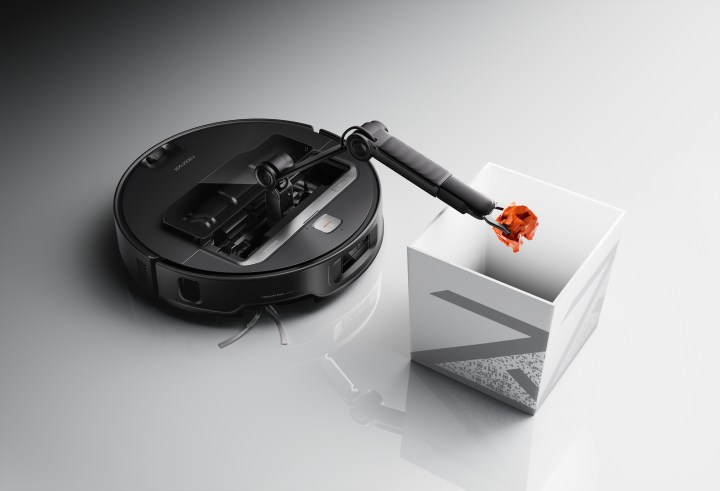
The Roborock Saros Z70 stands as the brand's flagship model, impressively demonstrating its capability to lift obstacles and continue cleaning. This vacuum has become the talk of the show for good reason, featuring an innovative Omnigrip extendable arm that can remove small items from its path.
This year has seen substantial innovation, often enhancing efficiency, but the ability to physically clear obstacles is a novel feature that sets this vacuum apart. The arm can handle objects weighing up to 300 grams, relocating them to designated spots. Although its current function is mainly to pick up smaller items like socks or towels, it significantly reduces the effort required to prepare a home for cleaning.
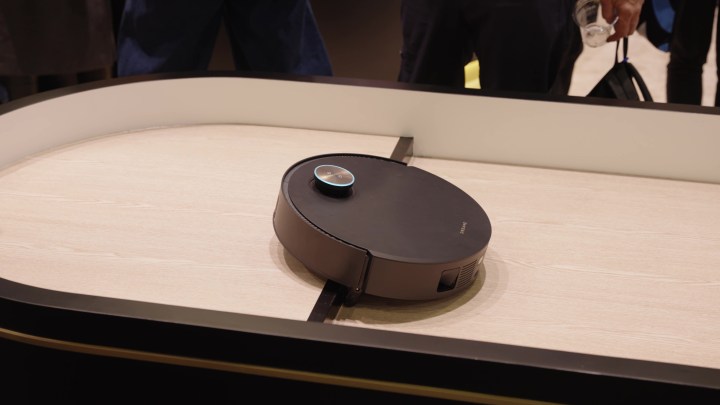
Dreame introduced its latest model, the X50 Ultra, which is capable of navigating over obstacles with impressive ease. While it can't manage stairs, it can conquer barriers that are up to 2.36 inches tall—significantly higher than previous models.
The X50 Ultra is equipped with the ability to identify a variety of objects—up to 200 different kinds—and adjust its cleaning approach accordingly. Additionally, a specially designed brush prevents hair tangles, all while operating at a low noise level.
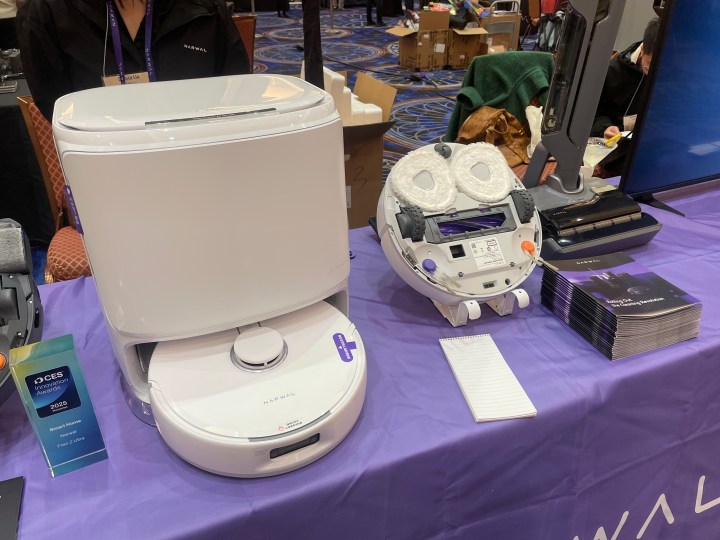
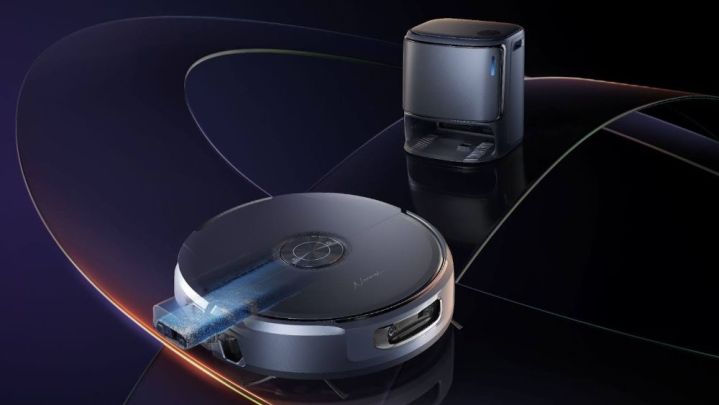
The Narwhal Flow is on the verge of being launched as the company’s flagship product later this year. A defining feature is its extendable spinning brush located along the edge, which effectively pulls dust and dirt from corners for a deeper clean than typical robotic vacuums achieve.
Additionally, it features spinning mop pads that are not merely pushed across the floor; rather, they actively spin and pick up dirt while simultaneously rinsing themselves with a built-in clean and dirty water tank.
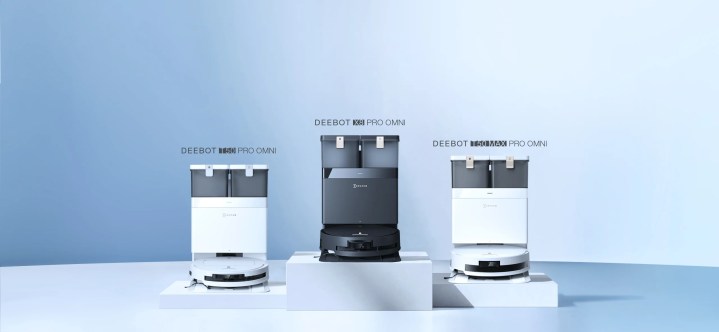
The Deebot X8 Pro Omni from Ecovacs wowed attendees with its innovative Ozmo Roller Instant Self-Washing Mop Technology. Similar to the Narwhal Flow, this device has a tank that consistently cleans the mop as it operates, employing 16 nozzles to spray while a scraper removes built-up debris—all occurring at a rate of 200 times per minute.
This multifunctional cleaner excels at mopping with capabilities that surpass many other devices on the market. It can also raise the mop by 18mm, enabling seamless transitions between hard surfaces and carpets without soaking them.
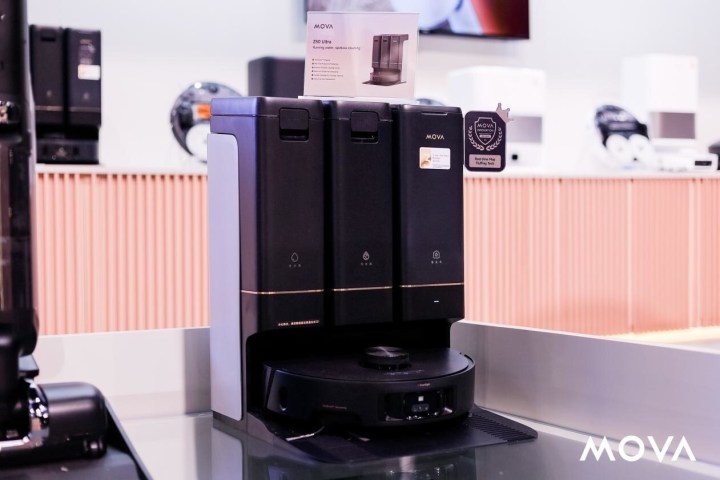
Mova might be a relatively new name in the western market, but the company showcased its Mova Z50 Ultra, a powerful robot vacuum boasting an impressive 24,000Pa of suction—among the highest in the industry. Coupled with intelligent navigation, this robot has tremendous potential for effective cleaning.
Additionally, the Mova includes lifting technology similar to the Dreame X50 Ultra, enabling it to handle lower obstacles effectively. Its mopping fabric is designed to maintain consistent contact with the floor by fluffing itself continuously. This could potentially eliminate the common streaking issue often associated with many robotic mops available today.
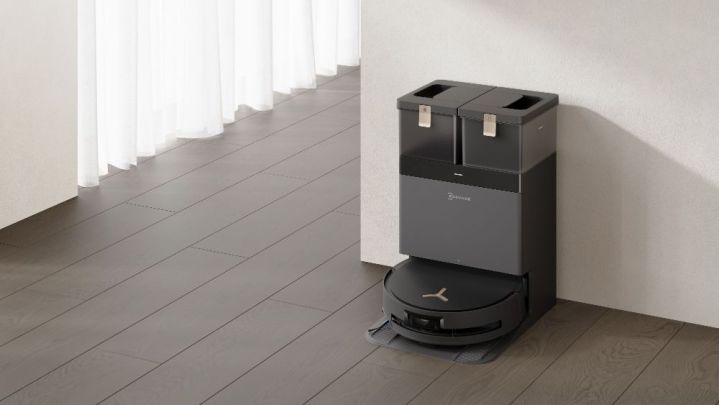
Ecovacs made a strong impression at CES 2025 by unveiling an array of innovative smart home products, including robot vacuums, lawnmowers, and even some head-turning window-cleaning gadgets. The highlight of the event was undoubtedly the Deebot X8 Pro Omni, a cutting-edge robot vacuum that significantly enhances its mopping capabilities thanks to a new partnership with Tineco.
While it didn’t incorporate a robotic arm like the Roborock Saros Z70, the Deebot X8 Pro Omni introduced several exciting mopping improvements. One of the major enhancements is the ability to apply additional pressure while cleaning. It can reach up to 4,000Pa of pressure and rotate at speeds of up to 200 rpm, promising superior cleaning performance compared to previous models from Ecovacs. Another noteworthy upgrade is the self-cleaning mop feature, which ensures the mop remains pristine while tackling your floors, so every mess is handled with a fresh mop.
Additional standout features of the Deebot X8 Pro Omni include an impressive 18,000Pa suction power during vacuuming, a swinging side brush for enhanced coverage around furniture, and a sliding roller mop designed for cleaning close to baseboards. The charging dock is equally innovative, automatically emptying debris from the robot’s dustbin and washing and drying its mopping pads in preparation for its next cleaning session.
Coupled with a LiDAR navigation system and the new TruEdge 3D Edge Sensor for improved home mapping, this vacuum is poised to be a strong contender for consumers when it launches on February 18, although the pricing details are still pending.
Ecovacs
In addition to the Deebot X8 Pro Omni, Ecovacs introduced the GOAT A1 3000, the flagship model of its robotic lawnmower series. This impressive device features satellite-based RTK positioning, front-facing LiDAR, and camera vision for precise navigation around your yard. It includes a dual-plate cutting system that promises extensive coverage and a motor robust enough to handle various grass types.
Also showcased was the unique Winbot W2 Pro Omni, an automatic window cleaner designed to deliver streak-free results with minimal manual effort. This device includes a portable docking station that charges the robot while it cleans, ensuring it won’t run out of battery during larger tasks. It’s particularly effective on large windows and employs a pioneering three-nozzle sprayer to tackle stains and achieve crystal-clear glass surfaces.
Stay tuned for more updates regarding pricing and availability in the upcoming weeks.
At CES 2025, iGarden showcased several innovative products, but the TurboX and TurboX Master robotic pool cleaners captured the most attention. Both models are engineered to simplify pool upkeep, but it was the TurboX Master that truly impressed with its remarkable 15-hour runtime.
Digital Trends received compensation for considering coverage of these products. The brand had no input on the editorial content and did not influence the coverage.
The TurboX Master is set to be available in April, promising to shake up the robotic pool cleaner market. Unlike most competitors that need to recharge after a few hours, this model can operate for a staggering 15 hours. iGarden claims it holds a Guinness Record for the longest uninterrupted operation of a robotic pool cleaner, attributed to its innovative AI-inverter technology that enhances battery performance while delivering top-tier cleaning.
This robot is equipped with advanced infrared sensors, a gyroscope, and a feature that enables it to return to its starting point when the battery is low, making it a well-crafted device. Its sleek design draws inspiration from supercars, putting it on par with premium pool cleaners from brands like Polaris, Aiper, and Beatbot.
Please enable Javascript to view this content
This cleaner can effectively tackle both the waterline and stubborn stains like algae from the pool floor. iGarden mentions that it is compatible with various pool shapes and sizes, ensuring a comprehensive clean.
Related
Beatbot unveils futuristic AquaSense 2 Series pool cleaners at CES 2025
Eureka introduces major mopping advancements with the J15 Max Ultra
Ultraloq presents the first ultra-wideband smart lock at CES 2025
Cleverly, users can set cleaning schedules or highlight specific areas that require extra attention, like walls or floors. With a month-long standby capability, you won’t frequently need to recharge the robot or handle manual maintenance. Depending on your settings and pool dimensions, you might only need to power it up once a month—a significant advantage over many robotic pool cleaners that require recharging after each cycle.
In addition, the TurboX Master boasts a user-friendly touchscreen interface, a two-year warranty, and a UV-resistant exterior, making it a product to watch. More information on pricing is anticipated soon.
At CES 2025, Ring unveiled an exciting partnership with Kidde, introducing a new range of smart smoke detectors. Set to launch in April, this lineup features the Kidde Smart Smoke Alarm and a Combination Alarm that can detect both smoke and carbon monoxide. These devices are designed to integrate seamlessly with the existing Ring app, allowing users to receive alerts when their sensors are activated. This could be an attractive choice for those already invested in the Ring ecosystem.
In addition to push notifications through the mobile app, homeowners can opt for a new Ring 24/7 Smoke & CO Monitoring Subscription for $5 a month. This service includes professional monitoring, enabling a trained dispatch team to monitor your smoke detectors. If the alarms are triggered, they can promptly contact emergency services to ensure help is on the way, offering a level of reassurance that standard smoke alarms lack.
While Ring brings the high-tech capabilities, Kidde contributes advanced detection technology. The alarms are engineered to identify smoke with three times greater accuracy and up to 25% faster than competitor products. They also minimize false alarms typically caused by cooking. Plus, users will receive a notification via the Ring app a week before the batteries run low, eliminating that annoying chirping sound that can disrupt your sleep.
Please enable Javascript to view this content
The retail price for the Kidde Smart Smoke Alarm will be $55, while the Combination Alarm will be available for $75. Both will be exclusive to Home Depot upon their release in April.
In addition to the smoke detectors, Ring announced enhancements to the Floodlight Cam Pro and Spotlight Cam Pro, which will now support 2K video capture. Current users can take advantage of this upgrade for free via an over-the-air update accessible through the Ring app. Moving from HD to 2K resolution represents a significant improvement, enabling users to gain clearer visibility of their surroundings and enhanced zoom capabilities. If you own either camera, check your Ring app to access the new resolution features.
This week in Las Vegas has been quite an eventful one as the Consumer Electronics Show (CES) 2025 unfolds. We have showcased a wide array of exciting technology from both the preview events and the opening day, and we are beginning to draw our coverage to a close.
Some of the standout announcements from day one featured Nvidia’s RTX 5090 graphics card, which boasts impressive performance at a steep price. HyperX unveiled their new line of customizable gaming mice, while both Sony and Honda introduced their cutting-edge electric vehicles. Additionally, Razer has decided to switch to AMD for its ultra-slim Blade 16, and Acer revealed an extraordinary 11-inch gaming PC handheld. And that’s just a selection of the major highlights from yesterday!
As we conclude another edition of CES, make sure to keep following us for all the key developments emerging from the convention today.
Delta Air Lines has commenced its centennial celebrations with several exciting announcements at CES 2025.
During a presentation in Las Vegas, CEO Ed Bastian unveiled initiatives aimed at enhancing customer experiences through premium offerings and personalized services.
One highlight is the introduction of Delta Concierge, an AI-powered assistant integrated into the Fly Delta app. This feature is designed to empower travelers with greater control and confidence throughout their journeys.
Similar to other AI-driven chatbots, Delta Concierge allows users to communicate using natural language text or voice commands. Travelers will soon be able to ask the assistant to book flights using just their voice. Additionally, the tool aims to anticipate customer needs, provide context-aware guidance, and take specific actions on their behalf. For instance, it could alert you if your passport requires renewal or inform you about entry requirements for international destinations. Customers will also receive packing suggestions based on local weather conditions.
Furthermore, Delta has announced a collaboration with Uber to improve its services, ensuring that an Uber vehicle is waiting for passengers as they exit the airport terminal. Customers can also earn extra SkyMiles through their Uber rides.
Additionally, Delta is set to launch a pioneering cloud-based in-flight entertainment system. YouTube will feature as part of the Delta Sync experience, offering passengers access to fresh, ad-free content.
Starting with selected new aircraft in 2026, travelers will enjoy the updated Delta Sync experience characterized by 4K HDR QLED seatback displays. This development is welcomed, especially considering the issues many passengers encounter with standard displays during flights. The upgraded screens are supported by a 96-terabyte storage system, significantly exceeding the typical capacity of Delta’s in-flight entertainment offerings.
Bluetooth capabilities will also be introduced across all cabin classes, enabling seamless pairing with wireless devices.
Bastian updated attendees on Delta’s partnership with Joby, a leader in electric vertical takeoff and landing (eVTOL) aircraft. The Delta Concierge will link with Joby’s upcoming air taxi service, expected to connect Delta’s hubs in New York (LGA and JFK) and Los Angeles (LAX), pending approval from federal and local authorities.
The Baseus EnerGeek has earned the CES Innovation Awards 2025 Honoree title, and it’s easy to see why. This 20,000mAh power bank is a perfect travel companion, offering a power output of up to 67W via its three available ports; however, the standout feature is its ability to also serve as a Wi-Fi hotspot while you’re on the move.
This versatile MiFi power bank boasts a portable design and includes an integrated cable that can be converted into a handle or lanyard. Its compact size belies its hefty 20,000mAh capacity.
The Baseus EnerGeek is equipped with a built-in USB-C cable, two USB-C ports, and one USB-A port, all offering a maximum power delivery of 67 watts. It also features a small display that provides real-time updates on battery life and Wi-Fi status, and its design includes an expanded area for heat dissipation to ensure safe charging with multiple security protection features.
How does a Wi-Fi hotspot work on a power bank?
One of the standout features of the Baseus EnerGeek is its capability to function as a Wi-Fi hotspot for smartphones, laptops, and other devices. It supports both 2.4GHz and 5GHz bands, allowing the connection of up to eight devices at once. With upload speeds reaching 150Mbps and download speeds of 50Mbps, it provides ample speed for your internet needs. Additionally, it supports dual Wi-Fi and Bluetooth connectivity for enhanced convenience.
To activate the Wi-Fi hotspot feature, you’ll need an app to manage the eSIM option globally, which negates the need for physical SIM cards while traveling. You can purchase and recharge data via the Baseus app, which offers customizable data plans with no ongoing subscription fees.
The EnerGeek power bank ensures comprehensive coverage across U.S. mobile networks, supporting 13 global frequency bands. It is compatible across areas such as the U.S., Europe, India, Hong Kong, Taiwan, Japan, Canada, Singapore, and Australia, providing cross-regional 4G network services with claimed international roaming capabilities in over 100 countries.
Why it matters
Prakhar Khanna / Digital Trends
The Baseus EnerGeek stands out as one of the most innovative power banks uncovered at CES 2025, addressing a significant challenge travelers often face.
If you're a digital nomad or remote worker, you know that ensuring reliable internet access is one of the first challenges to tackle when planning a trip. While I usually download an eSIM to my iPhone for hotspot needs, using a dedicated device like this one would conserve battery life on my iPhone 16 Pro, which is known for its less-than-stellar battery performance.
The Consumer Electronics Show (CES) 2025 has officially begun in Las Vegas, Nevada. While much of the groundbreaking news broke yesterday, it was primarily a preview for press members. Significant reveals include Samsung’s impressive 37-inch 4K gaming monitor, Withings’ Omnia smart mirror, AMD’s Ryzen 9 9950X 3D processor, and Hisense’s gigantic 116-inch TriChroma LED television.
There’s a wealth of innovative technology set to be unveiled today and into tomorrow, so stay connected for ongoing updates.
Narwal has become a favorite in the robot vacuum market with models like the upscale Narwal Freo Z Ultra, which boasts a sleek design and operates quietly. Continuing its tradition of innovative technology, Narwal unveiled the Narwal Flow at CES 2025 — a sophisticated robot vacuum featuring an advanced mopping system.
Digital Trends received compensation for considering coverage of these products. The brand had no input on the editorial content and did not influence the coverage.
The Narwal Flow features an innovative mopping system known as the FlowWash Mopping System, which keeps its mopping plate clean while it operates. This design ensures that users won’t inadvertently spread dirt around their floors, enhancing the overall cleaning process. The vacuum is equipped with separate tanks for clean and dirty water, allowing it to extract used water from the mop as it re-soaks it, thus maintaining optimal cleaning conditions without requiring returns to its docking station for self-cleaning.
Additionally, the mop can extend outward for better access to edges and beneath furniture, providing superior floor coverage.
To enhance vacuuming performance, Narwal has introduced a feature called Deep Carpet Boost. When activated, this setting boosts dirt pickup through counter-directional movements of the main roller brush, paired with a flexible adaptive brush cover that targets carpet fibers. Narwal claims that this method creates “high-pressure air zone boosts,” excelling at extracting hair and debris that are deeply embedded in carpets.
Of course, the Narwal Flow comes with a docking station that automatically empties its dustbin, cleans the mop with heated water, and dries it with warm air. Furthermore, it autonomously fills the robot’s water tank, ensuring it’s primed and ready for the next cleaning session. Additional upgrades include a refined camera and obstacle avoidance system, the capacity to navigate thresholds up to 40mm high, and a brush design engineered to minimize tangling.
The Narwal Flow is set to launch in June 2025, with pricing information to be announced soon.
The Consumer Electronics Show (CES) 2025 is kicking off in Las Vegas, Nevada, and there’s a lot of exciting new technology on the horizon. Representing everything from small startups to major industry players, the event features a wide array of cutting-edge innovations.
Though the official festivities begin on January 7, many media professionals are getting early access to previews of what’s in store. We’ll continually update this coverage with the most significant announcements from the event, so keep an eye out for the latest news.
Explore our comprehensive coverage of CES 2025 here
Updated just now
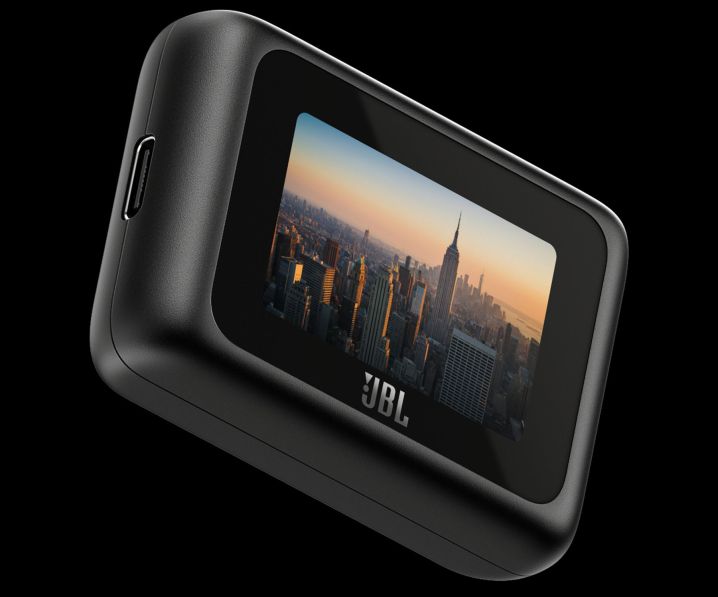
At CES 2025, JBL unveiled its third-generation JBL Tour One M3 noise-canceling wireless headphones, set to launch on April 13, 2025, priced at $400. A unique addition is a smart transmitter that features a color touchscreen and both digital and analog audio inputs. This device allows users to wirelessly stream audio to the Tour One M3, providing the ability to connect to wired sources like computers or in-flight entertainment without a physical connection to the headphones.
The JBL Smart Tx transmitter designed for the Tour One M3. JBL
This setup is reminiscent of JBL's design for the Tour Pro 3 wireless earbuds; in that case, the smart transmitter functionalities are built directly into the charging case. For wireless earbuds, this transmitter is a game-changer since they typically can't connect to wired sources independently. The necessity of such a system for headphones, however, may be less compelling since many wireless models include analog and digital cables as standard.
The Tour One M3's smart transmitter also supports Auracast broadcasts, enabling users to share their audio with anyone nearby who has an Auracast-compatible set of headphones or earbuds. Additionally, the transmitter can scan for and connect the Tour One M3 to any Auracast broadcasts available within range.
While the transmitter is a key highlight of the M3, JBL has also made significant enhancements throughout the product:
Extended battery life, increasing to 70 hours from the previous model's 50 hours, with just a 5-minute quick charge providing an additional 5 hours of listening time.
Equipped with new 40mm Mica dome drivers.
Features JBL Personi-Fi 3.0, the latest iteration of JBL's personalized audio technology.
Incorporates True Adaptive Noise Cancelling 2.0.
Spatial audio functionality includes head tracking capabilities.
Enhanced passive noise isolation.
Available in black, mocha, and blue.
In addition to the Tour One M3, JBL is set to launch two new models of wireless headphones for kids in March 2025:
Related
Marshall refreshes its Monitor headphones with insights from Billie Joe Armstrong
Soundcore introduces the Space One Pro headphones, perfect for travelers
JBL has packed many features into its Tour Pro 3 wireless earbuds
Maximum volume and listening duration can be controlled via the JBL app
Real-time tracking for volume and activity with reports on listening habits
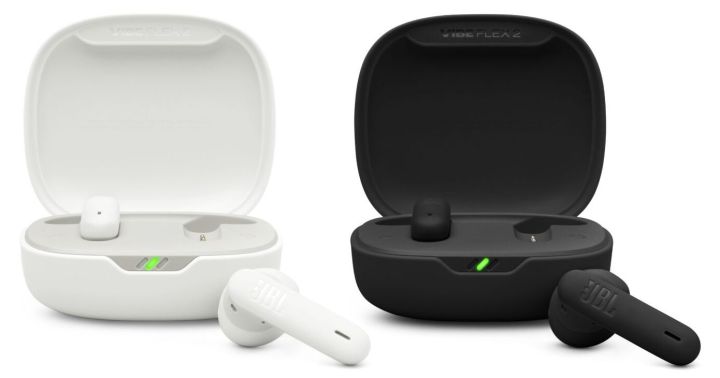
The event also showcased updates across JBL’s entire lineup of wireless and wired headphones, set to release in March 2025. The most remarkable updates include the introduction of active noise cancellation for the Vibe 2 series — the first instance of ANC in JBL's semi-open earbuds — and the addition of spatial audio to the Tune 2 series.
As January rolls around, it's time for CES 2025 to kick off. Samsung made a splash by unveiling its lineup for the year, featuring advanced Neo QLED and OLED TVs, audio devices, and other offerings, all set to showcase cutting-edge AI capabilities. While pricing and availability details are still pending, here’s a closer look at what Samsung has in store.
Vision AI Features
Before diving into the specific television models in Samsung's 2025 collection, it's essential to grasp the company's artificial intelligence focus this year, which will influence their upcoming tech.
This year's initiative is branded "Vision AI." In addition to enhancements to existing AI Upscaling, Auto HDR Remastering, and Adaptive Sound Pro features, Samsung has introduced a new Color Booster Pro function, which utilizes AI to deliver even richer and more vibrant colors.
But Vision AI is not just about enhancing visuals. Samsung has added several new AI-powered features, including:
Click to Search: This feature can identify actors in shows, the location settings, and even apparel worn by characters, all through a dedicated AI button on the Samsung SolarCell remote.
Live Translate: Using AI, this feature translates closed captions on live broadcasts into seven different languages.
AI-based Voice Removal with Audio Subtitles: Samsung’s 2025 TVs will analyze subtitles, separate voices, and adjust reading speed for a smooth viewing experience.
Samsung Food: This unique feature identifies food items in the content being watched and provides relevant recipes. It's linked to Samsung's smart refrigerators, which can scan and recognize food, issuing alerts before items expire and helping users acquire missing ingredients.
Samsung AI Home Security: This turns your TV into a smart security hub that connects with your security cameras and uses microphones to detect unusual sounds, sending alerts regardless if you're home or away.
Generative Wallpaper: This feature creates personalized wallpapers for your TV using AI.
“Samsung envisions TVs as interactive partners, not just devices for passive viewing,” noted SW Yong, president and head of Samsung’s visual display division. “With Vision AI, we’re transforming screens into intelligent companions that blend entertainment and lifestyle solutions for a seamless user experience.”
2025 Samsung Neo QLED 8K Lineup
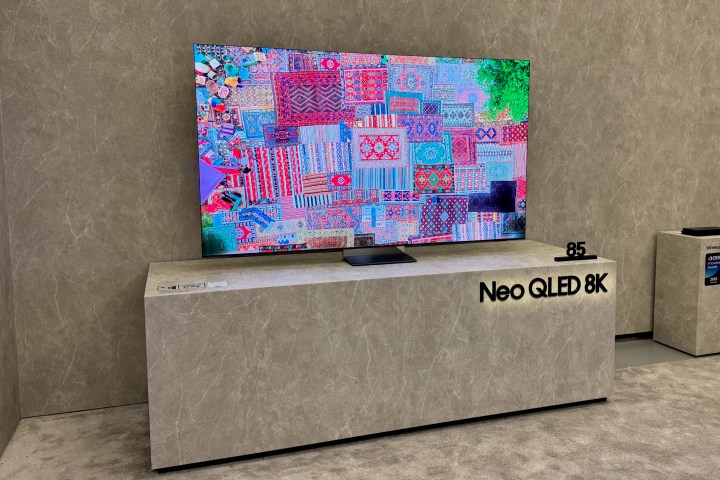
The 85-inch Samsung Neo QLED 8K TV at CES 2025.John Higgins / Digital Trends
While 8K TVs may not yet be the first choice for all consumers compared to their 4K counterparts, they continue to represent some of the highest levels of technology available. Samsung's 2025 Neo QLED 8K offerings maintain this tradition.
Samsung has introduced two new models, the QN990F and QN900F, building off the impressive features of last year's models while skipping the previously popular QN800D and QN900D from 2024. These new entries carry over the AI processors from last year's lineup, implementing some key improvements.
One major enhancement across both models is the inclusion of Samsung’s innovative Glare-Free technology, initially launched with the S95D 4K QD-OLED model. This function excels in bright environments by effectively reducing glare from both ambient and direct light, offering a more comfortable viewing experience. Notably, the 2025 iteration is even brighter and will also be introduced in an updated 4K QLED model.
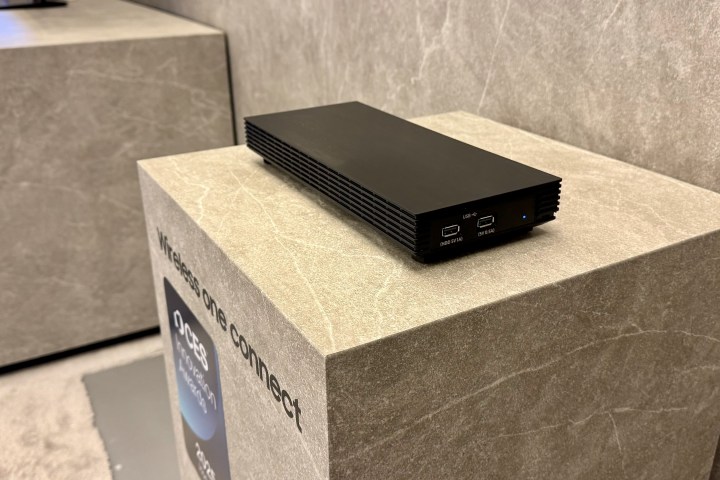
The flagship QN990F will be available in sizes ranging from 65 to 89 inches and is the first Samsung model to incorporate the Wireless One Connect Box, allowing for a cable-free setup. This box uses Wi-Fi 7 and advanced technology to wirelessly transmit 8K content at 120Hz from up to 10 meters away, traversing obstacles like furniture.
Similar to its predecessor, this setup minimizes tangled wiring connecting your devices to the TV, giving users the freedom to place the box anywhere in the room.
The Samsung Wireless One Connect Box at CES 2025.John Higgins / Digital Trends
The QN990F also features Samsung’s 8K Upscaling technology, which enhances lower-resolution content to near 8K quality, preserving detail and clarity. It includes Color Boost Pro, analyzing each frame for optimized color, paired with AI enhancements. Its audio capabilities include a 6.2.4-channel system with 90 watts and Dolby Atmos support, in addition to 4K gaming at 240Hz VRR capability.
The QN900F, available in sizes of 65, 75, and 85 inches, lacks the Wireless One Connect feature but still utilizes the wired version. It shares many enhancements seen in its counterpart, including 8K upscaling and HDR remastering, coupled with a robust 70-watt, 4.2.2-channel Dolby Atmos sound system and a fresh metal frame design.
2025 Samsung Neo QLED 4K Lineup
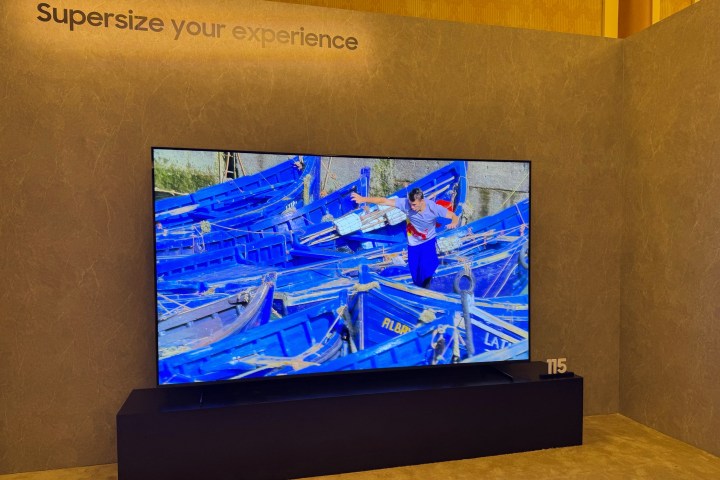
The 115-inch Samsung Neo QLED 4K TV showcased at CES 2025.John Higgins / Digital Trends
Next, we shift focus to the 4K QLED models. Samsung has rolled out three options for 2025: the QN90F, QN80F, and the new entry-level QN70F, aimed at offering an upgrade from the previous Q70D. Each of these models will include the AI features such as Click to Search, Samsung Food, and Live Translate.
The premium QN90F is offered in sizes from 43 to 98 inches, with a new colossal 115-inch option designed for those with ample space and budget. This model benefits from a feature called Supersize Picture Enhancer, which optimizes image quality for larger displays to eliminate blurriness.
Additionally, the QN90F incorporates the upgraded Glare-Free technology and boasts the latest NQ4 AI processor, which empowers its enhanced AI 4K Upscaling and overall picture quality. It also includes a 60-watt, 4.2.2-channel Dolby Atmos sound system.
The QN80F, available in sizes of 50 to 100 inches, showcases strong specs, although it remains unclear if it received the NQ4 AI Gen3 processor upgrade. It features a 30-watt, 4.0-channel Dolby Atmos-based sound system.
Lastly, the newcomer QN70F, offered in 55 to 85-inch models, comes equipped with a NQ4 AI Gen2 processor and a refreshed design, as well as a 20-watt, 2-channel sound system.
2025 Samsung OLED Lineup
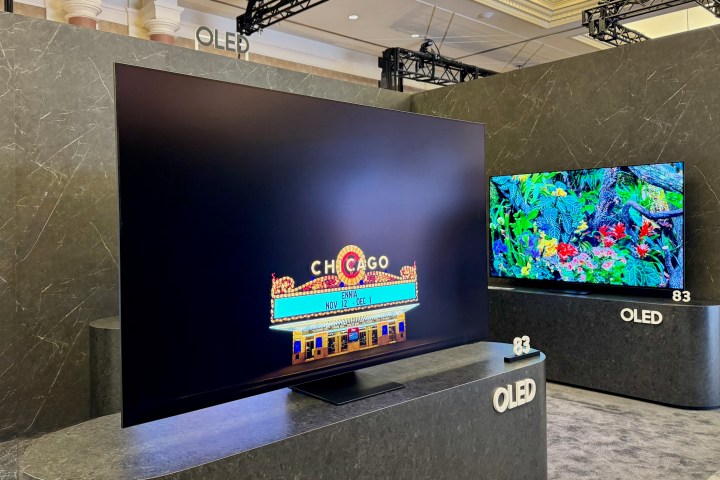
The 83-inch Samsung S95F OLED at CES 2025.John Higgins / Digital Trends
Samsung is introducing three new OLED models for 2025: the flagship S95F, along with the S90F and the S85F. All these models will benefit from the enhancements tied to Vision AI.
The S95F, representing the successor to the earlier successful S95D with unique anti-glare technology, stands out as the brightest OLED to date. Enhanced with the latest NQ4 AI Gen4 processor, it promises improvements in contrast, brightness, and depth of color. It will be available in sizes ranging from 55 to 83 inches and is designed to support Dolby Atmos with a 70-watt sound system.
Details regarding the other OLED models are still limited, but the S90F will feature the same NQ4 AI Gen3 processor, supporting sizes from 42 to 83 inches with a 40-watt 2.1-channel Dolby Atmos sound system.
The S85F will come in sizes of 55, 65, 75, and 83 inches, equipped with a 20-watt 2-channel sound system.
Samsung The Frame Pro and Art Store
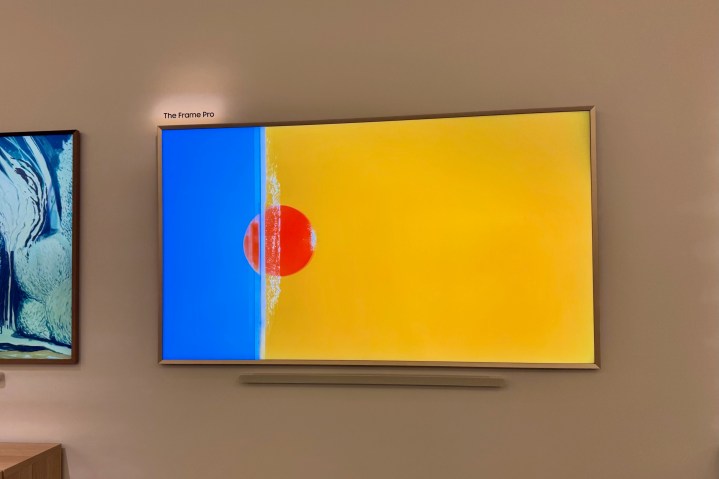
John Higgins / Digital Trends
Enhancing its popular lineup of Frame Art TVs, Samsung unveiled the Frame Pro, which features a Neo QLED panel, and utilizes the NQ4 Gen3 processor. It also benefits from the Wireless One Connect Box, enabling more flexible installations. The launch also marks an expansion of the Samsung Art Store, which now hosts over 3,000 artworks through partnerships with prominent institutions like MoMA. The Frame TVs hold Pantone’s ArtfulColor validation for color accuracy, while the Frame Pro supports a refreshing 144Hz refresh rate, catering to both film lovers and gamers alike.
2025 Samsung Audio Lineup
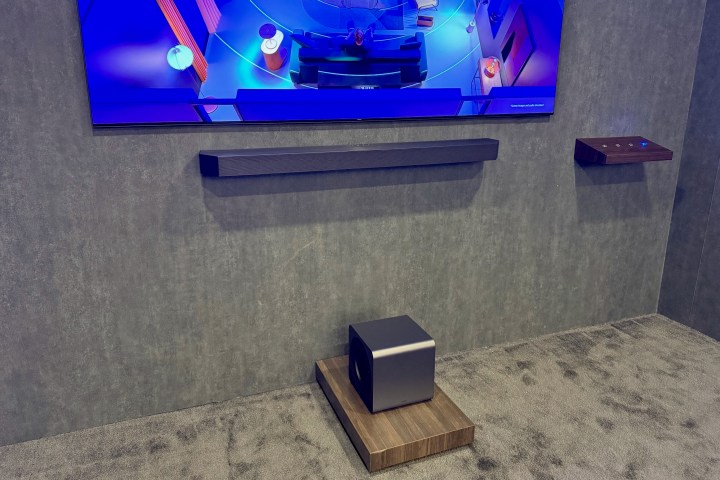
John Higgins / Digital Trends
Beyond TVs, Samsung has unveiled several new soundbar models this year. The HW-Q990F stands out as the flagship, a powerful 11.1.4-channel system that comes with a compact subwoofer half the size of its predecessor, the HW-Q990D.
The HW-QS700F offers versatility as it can be mounted on a wall or placed on furniture. Similar to the HW-Q990F, it features Q-Symphony Pro, which enables collaboration with select Samsung TVs for a captivating audio experience. It analyzes audio through the TV’s AI processor for enhanced surround sound, and includes Active Voice Amplifier Pro for better dialogue clarity.
Additionally, Samsung will integrate Q-Symphony Pro into two new budget-friendly soundbars, the HW-B750F and HW-B650F.
In anticipation of CES 2025, LG has made a splash by introducing two innovative lifestyle projectors. The first is a uniquely designed HD projector that also functions as a stylish floor lamp and a Bluetooth speaker. The second is a new ultra-short throw 4K projector that LG labels as its smallest model to date.
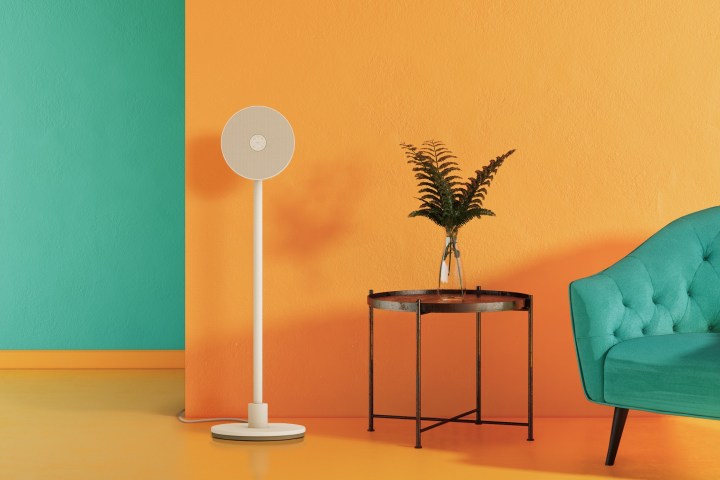
The 3-in-1 PF600U projector has been described as a “lifestyle companion for everyday spaces,” with the potential to transform various living areas through its multifunctionality.
One of the significant challenges faced by customers with traditional projectors, particularly standard-throw ones that require considerable space, is their often bulky and unattractive appearance. The LG PF600U aims to address this issue by combining the projector with the aesthetics of a modern floor lamp, allowing for easy relocation when not in use. Additionally, it serves as a Bluetooth speaker for music playback during non-cinema hours.
The LG PF600U is a stylish lamp… that also functions as a projector… and a Bluetooth speaker.LG
According to LG, “Inspired by a floor lamp, the stand-pole design ensures intuitive usability and effortless integration into any space.” The PF600U comes equipped with impressive specifications, including Full HD (1,920 x 1,080) resolution and a brightness level of 300 ANSI lumens provided by its LED light source. Users can access streaming services via LG’s webOS or connect their own devices through the projector’s HDMI port.
Weighing just over 16 pounds, the PF600U is lightweight and compact. it features a 110-degree tilting head for image adjustment and offers automatic screen adjustments to facilitate easy setup as you reposition it for optimal viewing.
As an LED lamp, the PF600U provides nine color options and five brightness settings, along with stereo speakers enhanced with passive radiators, promising “rich and immersive sound.”
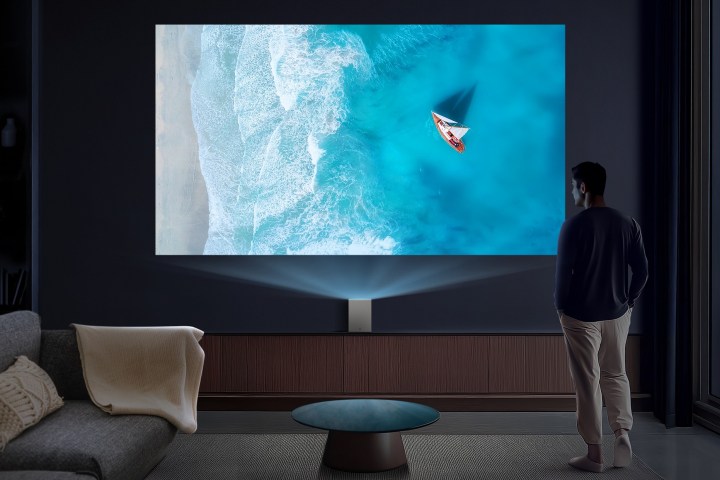
The LG CineBeam S is the company’s smallest UST projector to date.LG
LG also unveiled the CineBeam S (model PU615U), its latest ultra-short throw projector. This compact unit (measuring 4.3 inches by 6.3 inches by 6.3 inches and weighing 5.5 pounds) is the smallest that LG has produced. Although its brightness of 500 ANSI lumens may seem modest compared to other ultra-short throw models, it is likely sufficient for projecting images between 40 inches to 100 inches from just a few inches away from a surface.
Featuring 4K UHD (3,840 x 2,160) resolution and covering an impressive 154% of the DCI-P3 color spectrum, the CineBeam S operates on LG’s webOS system as well. It boasts additional features such as wall color adjustment and screen scaling/shifting to accommodate various room setups. While it doesn’t serve as a Bluetooth speaker, the CineBeam S is equipped with built-in stereo speakers that support Dolby Atmos sound for a fully immersive viewing experience.
“Through the versatility of the PF600U and the compact design of the CineBeam S, LG is establishing a new benchmark for lifestyle projectors that meet a variety of user needs and preferences,” stated YS Lee, vice president and head of LG’s IT Business Unit. “Our goal is to offer projectors that harmonize with different lifestyles and seamlessly blend into diverse environments, enhancing the everyday experiences of modern users.”
No information about pricing or availability for the PF600U or CineBeam S was provided in the press release, but stay tuned for updates during CES 2025.
Many may doubt that the U.S. will see a drop in electric vehicle (EV) prices by 2025, especially given the current tariffs and potential actions from the Trump administration.
This skepticism is understandable, particularly since Chinese automakers, known for their affordability, have halted plans to enter the U.S. following the imposition of 100% tariffs on EVs manufactured in China as of September.
Nonetheless, it’s important to note that if BYD, a leading Chinese manufacturer, were to sell its entry-level EVs in the U.S., they would still have a significant price advantage, retailing for under $25,000 despite the tariffs.
The announcement from Faraday Future is particularly thrilling: this California-based startup has stated it will provide a business update on two prototypes from its FX line, the FX 5 and FX 6, during CES 2025.
In September, the company informed investors that the FX 5 would be priced between $20,000 and $30,000.
Depending on the exact pricing and the fate of federal tax credits, the FX 5 could emerge as the most affordable EV available in the U.S. right now.
As it stands, the Nissan Leaf holds the title for the least expensive EV in the U.S., starting at $28,140. Additionally, it’s eligible for a federal tax rebate of $3,750, which effectively lowers its price to around $25,000 until January 20.
The next contender for the lowest-priced EV is the 2025 Chevy Equinox, priced at $34,995 for the LT front-wheel drive model. The Equinox EV also qualifies for a $7,500 federal tax credit, potentially bringing its cost down to $27,495.
Tesla is also entering the affordability game, aiming to launch a new model priced below $30,000, inclusive of federal subsidies, in 2025.
However, with the incoming Trump administration reportedly planning to eliminate EV tax incentives, this could impact pricing dynamics significantly.
These variables might give Faraday’s FX 5 an opportunity to claim the title of the least expensive EV in the U.S.
If the FX 5 is priced at or below $25,000, it could be neck-and-neck with BYD’s budget-friendly offerings.