الوسم: Caracas

  • Venezuela Scrambles to Rescue Hundreds Buried After Deadly Quakes, 235 Confirmed Dead

    Venezuela Scrambles to Rescue Hundreds Buried After Deadly Quakes, 235 Confirmed Dead

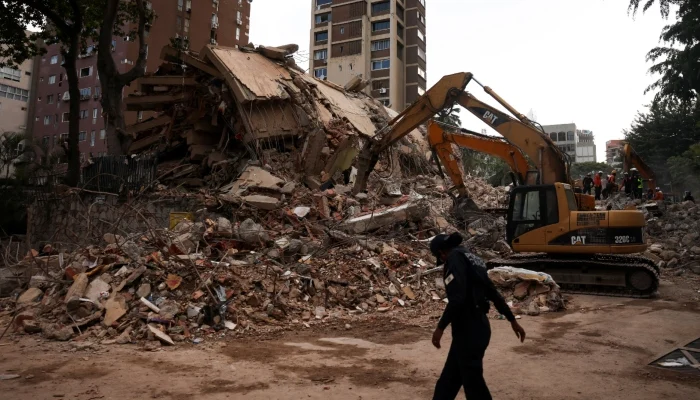
    In the aftermath of a series of devastating earthquakes in Caracas, Venezuela, a person navigates the debris of a collapsed building, reflecting the extensive destruction caused on June 25, 2026. — Reuters

    The health authorities report approximately 235 fatalities confirmed at medical facilities. The quakes reached a magnitude of 7.5, marking the most powerful in over a hundred years. The UN Secretary-General emphasizes that a “massive collective effort” will be essential to address this emergency.

    Hundreds remain trapped beneath rubble, with countless others unaccounted for, following twin seismic events that struck and damaged numerous structures in and around the capital. The initial quake, registering 7.2, occurred roughly 100 miles west of Caracas on Wednesday evening, swiftly succeeded by a 7.5-magnitude tremor—the strongest since 1900, per the US Geological Survey.

    Venezuela, already strained by prolonged economic hardship, faces further challenges as its battered infrastructure hampers rescue efforts amid ongoing aftershocks that shake the region. Health officials report that about 235 bodies have been taken to hospitals, though the total toll remains unconfirmed. Jorge Rodriguez, head of Venezuela’s National Assembly and brother to interim President Delcy Rodriguez, stated early that 200 individuals were trapped, and approximately 250 buildings had been damaged or destroyed.

    Critical sites, including eight hospitals, the Venezuelan Red Cross headquarters, and the French embassy, have sustained severe damage. In La Guaira state, roughly 70,000 families are affected, according to Interior Minister Diosdado Cabello. La Guaira, a coastal region bordering Caracas and home to the airport, is among the hardest-hit zones.

    Acting President Rodriguez describes the situation as a “disaster zone” and mentions ongoing efforts with private firms to bring heavy machinery for rescue operations. Power outages persist in some areas, and Caracas’s airport remains closed after sustaining damage, with footage emerging of panic inside the terminal. Emergency personnel and volunteers continue their search through collapsed buildings into the night, often finding the response slow, as residents voice frustrations over delayed aid.

    Yamileth Jimenez, a La Guaira resident, laments that her 19-year-old son remains trapped beneath the debris of their seven-story apartment building. “He’s under the slabs, and we don’t have the machinery to get him out,” she says, mourning her father’s recent death.

    In the city, volunteers dig through wreckage with their hands, while civilians line the roads toward the coast carrying water, food, and medicine in a desperate effort to support overwhelmed rescue teams. Pedro Perez, 64, owner of an upholstery shop, recounts having lost his home and business and now sleeping on the street with his family, hoping for swift aid.

    Many Venezuelans were at home during the quake, which struck on a national public holiday. Panic ensued as buildings rocked and collapsed across Caracas and neighboring coastal towns. Maria Alejandra, a resident of Caracas, describes the chaos: “When we went downstairs, it was like a horror movie.”

    In Moron, a seaside town near the epicenter, homes were flattened, and residents faced shortages of water and electricity. About 200 families from a damaged apartment complex are salvaging belongings or waiting for government shelters. Denis Sequera recalls her granddaughter guiding her 79-year-old father to safety while she helped her mother escape amid the tremors. “She kept telling him, ‘Grandpa, get out, put your hands over your head,’ and led him outside,” Sequera recounts. “We’ve been sleeping outdoors, waiting for help.”

    A government-supported website tracking missing persons reports over 46,000 individuals unaccounted for shortly after the quake’s impact, though verification is pending. Countries worldwide, regardless of previous relations with Venezuela, have pledged assistance, emphasizing solidarity in this crisis. The U.S. announced it is easing some sanctions related to earthquake relief efforts, with officials like Secretary of State Marco Rubio confirming plans to deploy rescue teams and aid logistics support, including at damaged airports.

    The UN’s aid chief highlights that a “massive collective effort” will be necessary, especially considering that millions of Venezuelans already depended on humanitarian assistance before the earthquakes. The international organization urges the government to lift certain social media restrictions to facilitate communication, describing connectivity as “a matter of life and death.”

    SpaceX’s Starlink has committed to providing free internet service through July 25 to those affected and is working to deploy terminals to critical areas to help restore communications. Despite widespread devastation, foreign energy companies report that their operations and the country’s vital oil infrastructure have largely remained unaffected despite the widespread damage.

  • US Effort to Detain Maduro Unveiled

    US Effort to Detain Maduro Unveiled

    In the early hours of Saturday, President Donald Trump announced on his Truth Social platform that the U.S. had executed a daring operation to apprehend Venezuelan President Nicolas Maduro and his wife. The surprise action was the culmination of months of planning, which included meticulous rehearsals. Elite American forces, such as Delta Force, built an exact replica of Maduro’s secure residence and practiced the assault extensively.

    Since August, a small team from the CIA had been on the ground gathering intelligence about Maduro’s routines, making a swift capture feasible. Additionally, the CIA reportedly had an asset close to Maduro monitoring his movements and ready to pinpoint his exact location during the operation.

    The green light for the mission was given by Trump four days earlier, although military and intelligence officials advised waiting for clearer weather conditions with less cloud cover. The operation officially commenced in the early hours, while Trump watched a live feed from his Palm Beach club, Mar-a-Lago.

    Details about the unfolding events come from interviews with four knowledgeable sources and Trump’s own disclosures. Following the operation’s completion, Trump shared on Fox News that he had never seen anything like it, highlighting the scale and precision of the mission.

    The Pentagon stationed substantial forces in the Caribbean, including an aircraft carrier, 11 warships, and over a dozen F-35 jets. In total, more than 15,000 troops were deployed for what was officially described as anti-drug efforts but also supported the covert operation.

    Key figures, such as senior aide Stephen Miller, Secretary of State Marco Rubio, Defense Secretary Pete Hegseth, and CIA Director John Ratcliffe, closely collaborated over months with frequent meetings and direct communication with the president. Late on Friday night and into Saturday morning, Trump and his advisors coordinated strikes against targets inside and near Caracas, including Venezuelan air defense systems. Trump described the aerial assault as involving a “massive” number of aircraft, with one fighter for every possible contingency.

    Additional sources confirmed that refueling tankers, drones, and electronic warfare aircraft had also been moved into the region quietly. The airstrikes targeted military sites, with images from La Carlota air base showing destroyed military vehicles from a Venezuelan anti-aircraft unit.

    US Special Forces, armed heavily and equipped with tools including a blowtorch, moved into Caracas. Although the exact entry method was not disclosed, social media videos displayed low-flying helicopters over the city. Upon reaching Maduro’s residence—described by Trump as a “fortress”—the troops, aided by FBI agents, stormed the safe house. Trump stated the residence was so well-guarded that it was difficult to breach, but the team was able to break in quickly through steel doors designed to withstand such assaults.

    Once inside, it is unclear precisely how Maduro and his wife were captured, though Trump indicated Maduro attempted to reach a safe room but was caught before he could. Trump noted that some U.S. forces sustained injuries but none were fatalities.

    As the operation unfolded, Rubio kept lawmakers informed, although notifications were made only after the mission’s initiation, deviating from usual protocols. Reports suggest Maduro was aboard a helicopter that was hit “pretty hard,” yet it managed to return. The Venezuelan leader was then transferred to the USS Iwo Jima, an amphibious assault ship, before being flown to New York for trial.

  • Venezuela Denounces US Military Threat Following Loud Explosions in Capital

    Venezuela Denounces US Military Threat Following Loud Explosions in Capital

    Smoke rising from buildings in Caracas, Venezuela, on January 3, 2026. —X@@AbujomaaGaza

    • Column of smoke visible, loud noises reported in Caracas.
    • U.S. Pentagon is holding back from official comments on the attack.
    • Trump administration officials acknowledge reports of explosions.

    Early Saturday morning, Caracas residents heard loud booms and saw at least one smoke column near a key military installation, with some areas in the south of the city losing power, according to Reuters witnesses.

    U.S. President Donald Trump has committed to possible military action in Venezuela, intensifying pressure on President Nicolas Maduro through increased sanctions, a growing military presence in the Caribbean and Pacific, and over 25 strikes on ships suspected of drug trafficking in regional waters.

    Venezuela has condemned what it calls “U.S. military aggression,” with President Maduro’s government stating Thursday’s attacks targeted Caracas and neighboring states Miranda, Aragua, and La Guaira, prompting Maduro to declare a national emergency and rally social and political groups to activate mobilization plans.

    CBS reporter Jennifer Jacobs tweeted that U.S. officials are aware of explosions and aircraft activity in Caracas early Saturday.

    The Pentagon has not yet issued an official statement.

    Nicolas Maduro has accused the Trump administration of trying to oust his government to seize Venezuela’s vast oil reserves.

    Colombian President Gustavo Petro issued a warning on X, stating, “They are bombing Caracas with missiles. The Organization of American States and the United Nations should meet immediately.”

    Petro, who hasn’t provided details or sources for his claims, has long opposed U.S. efforts to pressure Caracas.

    The U.S. has increased military assets in the region, including aircraft carriers, warships, and advanced fighters stationed in the Caribbean.

    President Trump announced a blockade of Venezuelan oil exports, tougher sanctions, and over two dozen strikes on vessels suspected of drug trafficking, claiming to have targeted a drug-loading area last week—marking the first known U.S. land operation in Venezuela since the pressure campaign began.

    It remains unclear whether the strikes were conducted by the CIA or other U.S. agencies. Some media reports suggest federal involvement.

    Trump has alleged Venezuela’s role in flooding U.S. markets with drugs. For months, the administration has been attacking vessels linked to South American drug trafficking, though Maduro’s government denies involvement in drug crimes.