الوسم: captured

  • Witness The Sun’s Terrifying Face Through New Instrument

    Witness The Sun’s Terrifying Face Through New Instrument

    The sun is a source of light and life for our planet, but it can also be quite intimidating. The inaugural image from the newly installed Visible Tunable Filter (VTF) at the Daniel K. Inouye Solar Telescope captures the sun’s surface in remarkable detail, showcasing a cluster of sunspots that resemble a scene from a horror film.

    This image represents the “first light” from the VTF, indicating it is the initial complete photo taken since the device was set up. The VTF functions as an imaging spectro-polarimeter, allowing scientists to capture two-dimensional images of the sun across specific wavelengths. Unlike standard cameras, which perceive a range of wavelengths, this device isolates one wavelength at a time, finely tuning through variations of a billionth of a meter. Essentially, it’s like snapping multiple photos, each tailored to a different color.

    The VTF has the capability to capture hundreds of images within mere seconds. These varying wavelengths can then be amalgamated into a comprehensive data set to create a three-dimensional representation of the object—in this instance, the sun’s surface. The image marks just the beginning of testing for this instrument, which is anticipated to be fully operational next year.

    “Witnessing those initial spectral scans was surreal. This instrument achieves something that no other equipment on the telescope can—a milestone that caps months of optical alignment, testing, and collaboration across continents,” remarked Stacey Sueoka from the National Solar Observatory, which oversees the telescope. “Even with just one etalon installed, the instrument’s potential is already evident. This is only the start, and I am eager to explore what more we can accomplish as we finalize the system, integrate the second etalon, and approach the phase of scientific validation and commissioning.”

    An annotated version of the image provides a depiction of the United States for scale, illustrating just how immense these sunspots are.

    These sunspots are indicative of solar activity and can trigger solar flares or coronal mass ejections—massive plasma outflows that can impact Earth. As this plasma travels towards our planet, it interacts with the atmosphere in a phenomenon known as space weather. While this can lead to stunning auroras, it may also disrupt communications and create various challenges.

    Instruments like those on the Inouye telescope play a crucial role in enhancing researchers’ understanding of solar activity and its influence on space weather, allowing for better forecasting in the future.

  • Stunning Eclipse View Captured by Blue Ghost Mission

    Stunning Eclipse View Captured by Blue Ghost Mission

    Earlier this month, Firefly Aerospace launched its Blue Ghost mission with the goal of reaching the moon. The mission has already produced remarkable footage showing the Earth obscuring the sun from space. Currently, the Blue Ghost lander is in a low Earth orbit, fine-tuning its trajectory as it prepares for its journey to the moon over the upcoming weeks. While en route, it’s actively collecting scientific data and testing its communication systems.

    Five days into the mission, Firefly announced, “We’ve covered 220,000 miles and transmitted 1.4 GB of data!” Their message emphasized the significant accomplishments of their team, mentioning that, “There’s a long road ahead, but our #GhostRiders are making remarkable progress!”

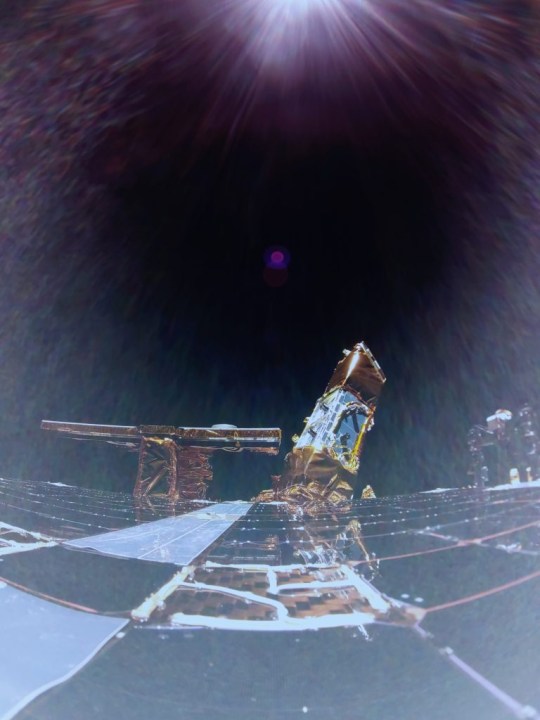
    Initial image from space of Firefly’s Blue Ghost mission 1 lunar lander during its 45-day transit to the Moon, showcasing the X-band antenna and NASA’s LEXI payload.
    Initial image from space of Firefly’s Blue Ghost mission 1 lunar lander as it embarks on its 45-day journey to the Moon, featuring the top deck with the X-band antenna and NASA’s Lunar Environment heliospheric X-ray Imager (LEXI) payload. Firefly Aerospace

    The company also released an initial photograph of the lander in orbit, revealing some of the six NASA payloads onboard, including the X-ray instrument LEXI. This instrument will examine the Earth’s magnetosphere from lunar orbit using X-ray wavelengths.

    The mission shared an exciting update—video footage showing the Earth moving across the sun, creating an eclipse:

    Blue Ghost Mission 1 – Earth eclipse from Orbit

    Additionally, Firefly Aerospace made a significant announcement regarding a signal received from the Lunar GNSS Receiver Experiment (LuGRE), a collaboration with NASA and the Italian Space Agency. This experiment achieved a remarkable feat by connecting with a global satellite system from a distance of 205,674 miles, setting a new record. Firefly noted, “This step toward establishing a navigation solution for the Moon marks another successful milestone for our payload partners aboard Blue Ghost.”

    According to NASA, “This achievement indicates that Earth-based GNSS constellations can be utilized for navigation at nearly 90% of the distance to the Moon, marking a groundbreaking Earth-Moon signal distance record. It also highlights the potential of integrating multiple GNSS constellations, like GPS and Galileo, for navigation purposes.”

    The Blue Ghost lander will continue its orbit around the Earth for another 25 days before embarking on a four-day journey to the moon, with plans to enter lunar orbit in early March.


  • Stunning Sombrero Galaxy View Captured By James Webb

    Stunning Sombrero Galaxy View Captured By James Webb

    The latest capture from the James Webb Space Telescope reveals a breathtaking view of the Sombrero Galaxy, which gets its name due to its resemblance to the iconic Mexican hat. This galaxy, officially known as Messier 104, features a broad, flat structure akin to the wide brim of a sombrero, and for the first time, its outer rings have come into clear focus.

    Situated approximately 30 million light-years away in the Virgo constellation, the Sombrero Galaxy has been photographed before by the Hubble Space Telescope. However, in Hubble’s images, it appears as a pale, opaque disk, while Webb’s latest image uncovers an outer blue disk surrounding a small, luminous core at the center.

    Comparison of the Sombrero Galaxy in mid-infrared light (top) and visible light (bottom). Webb's MIRI showcases the smooth inner disk, whereas Hubble captures the vast glow of the stellar bulge.
    This image compares the view of the famous Sombrero Galaxy in mid-infrared light (top) and visible light (bottom). The James Webb Space Telescope’s MIRI (Mid-Infrared Instrument) reveals the smooth inner disk of the galaxy, while the Hubble Space Telescope’s visible light image shows the large and extended glow of the central bulge of stars. Both the Webb and Hubble images resolve the clumpy nature of the dust that makes up the Sombrero galaxy’s outer ring.
    NASA, ESA, CSA, STScI, Hubble Heritage Team (STScI/AURA)

    The contrasting visuals stem from the different wavelengths utilized by the telescopes. Hubble primarily captures images in the visible light spectrum—similar to how our eyes perceive it—rendering dusty galaxies like the Sombrero Galaxy somewhat opaque. In contrast, Webb operates in the infrared spectrum, allowing it to see through the dust and reveal hidden structures.

    Webb’s imagery also provides a detailed look at the dust in the galaxy’s outer ring. A closer examination reveals that this blue-white area has a clumpy texture, with dust unevenly distributed in various pockets. This feature is particularly interesting to scientists as it contains molecules known as polycyclic aromatic hydrocarbons, typically found in regions where new stars are forming. However, the rate of star formation in the Sombrero Galaxy is quite low, producing only half the number of stars annually compared to our Milky Way.

    Additionally, the image highlights a bright region at the galaxy’s core, which is associated with an active galactic nucleus (AGN) around its supermassive black hole. Unlike some more active AGNs, this particular black hole is relatively quiescent, consuming material at a more subdued rate.