Tag: Blue Ghost

  • First Images Of Blue Ghost Lander On Moon’s Surface

    First Images Of Blue Ghost Lander On Moon’s Surface

    This past weekend marked a significant milestone with the successful landing of the Blue Ghost lander on the moon. Firefly Aerospace’s mission arrived at the Mare Crisium region on Sunday, March 2. Fresh images from the lander have already been released, showcasing its new lunar environment.

    Among the captivating visuals is a striking photograph capturing the lander’s shadow cast on the moon’s surface. Another image highlights the lander with Earth appearing in the night sky:

    This image illustrates the Moon's surface, with Earth visible on the horizon and the Blue Ghost’s solar panel and X-band antenna in the foreground.
    This image illustrates the Moon’s surface, with Earth visible on the horizon and the Blue Ghost’s solar panel and X-band antenna in the foreground. Firefly Aerospace

    The image also features two of the lander’s key instruments, the X-band antenna for transmitting data back to Earth and the Lunar Environment Heliospheric X-ray Imager (LEXI). This telescope will utilize X-rays to investigate the interaction between solar winds and Earth’s magnetic field and is one of several NASA tools aboard the lander.

    NASA’s acting Administrator, Janet Petro, remarked on the landing, stating, “This incredible achievement demonstrates how NASA and American companies are leading the way in space exploration for the benefit of all. We have already learned many lessons – and the technological and scientific demonstrations onboard Firefly’s Blue Ghost Mission 1 will enhance our ability to not only discover more science but also ensure the safety of our spacecraft instruments for future human exploration – both in the immediate and distant future.”

    Another captivating image shows a bird’s-eye view of the moon’s surface where the lander’s thrusters are prominently displayed:

    This image captures the Moon's surface from above, focusing on the lander’s RCS thrusters amid sunlight glare.
    This image captures the Moon’s surface from above, focusing on the lander’s RCS thrusters amid sunlight glare. Firefly Aerospace

    The deployment of the lander’s instruments has commenced, and Firefly has announced that the X-band antenna is fully operational. This antenna provides superior image quality and transmits scientific data and videos, significantly better than the previous S-band antennas that delivered lower-quality images.

    “The science and technology we send to the Moon now helps pave the way for future NASA exploration and supports a long-term human presence to inspire generations worldwide,” stated Nicky Fox, NASA’s associate administrator for science. “Partnering with American companies for these payloads bolsters a thriving lunar economy.”

  • See Earth Rise And Set Behind Moon In New Blue Ghost Video

    See Earth Rise And Set Behind Moon In New Blue Ghost Video

    The Blue Ghost mission by Firefly Aerospace is gearing up for its groundbreaking lunar landing endeavor this week. While circling the moon, the spacecraft continues to take breathtaking images of both the Earth and its distant satellite. Recently released footage captures the Earth setting and rising behind the moon shortly after the craft completed its second lunar orbital maneuver.

    Earth rise, Earth set, repeat!

    The footage reveals the moon rising in the background of the Blue Ghost spacecraft, with Earth appearing as a tiny crescent. As the spacecraft orbits the moon, Earth disappears behind it, only to reappear as the craft continues its journey. This striking imagery serves as a poignant reminder that, although the moon is relatively close to us in the vastness of space, Earth appears merely as a small dot in the distance.

    According to Firefly Aerospace, “The footage displaying Earth’s rise and set behind the Moon was captured by Firefly’s Blue Ghost lunar lander shortly after our second lunar orbit maneuver on February 18. The video also shows our solar panel, X-band antenna (on the left), and LEXI payload (on the right) positioned on the top deck.”

    A still from footage captured by Blue Ghost shortly after its second lunar orbit maneuver.
    A snapshot taken from footage of the Blue Ghost shortly after its second lunar orbit maneuver. Firefly Aerospace

    Along with this captivating footage, Firefly has confirmed that Blue Ghost has successfully completed its third and final lunar orbit maneuver. During this maneuver, the spacecraft’s engines fired for 16 seconds to adjust its orbit, allowing it to move into a near-circular low lunar orbit.

    Looking forward, the significant challenge lies ahead as Blue Ghost is set to attempt a soft landing on the moon this Sunday, March 2. If successful, this would mark just the second instance of a commercial craft successfully landing on the lunar surface. To prepare for the landing, the spacecraft will perform another engine burn as it approaches the moon, a maneuver known as Descent Orbital Insertion. The targeted landing site is a region known as Mare Crisium, a lunar basin situated in the northeast area of the moon’s near side.

    The spacecraft is carrying various experiments and technological tests for lunar applications, including several payloads from NASA designed to evaluate concepts in anticipation of human missions to the moon as part of the Artemis program. In a recent announcement, NASA revealed that one of these experiments, the Lunar GNSS Receiver Experiment (LuGRE), succeeded in receiving a Global Navigation Satellite System (GNSS) signal from an astounding distance of 246,000 miles, setting a new record for this technology.

  • Hello Moon: Blue Ghost Enters Lunar Orbit in Stunning Footage

    Hello Moon: Blue Ghost Enters Lunar Orbit in Stunning Footage

    Excitement continues to build around Firefly Aerospace’s Blue Ghost lunar mission, as the spacecraft recently shared stunning imagery of the Earth from space. Now, it has also provided remarkable footage of the moon from its orbit.

    Launched last month, the Blue Ghost mission aims to achieve the second-ever soft landing on the moon by a commercial company. After spending several weeks orbiting Earth, it officially entered lunar orbit yesterday, February 13.

    “The Firefly team nailed our most challenging burn to date!” the company announced in an update. “Starting at 7:51 p.m. CST on February 13, the team completed a 4 minute, 15 second Lunar Orbit Insertion burn using Blue Ghost’s RCS thrusters and main engine to achieve an elliptical orbit around the moon. Over the next 16 days, we will perform additional maneuvers to circularize our orbit and move closer to the lunar surface.”

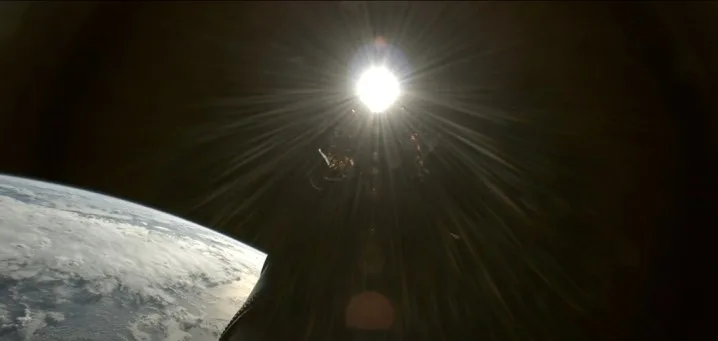
    As the spacecraft neared the moon, it captured a breathtaking image that showcases the sun, the moon, and its solar panels in the foreground. This image also features some of the scientific instruments carried by the spacecraft, including the LEXI payload (the Lunar Environment Heliospheric X-ray Imager, a tool for studying space weather) and a communications antenna.

    Firefly's Blue Ghost lander captured an image of the Moon from its top deck camera. The image also shows Blue Ghost's solar panel, X-band antenna on the left, and NASA's LEXI payload on the right.
    Firefly’s Blue Ghost lander captured an image of the Moon from its top deck camera, showing the spacecraft’s solar panel, X-band antenna (left), and NASA’s LEXI payload (right).
    Firefly Aerospace

    Additionally, a series of photos taken during the lunar orbit insertion burn have been combined to create an impressive timelapse showcasing the view of the moon as the spacecraft maneuvers around it.

    Hello Moon

    The spacecraft is currently in a wide elliptical orbit around the moon, navigating in an oval pattern. Over the next two weeks, it will make engine adjustments to transition to a more circular orbit, gradually getting closer to the moon as it prepares for its landing attempt on March 2.

    Landing on the moon presents its own set of challenges due to the uneven terrain, populated with boulders and craters. A previous private company, Intuitive Machines, faced difficulties when its lander came down at an angle, hindering its ability to effectively gather power from its solar panels.

    To overcome these challenges, Firefly intends to implement terrain-relative navigation, which utilizes images of the lunar surface processed by an onboard computer to determine a safe landing zone. We will have to wait until next month to find out if they succeed in this ambitious endeavor.

  • Firefly’s Blue Ghost Moon Mission Reveals Stunning Image

    Firefly’s Blue Ghost Moon Mission Reveals Stunning Image

    As Firefly Aerospace’s mission known as Blue Ghost progresses toward the moon, it has been capturing breathtaking images, including vivid views of Earth as it travels. Recently, the company unveiled its most impressive image yet, featuring our planet’s reflection shimmering on the smooth surface of a solar panel on the spacecraft.

    Firefly’s Blue Ghost lander captures the reflection of Earth on its solar panel, with the Moon visible above Earth.
    Firefly’s Blue Ghost lander captures the reflection of Earth on its solar panel, with the Moon visible above the planet. Firefly Aerospace

    Launched last month, Blue Ghost has been orbiting Earth to fine-tune its path before making its way to the moon. This week, the spacecraft executed a Trans Lunar Injection maneuver, firing its engines to set its course away from Earth and toward its lunar destination.

    The journey to the moon will take several days, after which the spacecraft will ignite its engines again to establish lunar orbit. Over the next few weeks, it will make adjustments to this orbit before attempting to land softly on the moon’s surface. Firefly Aerospace aims to become the second commercial entity in history to achieve a successful soft landing on the lunar surface.

    Shortly after Trans Lunar Injection, Firefly’s Blue Ghost lunar lander captured a view of Earth with the Moon in the distance.
    Shortly after Trans Lunar Injection, Firefly’s Blue Ghost lunar lander captured a view of Earth with the Moon below in the distance. Firefly Aerospace

    In addition to the stunning image of Earth reflected in the solar panel, the spacecraft has also photographed our planet fading into the distance. With its mission well underway, Blue Ghost is relaying valuable data from various payloads, which include numerous NASA experiments and technology assessments.

    “Now four weeks into the mission, Blue Ghost has transmitted over 15 GB of data, including NASA science data, from exceptional GNSS signals to magnetic field measurements, providing insights that will benefit future space exploration,” Firefly Aerospace stated in a recent update.

    The payloads aboard the spacecraft feature an experimental technique for gathering samples of the lunar surface’s dust, known as regolith, by firing a jet of gas to disturb the surface and capturing this material for analysis.

    Additionally, there is an experiment underway to explore the use of electric fields to prevent dust accumulation on surfaces—a significant concern for lunar missions due to the sharp and abrasive nature of the moon’s dust, which can quickly damage materials like seals. The goal is to test technologies that could support human exploration of the moon as part of NASA’s Artemis program.

  • Stunning Eclipse View Captured by Blue Ghost Mission

    Stunning Eclipse View Captured by Blue Ghost Mission

    Earlier this month, Firefly Aerospace launched its Blue Ghost mission with the goal of reaching the moon. The mission has already produced remarkable footage showing the Earth obscuring the sun from space. Currently, the Blue Ghost lander is in a low Earth orbit, fine-tuning its trajectory as it prepares for its journey to the moon over the upcoming weeks. While en route, it’s actively collecting scientific data and testing its communication systems.

    Five days into the mission, Firefly announced, “We’ve covered 220,000 miles and transmitted 1.4 GB of data!” Their message emphasized the significant accomplishments of their team, mentioning that, “There’s a long road ahead, but our #GhostRiders are making remarkable progress!”

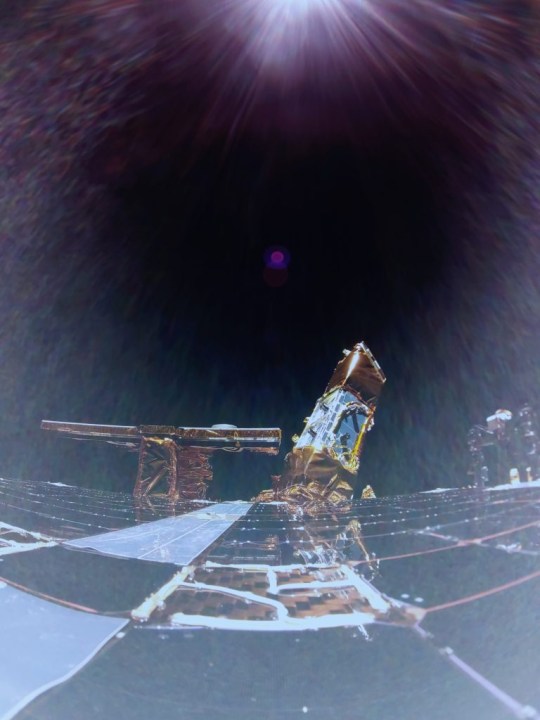
    Initial image from space of Firefly’s Blue Ghost mission 1 lunar lander during its 45-day transit to the Moon, showcasing the X-band antenna and NASA’s LEXI payload.
    Initial image from space of Firefly’s Blue Ghost mission 1 lunar lander as it embarks on its 45-day journey to the Moon, featuring the top deck with the X-band antenna and NASA’s Lunar Environment heliospheric X-ray Imager (LEXI) payload. Firefly Aerospace

    The company also released an initial photograph of the lander in orbit, revealing some of the six NASA payloads onboard, including the X-ray instrument LEXI. This instrument will examine the Earth’s magnetosphere from lunar orbit using X-ray wavelengths.

    The mission shared an exciting update—video footage showing the Earth moving across the sun, creating an eclipse:

    Blue Ghost Mission 1 – Earth eclipse from Orbit

    Additionally, Firefly Aerospace made a significant announcement regarding a signal received from the Lunar GNSS Receiver Experiment (LuGRE), a collaboration with NASA and the Italian Space Agency. This experiment achieved a remarkable feat by connecting with a global satellite system from a distance of 205,674 miles, setting a new record. Firefly noted, “This step toward establishing a navigation solution for the Moon marks another successful milestone for our payload partners aboard Blue Ghost.”

    According to NASA, “This achievement indicates that Earth-based GNSS constellations can be utilized for navigation at nearly 90% of the distance to the Moon, marking a groundbreaking Earth-Moon signal distance record. It also highlights the potential of integrating multiple GNSS constellations, like GPS and Galileo, for navigation purposes.”

    The Blue Ghost lander will continue its orbit around the Earth for another 25 days before embarking on a four-day journey to the moon, with plans to enter lunar orbit in early March.


  • Firefly Aerospace Launches Blue Ghost Mission To The Moon

    Firefly Aerospace Launches Blue Ghost Mission To The Moon

    This morning, Firefly Aerospace successfully launched a moon lander equipped with a range of NASA science instruments and technology demonstrations. The mission, known as Blue Ghost, lifted off aboard a SpaceX Falcon 9 rocket from NASA’s Kennedy Space Center in Florida at precisely 1:11 a.m. ET on Wednesday, January 15.

    The primary goal of this mission is to achieve a soft landing on the lunar surface. If accomplished, it will mark only the second successful moon landing by a private company, following the Odyssey landing by Intuitive Machines last year. Both missions are integral to NASA’s Commercial Lunar Payload Services program, which aims to have commercial partners deliver scientific payloads to the moon in preparation for the upcoming Artemis human exploration missions.

    “This mission embodies the bold spirit of NASA’s Artemis campaign – a campaign driven by scientific exploration and discovery,” remarked NASA Deputy Administrator Pam Melroy. “Every flight we participate in is a crucial step towards establishing a sustainable human presence on the moon, Mars, and beyond. Each scientific instrument and technology demonstration takes us closer to making our vision a reality. Congratulations to the teams at NASA, Firefly, and SpaceX for this successful launch.”

    Following launch vehicle separation, Firefly’s Blue Ghost lunar lander acquired signal and completed on-orbit commissioning.
    After separating from the launch vehicle, Firefly’s Blue Ghost lunar lander established communication and completed its on-orbit commissioning.
    Firefly Aerospace

    Following the launch, the spacecraft successfully separated from its rocket at 2:17 a.m. ET and made contact with ground control. The team carried out checks to verify the spacecraft’s condition and status, confirming that all systems were operational and data transfer was functioning correctly.

    The Blue Ghost will remain in Earth orbit for approximately 25 days before embarking on its four-day journey to the moon, where it will spend 16 days orbiting the lunar surface. The mission aims to execute a landing on Sunday, March 2, in the Mare Crisium basin—a 300-mile-wide crater located on the moon’s near side—followed by conducting experiments related to lunar drilling and sample collection.

    “On behalf of Firefly, I want to extend our gratitude to SpaceX for their precise deployment into our target orbit,” stated Jason Kim, CEO of Firefly Aerospace. “The mission is now in the capable hands of the dedicated Firefly team. Having completed extensive testing and mission simulations, we are focused on executing our planned operations, achieving a successful soft landing on the lunar surface, and paving the way for humanity’s return to the moon.”