الوسم: Barnard’s Star

  • Scientists discover miniature rocky planets in perpetual darkness and daylight

    Scientists discover miniature rocky planets in perpetual darkness and daylight

    Astronomers have conducted their most detailed examination yet of the planetary system orbiting Barnard’s Star, one of our closest stellar neighbors. The findings indicate these nearby planets are quite different from anything in our own solar system. Although they are relatively close to Earth in cosmic terms, the planets appear to be dry, airless, and far too harsh to support life.

    Barnard’s Star is just under six light-years away, making it the closest individual star to the Sun after the Alpha Centauri system. In 2025, scientists confirmed that four small rocky planets orbit this star. Each planet is smaller than Earth and Venus but larger than Mars, placing them in a size range that doesn’t exist anywhere else in our solar system.

    The recent study, published in the Monthly Notices of the Royal Astronomical Society, involved researchers from the University of Cambridge who analyzed the star’s chemical makeup to better understand the composition of its planets. They found that Barnard’s Star has unusually high levels of magnesium. Lead author Xander Byrne from Cambridge’s Institute of Astronomy explains that this extra magnesium likely influenced how the planets formed billions of years ago.

    On Earth, much of the magnesium turns into minerals called olivines, which are essential for storing water deep within the planet. However, scientists believe that on the planets orbiting Barnard’s Star, the excess magnesium primarily formed a different mineral called periclase. Unlike olivine, periclase doesn’t retain water well, making these planets much drier than Earth.

    Furthermore, these planets likely lack long-lasting atmospheres. They orbit extremely close to their star — the outermost planet is about ten times closer than Mercury is to the Sun. Such proximity exposes them to intense radiation and stellar winds that can gradually strip away any atmosphere they might have had.

    Given their weak gravity and close orbits, the researchers estimate that any primordial atmospheres could have only persisted for around two billion years. Since Barnard’s Star is approximately 10 billion years old, those atmospheres would have disappeared billions of years ago.

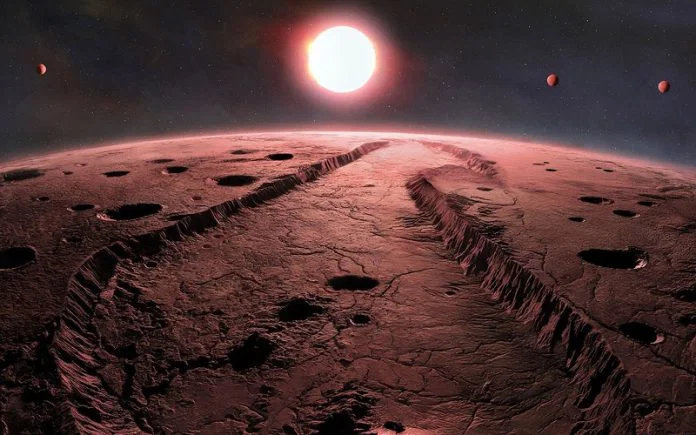
    Another notable feature is that all four planets are probably tidally locked, meaning one side constantly faces the star while the other remains in perpetual darkness. This is similar to how the Moon always shows the same face to Earth. One side would be in constant daylight and extreme heat, while the dark side would remain cold and shadowed.

    Despite their tight spacing, the system appears surprisingly stable. Typically, planets so close together would exert strong gravitational pulls on each other, increasing the chances of collisions or ejections. However, the study found that their orbits are arranged in a pattern called orbital resonance. The inner three planets follow a repeating 9:12:16 orbital rhythm, a gravitational configuration that also helps stabilize some of Jupiter’s moons.

    Future space missions, such as the European Space Agency’s PLATO mission, are expected to discover many more small rocky planets like these. While the planets around Barnard’s Star are most likely uninhabitable, the research demonstrates that a star’s chemical composition can provide valuable insights into the nature of its planets. This knowledge may guide scientists in finding more promising worlds elsewhere in the galaxy where life could potentially exist.
  • Scientists Discover a Unique Nearby Planet System Unlike Our Solar System

    Scientists Discover a Unique Nearby Planet System Unlike Our Solar System

    Barnard’s Star is one of the brightest stars in our night sky for astronomers because of its proximity to Earth. Situated just under six light-years away, it ranks as the second-closest star system after Alpha Centauri. In 2025, researchers confirmed the presence of four small planets orbiting this nearby star.

    A recent study has provided the clearest view yet of these unusual worlds, revealing that they are rocky, incredibly hostile, and markedly different from any planets in our solar system. Published in the Monthly Notices of the Royal Astronomical Society, the study was led by scientists from the University of Cambridge. By analyzing the star’s chemical composition, the team estimated what these planets might be made of and how they have changed over billions of years.

    All four planets are smaller than Earth and Venus but larger than Mars. Interestingly, this size range is quite common in other planetary systems, even though our solar system lacks planets of this size. As more small rocky worlds are discovered, scientists are beginning to realize that our solar system may not be as typical as previously thought.

    One of the most surprising discoveries is that these planets are possibly rich in a mineral called periclase. On Earth, periclase is found deep underground, hundreds of kilometers below the surface. Barnard’s Star has a much higher magnesium content compared to the Sun, which likely influenced the mineral formation inside its planets. On Earth, magnesium is mainly stored in olivine minerals that help retain water. However, the high magnesium levels around Barnard’s Star probably led to the formation of more periclase, which isn’t as efficient at holding water. This suggests that these planets might have had significantly less water from the start.

    The planets orbit very close to their star. The farthest one circles Barnard’s Star at about ten times the distance Mercury orbits the Sun. Such proximity to the star likely caused intense radiation that stripped away any original atmospheres, which probably only lasted for around two billion years—considerably shorter than the star’s estimated age of around ten billion years.

    Because of their tight orbits, the planets are expected to be tidally locked, meaning one side constantly faces the star while the other remains in perpetual darkness, similar to how the Moon always shows one face to Earth.

    Despite their close proximity, the planets seem to maintain stable orbits. The inner three move in a resonant pattern, with their orbital periods following a 9:12:16 ratio. Gravitational interactions like this are similar to those that keep some of Jupiter’s moons in stable orbits, possibly preventing the planets from colliding.

    While these worlds are almost certainly inhospitable, the findings offer valuable insights into planetary formation around different types of stars. Upcoming space missions, including the European Space Agency’s PLATO, aim to find many more small rocky planets like these. By studying the chemistry of stars and their planets, astronomers hope to better identify which distant worlds might support life.