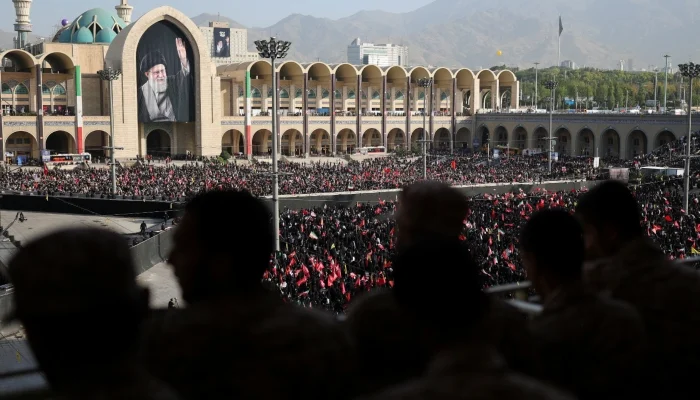
People gather in Tehran for the funeral of Iran’s late Supreme Leader Ali Khamenei, whose image is displayed on a banner during the public farewell ceremony at the Imam Khomeini Grand Mosalla. The event took place on July 4, 2026, at a time when Khamenei’s death was officially announced following Israeli and U.S. airstrikes on February 28 that resulted in his martyrdom.
The funeral aimed to showcase Iran’s unity and resilience. Khamenei led the nation from 1989 until his passing at 86. As mourners chanted slogans against the United States, crowds assembled in the hundreds, waving red banners symbolizing revenge, and lining the streets for miles to pay their respects. Security measures were heightened, with roads closed and airspace restrictions in place, making this the largest public gathering since the burial of Ayatollah Ruhollah Khomeini in 1989.
The coffin was placed in state until Monday, after which a procession was scheduled through Tehran. From there, it would be transported to Qom, then Iraq’s holy cities, and finally to Mashhad for burial on Thursday. Top Iranian officials, including parliament speaker Mohammad Bagher Ghalibaf—who was visibly emotional—attended the ceremonies alongside military leaders like Ahmad Vahidi, the new head of the Revolutionary Guards.
Mourners carried signs of vengeance and expressed grief, while the public vigil also served as a moment to observe the posture of Khamenei’s son and successor, Mojtaba Khamenei, who was appointed supreme leader a week after the assassination but has yet to appear publicly and was reportedly wounded in the strike. Other family members, including Khamenei’s infant granddaughter, were also laid to rest during the ceremonies.
International dignitaries present included Pakistani Prime Minister Shehbaz Sharif, reflecting Pakistan’s mediating role, and Dmitry Medvedev, the Russian deputy security council chairman representing President Vladimir Putin. Representatives from Hamas, Hezbollah, and the Taliban were also in attendance, emphasizing the event’s regional significance.
Amid ongoing tensions and a temporary halt in Middle East hostilities following a tentative Iran-U.S. truce, Iranian officials have warned that they are prepared to resume fighting if necessary. Ghalibaf called on Iranians to show unity and strength, urging mass participation in the upcoming events. Army Chief Amir Hatami pledged that Israel and the U.S. would be held accountable for Khamenei’s death.
Authorities prioritized crowd safety, aware of past incidents involving large gatherings. Extra precautions included water spray trucks to combat the intense summer heat, with temperatures expected to soar past 95°F. The city’s streets appeared notably quieter than usual as Tehran prepared to honor its former leader with dignified ceremonies spanning several days.

