الوسم: assassination

  • Trump Claims His Plane Encountered ‘Greater Risk’ During Secret Flight Change

    Trump Claims His Plane Encountered ‘Greater Risk’ During Secret Flight Change

    US President Donald Trump boards Air Force One en route to Joint Base Andrews in Cleveland, Ohio, US, August 11, 2026. — Reuters

    • President Trump secretly changed planes in Turkey.
    • Trump ‘hid’ inside a catering truck during a covert aircraft switch due to a threat: report.
    • Journalists and White House staff flew on Air Force One without Trump.

    The US President, Donald Trump, announced on Wednesday that he secretly switched aircraft in Turkey last month under the guidance of the US Secret Service. He added that the plane he flew on was more at risk than Air Force One.

    After a NATO summit in Ankara, Trump was moved from Air Force One to a military aircraft via a catering truck in an unusual deception triggered by a threat from Iran, according to US media reports.

    The White House kept this change under wraps until The Washington Post revealed it on Monday. Some commentators questioned whether this operation jeopardized Trump’s aides and traveling journalists aboard the plane believed to be carrying the president.

    “I actually think the plane I flew on was at greater risk,” Trump told reporters Tuesday. “It might have been a bigger target because they would be more inclined to go after that one.”

    Following a flood of social media memes depicting Trump hiding inside the catering truck, the image-conscious president—often promoting memes of himself as a daring leader—stated he was acting in accordance with Secret Service directives.

    “It’s entirely up to the Secret Service. I just follow their lead, whether it’s Secret Service or the military,” Trump explained.

    “There was a threat out there. I didn’t get into the details. I receive many threats,” he added.

    The White House originally said Trump was flying on Air Force One from Turkey to the UK. However, moments after boarding, he left the plane secretly via the catering truck and transferred to another aircraft bound for Britain, according to The Post, citing anonymous sources.

    Trump had used a recently upgraded Qatari-donated jet for the NATO summit but unexpectedly switched to an older Air Force One when departing Turkey—prompting questions about the newer plane’s security features.

    This marked the maiden international trip for the upgraded aircraft, which has sparked debates over its cost and security, especially amidst rising tensions with Iran, which borders Turkey.
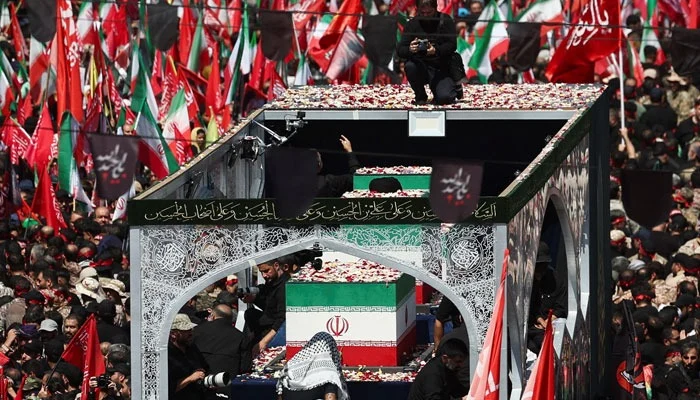
  • Khamenei’s Funeral Starts in Tehran Amid Large Crowds

    Khamenei’s Funeral Starts in Tehran Amid Large Crowds

    A vehicle transporting coffins of Iran’s late Supreme Leader Ayatollah Ali Khamenei and his family members moved through the streets as crowds gathered for his funeral in Tehran on July 6, 2026. The procession took place amidst rare appearances by three of Khamenei’s sons. To prevent stampedes, reinforced concrete barriers kept the public at a safe distance from the coffins. Mourners chanted slogans calling for revenge over his assassination.

    The funeral procession kicked off in Tehran after two days of lying in state at the Grand Mosalla religious complex. Khamenei was killed on February 28 during Israeli and US airstrikes, marking the start of the Middle East conflict. Thousands of Iranians assembled in Imam Hussein Square, where they even hung an effigy of then-US President Donald Trump in protest.

    Authorities aimed to manage the crowds and avoid a repeat of the chaos seen during Khomeini’s funeral in 1989, which drew an estimated 10 million people and resulted in over ten deaths and thousands injured. During Khamenei’s initial wake, large concrete walls separated mourners from the coffins to prevent stampedes. The public’s access during the procession remains uncertain, but officials are cautious, recalling how Khomeini’s funeral required a helicopter to bypass a stormed vehicle.

    The events are also an opportunity for Iran’s leadership to showcase resilience after over a month of war involving Israel and the US. Parliament speaker and primary US negotiator Mohammad Bagher Ghalibaf praised Iranians for their united homage to their “martyr.” Similar ceremonies will follow in Qom, Najaf, and Karbala, culminating in Khamenei’s burial in Mashhad on Thursday.

    The funeral was notably marked by a rare appearance of three of Khamenei’s sons, with Mojtaba Khamenei notably absent. Although he was appointed Supreme Leader following his father’s death, he has not been seen publicly and is believed to have been wounded in the airstrikes. The new commander of the Revolutionary Guards, Ahmad Vahidi, also appeared in public for the first time since the conflict began, alongside Esmail Qaani, head of the Quds Force.

    While Iranian officials project unity, the current and past leaders with strained relations with Khamenei—such as President Pezeshkian’s predecessors—have not been present at the ceremonies. The government emphasizes mass mobilization as a display of national strength, especially after recent protests and crackdowns that rights groups say claimed thousands of lives.

    The war pause, following a ceasefire and a preliminary deal with the US, keeps tensions high. Both sides have warned that military action could resume, and calls for revenge echoed through the funeral rituals. Citizens expressed that the killers of Khamenei should be held accountable, with some demanding retribution to honor their fallen leader and loved ones. Iran remains committed to its confrontational stance against the West, supporting groups like Hamas and Hezbollah, which sent representatives to the funeral.

  • Washington Dinner Shooting Suspect Charged with Trump Assassination Attempt

    A man accused of shooting a U.S. Secret Service agent attempting to breach security at a Washington dinner attended by President Donald Trump is facing federal charges of attempting to assassinate the president, a court official announced Monday.

    Twenty-one-year-old Cole Tomas Allen from Torrance, California, also faces multiple firearms-related charges in a three-count complaint.

    Allen appeared in Washington federal court wearing a blue inmate jumpsuit, just two days after authorities disrupted an attack at the White House Correspondents’ Dinner—an annual formal event featuring journalists and politicians.

    “ He tried to assassinate President Donald J. Trump,” prosecutor Jocelyn Ballantine stated during the hearing.

    Allen has yet to respond to the allegations. Sitting at the defense table flanked by U.S. marshals, he expressed willingness to answer questions honestly and mentioned holding a master’s degree in computer science.

    U.S. Magistrate Judge Matthew Sharbaugh ordered Allen to remain detained as the case proceeds and scheduled a further detention hearing for Thursday.

    Allen left a manifesto with family members, in which he dubbed himself the “Friendly Federal Assassin” and detailed plans to target senior Trump administration officials present in the hotel ballroom. Officials suggest Trump himself may have been among his targets.

    White House press secretary Karoline Leavitt described the incident as the third major assassination attempt against Trump, following two such attempts in 2024. She compared the language in Allen’s manifesto to rhetoric from Trump’s political opponents.

    “Much of the suspect’s manifesto sounds indistinguishable from the words we hear daily from many critics,” Leavitt said. “The entire Democrat Party has portrayed Donald Trump as an existential threat to democracy, labeling him a fascist.”

    Prominent Democrats have condemned the shooting.

    Allen booked a room at the Washington Hilton hotel where the dinner was held and traveled from California to D.C. by train, officials noted.

    The shooting caused chaos at the event, a significant fixture on Washington’s social scene. Attendees scrambled under tables and law enforcement quickly evacuated senior officials. Trump, who was scheduled to speak later that evening, was hurried off stage as gunshots rang out.

    The suspect reportedly fired a shotgun at a Secret Service agent at a hotel checkpoint before being tackled and arrested. Video footage shared online by Trump showed the suspect running through a hallway outside the ballroom.

    Authorities said the suspect was subdued just inside a secure perimeter and described his capture as a law enforcement success. The Secret Service agent was hit but was protected by a tactical vest and was released from the hospital hours later.

    Allen was armed with a handgun, multiple knives, and the shotgun. He was also transported to a hospital for evaluation following the incident.

  • Global Response to Iran’s Supreme Leader Khamenei’s Martyrdom

    Global Response to Iran’s Supreme Leader Khamenei’s Martyrdom

    Iran’s top leader Ayatollah Ali Khamenei was killed in strikes carried out by the US and Israel, according to state media reports. On Sunday, the country experienced another wave of attacks. Various nations, international organizations, and influential groups have responded to the assassination, calling for de-escalation.

    Pakistan‘s Prime Minister Shehbaz Sharif condemned the joint US and Israeli strikes targeting Iran’s leader, calling it a violation of international norms. In a post on X, he emphasized that historically, heads of state or government are not to be targeted.

    Russia‘s President Vladimir Putin labeled Khamenei’s death a “cynical murder” that breaches all human morality and international law. He extended his condolences for the loss and condemned the attack.

    China strongly denounced the assassination, reiterating its call for an immediate halt to military actions. It characterized the attack as a serious breach of Iran’s sovereignty, a violation of the UN Charter, and a breach of international norms.

    Malaysia‘s Prime Minister Anwar Ibrahim expressed unequivocal condemnation of Khamenei’s killing, warning that such acts threaten Middle Eastern stability. He offered sympathies to Iran and its people during this difficult time.

    Indonesia’s Ulema Muslim Clerical Council (MUI) offered their deepest condolences over Khamenei’s death following the Israeli-American attack. The council questioned the US role in the Palestinian conflict and urged Indonesia to reconsider its membership in the Board of Peace, implying that current strategies may undermine Palestinian independence instead of promoting peace.

    North Korea condemned the US and Israeli strikes, calling them “illegal acts of aggression” that violate sovereignty.

    Iranian President comments that the martyrdom of their Supreme Leader at the hands of Israel and the US is a great disaster for Iran. He warned that these actions would only cause embarrassment for the US and Israel.

  • Bangladesh Violence Flare After Young Leader’s Fatal Wounding

    Bangladesh Violence Flare After Young Leader’s Fatal Wounding

    A group of individuals set fire to the Prothom Alo newspaper office in Karwan Bazar after the death of Sharif Osman Hadi, a student leader who had been treated in Singapore following a headshot injury, in Dhaka, Bangladesh, December 19, 2025. — Reuters

    Thousands march through Dhaka calling for the arrest of Hadi’s killers.

    Fires have broken out in major newspaper buildings, with staff trapped inside.

    Authorities have launched a manhunt, offering a reward for information leading to the suspects behind the assassination.

    Early Friday morning, violence erupted in Bangladesh’s capital following the death of Hadi, a youth leader involved in last year’s pro-democracy movement. He was injured in an assassination attempt and died in a Singapore hospital.

    Protesters flooded the streets of Dhaka to demand justice, with several buildings, including the nation’s two biggest newspapers, torched—trapping employees inside.

    Hadi played a significant role in the uprising that ousted Prime Minister Sheikh Hasina’s autocratic government last year, prompting her to seek refuge in India. He was also a candidate for a parliamentary seat in the upcoming February 2026 elections.

    On December 12, Hadi was shot by masked assailants outside a mosque in Dhaka. He was evacuated to Singapore for medical care and passed away there on Thursday.

    Following his death, at least three cases of arson were reported across Dhaka, including fires at The Daily Star and Prothom Alo newspaper headquarters, according to a Fire Brigade spokesperson. The protestors accused these outlets of being aligned with India, where Hasina is in exile.

    A journalist from The Daily Star, Zyma Islam, revealed she was trapped inside the burning building, sharing on Facebook, “I can’t breathe anymore. There’s too much smoke. I am inside. You are killing me.”

    Firefighters managed to control the blaze at The Daily Star headquarters by 1:40 a.m. local time, but 27 employees remained inside. An employee, Ahmed Deepto, said, “We hid behind the building’s rear, hearing chants from the protesters.”

    Additionally, the home of Bangladesh’s deputy ambassador to India was surrounded by demonstrators attempting to stage a sit-in. Police deployed tear gas to disperse the crowd amid ongoing unrest.

    Footage showed protesters blocking a key highway from Dhaka and attacking a former minister’s residence in Chittagong. Other sites targeted included Dhaka’s Chhayanaut cultural center.

    Earlier that day, Singapore authorities announced Hadi’s death. The country’s foreign ministry stated, “Despite the best efforts of medical teams, Mr. Hadi succumbed to his injuries,” and that assistance was being provided for the repatriation of his body.

    In Dhaka, Nobel laureate Muhammad Yunus, now heading the interim government, called Hadi’s passing an “irreparable loss to the nation” in a televised statement.

    He added, “Our march toward democracy cannot be stopped with fear, terror, or bloodshed.”

    The government has scheduled special prayers in mosques and declared a half-day of mourning on Saturday.

    Hadi, a prominent leader of the Inqilab Moncha student group, was a vocal critic of India, where Hasina remains in voluntary exile.

    Meanwhile, police are actively searching for Hadi’s shooters. They’ve released images of two prime suspects and are offering a bounty of five million taka (roughly $42,000) for tips that lead to arrests.

    Opposition figure and Nobel Peace Prize winner Muhammad Yunus believes the shooting was a premeditated attack orchestrated by a powerful network aiming to derail the upcoming elections.

    Bangladesh, a Muslim-majority country with a population of 170 million, will directly elect 300 parliament members, with 50 additional seats reserved for women. The elections scheduled for January 2024 previously gave Sheikh Hasina a fourth consecutive term, but opposition parties dismissed those results as illegitimate.

    The Bangladesh Nationalist Party (BNP), led by Khaleda Zia—who served three terms as prime minister—is favored to win the upcoming vote. Zia is currently in intensive care in Dhaka, while her son and political heir, Tarique Rahman, is expected to return from exile in Britain on December 25 after 17 years abroad.

  • Bangladesh Student Leader Sharif Osman Hadi Passes Away in Singapore

    Bangladesh Student Leader Sharif Osman Hadi Passes Away in Singapore

    A leader from Bangladesh’s 2024 uprising, who was injured in an assassination attempt and transported to Singapore for medical treatment, has passed away in the city-state, according to officials on Friday.

    Masked assailants shot 32-year-old Sharif Osman Hadi, spokesperson for the student protest group Inqilab Moncho, last week as he was leaving a mosque in Dhaka, the capital of Bangladesh. The attack resulted in a gunshot injury to his ear.

    “Despite the best efforts of medical professionals, Mr. Hadi succumbed to his injuries,” stated Singapore’s Foreign Affairs Ministry, which also noted that it is aiding Bangladeshi authorities in repatriating his remains.

    Inqilab Moncho broke the news of Hadi’s death via Facebook, expressing that “In the fight against Indian dominance, Allah has called the great revolutionary Osman Hadi home as a martyr.”

    Hadi was a candidate in the upcoming February 2026 elections, the first parliamentary elections since a student-led uprising overthrew the autocratic rule of former Prime Minister Sheikh Hasina last year.

    He was flown to Singapore on Monday for treatment. The interim government in Dhaka, led by Nobel laureate Muhammad Yunus, confirmed Hadi’s death.

    “I extend my deepest condolences. His passing is an irreparable loss to our nation,” Yunus said.

    He added, “The country’s journey toward democracy cannot be halted through fear, terror, or violence.”

    In response, the government announced special prayers at mosques after Friday prayers and declared a half-day of mourning on Saturday.

    Hadi was a senior figure within Inqilab Mancha and was known for his vocal criticism of India, a long-time ally of Sheikh Hasina, who remains in self-imposed exile.

    ### Manhunt for Suspected Gunmen

    Bangladesh police have initiated a manhunt for those responsible for shooting Hadi, releasing images of two primary suspects and offering a reward of five million Taka (roughly $42,000) for information leading to their apprehension.

    Yunus, the 85-year-old Nobel Peace Prize recipient leading Bangladesh until the elections on February 12, described the shooting as a deliberate attack orchestrated by a powerful network, though no specific group has been named.

    He stated, “The goal of these conspirators is to sabotage the election,” asserting that the attack was “symbolic — meant to show their strength and disrupt the entire electoral process.”

    Bangladesh, a Muslim-majority country with a population of approximately 170 million, will directly vote for 300 members of parliament, with an additional 50 seats filled via women’s quotas.

    On the same day, a referendum on a significant democratic reform package will also take place.

    Political tensions are high as parties prepare for the elections, leaving the country in a state of volatility.

    Sheikh Hasina, convicted in absentia last month and sentenced to death, refused to attend her trial and remains in hiding in India despite Bangladesh’s repeated requests for her extradition.

    The last elections, held in January 2024, awarded Hasina a fourth term and her party, the Awami League, 222 seats. However, opposition parties described the elections as illegitimate.

    The Bangladesh Nationalist Party (BNP), led by three-time former Prime Minister Khaleda Zia, is widely expected to win the upcoming vote.

    Zia remains in intensive care in Dhaka, and her son, Tarique Rahman, a political heir, plans to return from exile in Britain on December 25 after 17 years abroad.

  • Iran alerts to attempts on Supreme Leader Khamenei’s safety

    Iran alerts to attempts on Supreme Leader Khamenei’s safety

    Iran’s intelligence agency has issued a warning about foreign adversaries, including the U.S. and Israel, attempting to target Supreme Leader Ayatollah Ali Khamenei and destabilize the country. On Saturday, the ISNA news agency quoted Intelligence Minister Esmail Khatib, who expressed concern that these enemies may carry out assassination attempts or conduct hostile attacks against Khamenei. While it’s unclear if Khatib was referencing a specific incident, reports of foreign plots are common, though threats against Khamenei had been infrequent until the recent 12-day conflict between Israel and Iran in June. Khatib emphasized that any individuals acting in this direction, knowingly or unknowingly, are considered foreign infiltrators, specifically implicating Israel and the U.S.

    During the recent conflict, Israel targeted high-ranking Iranian military officials, nuclear scientists, and strategic sites, along with residential areas. The U.S., later on, joined with strikes against key Iranian nuclear facilities. When asked about reports that then-President Donald Trump vetoed an Israeli plan to kill Khamenei out of fear of escalating the Iran-Israel conflict, Israeli Prime Minister Benjamin Netanyahu dismissed the reports but claimed that such an action would have “ended the conflict.” Trump had previously described Iran’s leader as a “very easy target,” stating that he would not take him out “for now,” though later claimed to have prevented Khamenei from meeting a “very ugly and ignominious death.”

    Khamenei, 86, has been Iran’s supreme leader since 1989, holding final authority over all state matters. Earlier this month, Iran’s President Masoud Pezeshkian expressed particular concern for Khamenei’s safety amid the war, warning that Iran’s institutions might start turning against each other. In July, Khamenei accused Israel’s attacks during the conflict of aiming to weaken Iran, stir unrest, and incite protests to overthrow the regime. While a ceasefire has been in place since June 24, both Israel and the U.S. have threatened new strikes if Iran revitalizes its nuclear activities.

  • Navalny’s Wife Claims Poison Caused Putin Critic’s Death

    Navalny’s Wife Claims Poison Caused Putin Critic’s Death

    The wife of Russian opposition leader Alexei Navalny announced Wednesday that laboratory tests of labeled biological samples smuggled out of prison confirmed he was poisoned, resulting in his death in an Arctic detention facility in February 2024.

    Navalny, a prominent critic of President Vladimir Putin for years, died under suspicious circumstances while serving a 19-year sentence on charges widely believed to be retaliation for his activism. Known for rallying massive protests across Russia and exposing alleged corruption among Putin’s inner circle, he mobilized many supporters and became a symbol of opposition.

    His allies insist he was deliberately murdered in prison, and the Russian government has never fully explained the cause of his death, merely stating he fell ill while walking in the prison yard on February 16, 2024.

    Prior to his burial, Yulia Navalnaya, his widow, stated that his supporters had successfully obtained and transported his biological samples abroad. She claimed that lab analyses in two countries concluded Navalny was intentionally poisoned. She did not specify what type of samples were collected or disclose the analysis results but urged the labs to publicly share their findings and identify the poison believed to have been used.

    Yulia also released unverified images purportedly showing Navalny’s prison cell after his body was taken, depicting a pool of vomit on the floor and testimonies from prison officials claiming he had been convulsing on the ground.

    Navalny had previously been poisoned in 2020 with a nerve agent from the Novichok class while campaigning in Siberia. He was evacuated to Germany, where he spent months recovering. After returning to Russia in January 2021, he was convicted on various charges, including “extremism,” and imprisoned. Despite being incarcerated, he continued to speak out against Putin and oppose Russia’s invasion of Ukraine.

    Russian officials said Navalny’s death was sudden and occurred after he fell ill while outside after lunch in his detention facility. Following his death, authorities delayed releasing his body to his family for several days, raising suspicions. Yulia has accused Putin of ordering her husband’s murder, a claim the Kremlin denies.

    In the aftermath, the Kremlin intensified repression of Navalny’s allies and critics, adding his wife to a list of “terrorists and extremists” and sentencing his lawyers and journalists involved in his case to lengthy prison terms. Most of Navalny’s family and key supporters live abroad.

    The Russian opposition struggle for relevance in exile has been hampered by internal disagreements and declining activities since Navalny’s death. Inside Russia, open criticism of Putin has become exceedingly rare, especially following the full-scale invasion of Ukraine in February 2022. The government has ramped up censorship, targeted dissenters, and effectively suppressed any critique of its policies.

  • Uribe, Colombian Presidential Hopeful, Dies Two Months After Shooting

    Uribe, Colombian Presidential Hopeful, Dies Two Months After Shooting

    Colombian Senator and presidential candidate Miguel Uribe, who was shot in the head during a campaign event two months ago, passed away early Monday at age 39, according to the hospital treating him. Uribe, from a well-known political family and a member of the right-wing opposition, was shot in Bogotá on June 7 while speaking to secure his party’s nomination for the 2026 elections.

    His wife, Maria Claudia Tarazona, announced his death on social media, writing, “I pray that God guides me through living without you. Rest in peace, my love. I will care for our children.” The attack marked the most severe political violence in Colombia in over 20 years and drew comparisons to the tumultuous 1980s and 1990s when four presidential candidates were assassinated in separate cartel-related attacks.

    President Gustavo Petro shared on X (formerly Twitter) that the investigation needs to be thorough, with authorities and international experts providing updates when appropriate. “Every Colombian life lost is a defeat for our nation and for life itself,” he stated.

    The Santa Fe Foundation hospital in Bogotá, where Uribe received treatment and underwent multiple surgeries, reported over the weekend that his condition had worsened due to a brain hemorrhage. Early Monday, they confirmed his passing at 1:56 a.m. local time.

    Former President Álvaro Uribe, who leads the Democratic Center party and is not related to the senator, wrote on X that “evil destroys everything; they have taken hope.” He also expressed hope that Miguel’s fight would serve as a guiding light for Colombia’s future, even as he faces his own legal issues—recently sentenced to 12 years of house arrest for abuse of process and bribery.

    U.S. Secretary of State Marco Rubio expressed his sorrow on X, stating, “The United States stands with his family and the Colombian people in mourning and demanding justice.”

    Six individuals have been detained in connection with the shooting, including two men accused of planning the attack in Medellín. A 15-year-old suspect, who was arrested within hours, claimed he was hired by a local drug dealer, a statement confirmed by a video of his arrest obtained by Reuters. Authorities are still searching for those behind the conspiracy.

    Defense Minister Pedro Sanchez pledged Monday that authorities would bring those responsible to justice, emphasizing that violence will not silence Colombia’s political voices. The Ministry of Defense has offered a reward of roughly $740,000 for information leading to the suspects’ arrest, with assistance from the U.S., Britain, and the United Arab Emirates.

    The tragedy also echoes a dark chapter in Uribe’s family history: his mother, journalist Diana Turbay, was murdered in 1991 during a failed rescue mission after her kidnapping by the Medellín Cartel, led by Pablo Escobar.

    Uribe experienced a swift rise in politics, serving as a city councilor in Bogotá at age 25 and later becoming a prominent critic of leftist President Gustavo Petro’s administration. On the day he was shot, he released videos calling for respect for the separation of powers and opposing Petro’s proposed labor reform referendum. He also criticized the president’s restrictions on oil exploration, advocating for policies to attract investment and secure legal stability for companies.

    In his early political career, Uribe challenged Bogotá’s mayor, Petro, over waste management and social programs. In the 2022 legislative contest, he headed the Democratic Center’s Senate list. Since his shooting, his Senate seat has been draped with the Colombian flag in his honor.

    He was the grandson of Julio César Turbay, Colombia’s president from 1978 to 1982, and Rodrigo Uribe Echavarría, a past leader of the Liberal Party who supported Virgilio Barco’s victorious 1986 presidential campaign. Uribe is survived by his wife, son, stepdaughters, father, and sister.

  • Iran’s President Claims Assassination Plot by Israel

    Iran’s President Claims Assassination Plot by Israel

    Iran’s President Masoud Pezeshkian speaks at a press conference in Tehran. — Reuters

    • Pezeshkian claims the U.S. did not orchestrate the attack on his life.
    • He alleges that Israel attempted to bombard the venue of their meeting.
    • Over 900 deaths reported in Iran amid the 12-day conflict with Israel.

    In an interview released on Monday, Iranian President Masoud Pezeshkian claimed that Israel had made an assassination attempt against him following a recent 12-day conflict with the nation.

    This statement comes on the heels of Israel’s unprecedented bombing campaign starting on June 13, which resulted in numerous fatalities among high-ranking military officials and nuclear scientists in Iran.

    The Israeli strikes occurred just two days before scheduled nuclear negotiations between Tehran and Washington, effectively halting talks aimed at securing a deal regarding Iran’s nuclear ambitions.

    “Yes, they did try. They acted on that, but they were unsuccessful,” Pezeshkian told U.S. media personality Tucker Carlson when asked about Israel’s alleged attempt on his life.

    “The United States was not behind this attempt; it was definitely Israel. I was in a meeting when they tried to bomb our location,” he explained, indicating it was a reference to an alleged assassination during the recent conflict.

    The judiciary in Iran has reported that more than 900 people lost their lives during the warfare.

    In retaliation, Israel faced a barrage of drone and missile strikes, resulting in 28 fatalities according to local authorities.

    “Endless Wars”

    The conflict between Iran and Israel included orchestrated strikes on Iranian nuclear facilities located in Fordo, Isfahan, and Natanz.

    A ceasefire came into effect between Iran and Israel on June 24.

    On June 16, Israeli Prime Minister Benjamin Netanyahu hinted at the possibility of targeting Iran’s Supreme Leader, Ayatollah Ali Khamenei, stating that it could “end the conflict,” referring to earlier discussions where U.S. President Donald Trump reportedly vetoed such a plan.

    During the Carlson interview, Pezeshkian accused Netanyahu of advancing his “own agenda” of prolonged conflict in the Middle East and cautioned that the U.S. should avoid getting entangled.

    “The U.S. government should steer clear of conflicts that do not concern them; this is Netanyahu’s war,” he stated.

    Pezeshkian also mentioned that Iran would be open to resuming nuclear discussions if trust could be rebuilt.

    “We have no objections to re-engaging in negotiations,” he affirmed.

    “However, we must consider how we can trust the United States again,” he added. “We entered discussions before, so how can we be sure that the Israeli regime won’t receive clearance to strike us again during the talks?”

  • Suspect Arrested in Shooting of Minnesota Lawmakers

    Suspect Arrested in Shooting of Minnesota Lawmakers

    This image, released by the Ramsey County Sheriff’s Office, depicts Vance Luther Boelter, 57, the alleged shooter involved in the deaths of a Minnesota Democratic state lawmaker and her spouse, while in custody at an undisclosed location. The photo was released on June 15, 2025. — Reuters

    • Authorities report the same shooter previously targeted another lawmaker.
    • Hoffman is undergoing surgery after being struck by nine bullets.
    • A target list “included abortion providers,” according to Minnesota Democrats.

    MINNEAPOLIS: Minnesota Governor Tim Walz announced the arrest of a 57-year-old suspect on Sunday in connection with the shootings of a Democratic state lawmaker and her husband, who were both fatally shot while the assailant posed as a police officer.

    This arrest followed an extensive manhunt after the tragic incident involving Melissa Hortman, the leading Democrat in the Minnesota House, and her husband, Mark. Governor Walz referred to the incident as a “politically motivated assassination.”

    Officials stated that Vance Luther Boelter, the suspect, is believed to have also shot and injured another Democratic lawmaker, State Senator John Hoffman, along with his wife, Yvette, at their home nearby.

    According to Walz, Hoffman, who was struck nine times, is on the road to recovery following his recent surgery.

    Boelter reportedly has ties to evangelical ministries and has claimed expertise in security, including experience in the Gaza Strip and Africa, based on his online profiles and public records reviewed by Reuters.

    A Hennepin County criminal complaint revealed that Boelter has been charged with two counts of second-degree murder and two counts of attempted second-degree murder, with three of those charges carrying potential prison sentences of up to 40 years.

    Upon searching Boelter’s SUV after the attacks, law enforcement discovered three AK-47 rifles, a 9-mm handgun, and a list of other public officials that included their addresses, as indicated in the complaint.

    This incident marks yet another instance of escalating political violence in the U.S., joining a troubling series that includes a 2022 assault on Nancy Pelosi’s husband, a failed assassination attempt on Donald Trump, and an arson attack at Pennsylvania Governor Josh Shapiro’s residence in April.