الوسم: Arctic

  • Trump Announces Sending Hospital Boat to Greenland

    Trump Announces Sending Hospital Boat to Greenland

    President Donald Trump announced on Saturday that he will send a hospital ship to Greenland, a Danish autonomous territory he has long shown interest in and previously threatened to take by force. His statements have heightened tensions between the US and Denmark, drawing global attention to the Arctic. Trump argues that Greenland, rich in minerals, is crucial for US and NATO security amidst concerns about Russia and China.

    He stated that the ship would serve to care for many “sick” individuals in Greenland but did not specify who they were or how many people the vessel would assist. In a social media post, Trump said, “We are going to send a great hospital ship to Greenland to help many who are unwell and without proper care there. It’s on its way!!!” The post, shared on his Truth Social platform, included a digitally created image showing the USNS Mercy—a vessel about 894 feet long, normally based in Southern California—heading toward snow-covered mountains.

    It remains uncertain whether this is the actual ship being dispatched. Trump indicated the operation would be coordinated with Governor Jeff Landry of Louisiana, who was appointed as Trump’s Arctic envoy in December. Earlier this month, Landry shared an image of himself with two others at a notable New Orleans ball, holding a Greenland flag, calling their visit a gesture of hospitality.

    Earlier this week, Denmark’s King Frederik X visited Greenland, where he is highly popular, amid growing concerns over Trump’s interest in the territory. Trump toned down his previous threats to seize Greenland last month after reaching a “framework” agreement with NATO Secretary-General Mark Rutte to bolster American influence there.

  • Trump promotes ‘total access’ Greenland deal as NATO urges support

    Trump promotes ‘total access’ Greenland deal as NATO urges support

    Greenland’s capital, Nuuk, was viewed from above on January 15,, 2026. — Reuters

    – NATO plans to bolster its Arctic presence as part of a U.S.-led framework agreement.
    – President Trump’s intentions toward Greenland are straining transatlantic relations.
    – EU leaders are cautious about trusting U.S. commitments following the Greenland controversy.

    President Donald Trump announced on Thursday that he secured indefinite U.S. access to Greenland through a deal with NATO, whose secretary emphasized that allies must increase their Arctic security efforts to counter threats from Russia and China.

    The announcement of this framework agreement coincided with Trump relaxing tariff threats against Europe and ruling out military action to seize Greenland, easing what had been a potential major fracture in transatlantic relations.

    While European markets rebounded and Wall Street neared record highs, skepticism remains about the potential damage already inflicted on transatlantic trust and business confidence.

    Details of the agreement remain unclear, with Denmark asserting that its sovereignty over Greenland is non-negotiable. EU foreign policy chief Kaja Kallas remarked that relations with the U.S. have “suffered a major blow” recently, as EU nations gathered for an emergency summit.

    Greenland’s Prime Minister, Jens-Frederik Nielsen, expressed cautious optimism regarding Trump’s comments but admitted he was still in the dark about many specifics.

    “I don’t know what’s in the agreement or deal concerning my country,” he told reporters in Nuuk.

    “Many topics are open for discussion, and we’re willing to negotiate a better partnership. But sovereignty is a red line,” he added, when asked about reports that Trump aimed for control over regions around U.S. military bases in Greenland as part of a broader deal.

    On his return from the World Economic Forum in Davos, Switzerland, Trump told reporters aboard Air Force One that negotiations are ongoing for a deal that would be “much more generous to the United States—much more so.”

    He declined to address sovereignty directly but emphasized: “We have to be able to do exactly what we want.”

    Earlier, Trump told Fox Business Network that the agreement would essentially grant “total access” rights to the U.S.

    “There’s no deadline or limit,” he said.

    A source familiar with the negotiations told Reuters that NATO Secretary General Jens Stoltenberg and Trump agreed in Davos to hold further talks involving the U.S., Denmark, and Greenland to revisit the 1951 agreement governing U.S. military presence and access on the island.

    The framework discussed also includes measures to block Chinese and Russian investments in Greenland.

    Another insider noted that what was agreed upon was “a starting point for discussions,” emphasizing that details reported are speculative.

    Rutte indicated to Reuters during Davos that NATO’s top commanders will handle the specifics of security arrangements, hoping for a swift resolution—preferably in early 2026.

    Denmark insists the sovereignty of Greenland, a semi-autonomous Danish territory, remains unchanged. Prime Minister Frederiksen stated no negotiations have taken place regarding territorial sovereignty but acknowledged progress in joint Arctic security initiatives.

    She also called for a “permanent NATO Arctic presence, including around Greenland.”

    Kallas pointed out that disagreements between allies, such as Europe and America, only serve adversaries who are observing.

    Finnish President Alexander Stubb expressed hope for a plan to enhance Arctic security by the NATO summit scheduled for July in Ankara.

    British Prime Minister Keir Starmer confirmed that the UK stands ready to contribute fully to Arctic security efforts.

    Following talks with Rutte, Trump suggested potential agreements that would satisfy his desires for a “Golden Dome” missile defense system and access to critical minerals, while preventing Russia and China from expanding in the region.

    Rutte clarified that mineral rights were not discussed, and negotiations about Greenland’s strategic future continue directly among the U.S., Denmark, and Greenland.

    The 1951 pact originally allowed the U.S. to build military bases and operate freely across Greenland, provided Denmark and Greenland are kept informed. Currently, the U.S. maintains a base at Pituffik in northern Greenland.

    Marc Jacobsen, a professor at the Royal Danish Defence College, highlighted that during the Cold War, the U.S. operated 17 bases there, indicating that more extensive activities could be resumed under the existing agreement.

    He added, “I anticipate concrete discussions about the Golden Dome missile system and about excluding Russia and China from Greenland.”

    The EU Parliament’s president indicated that the EU might resume work on a trade deal with the U.S. now that Trump has withdrawn tariff threats. Previously, work had been paused due to those threats.

    However, diplomatic sources reveal that confidence in transatlantic relations has been significantly shaken, prompting EU leaders to reassess their expectations of U.S. commitments. Many remain wary of future U.S. shifts, viewing Trump increasingly as unpredictable.

    Back in Nuuk, residents are also hesitant. Pensioner Jesper Muller commented, “It’s all very confusing. One moment we’re on the brink of war; the next, everything seems fine. It’s hard to build on this instability.”

  • Greenland Issues ‘Crisis’ Guidelines Amid Trump Warning

    Greenland Issues ‘Crisis’ Guidelines Amid Trump Warning

    Greenland’s government introduced a new guide on Wednesday, providing residents with emergency preparedness tips amid ongoing tensions with former U.S. President Donald Trump, who has repeatedly expressed interest in taking control of Greenland from Denmark. The pamphlet emphasizes actions like stockpiling food and water, securing hunting rifles, and preserving ammunition.

    Minister of Self-Sufficiency Peter Borg described the brochure as “a form of insurance,” made clear during a press briefing in Nuuk, Greenland’s capital. “We don’t anticipate having to activate it,” Borg added.

    Trump escalated his stance on Greenland Thursday, calling for “urgent” discussions about potential U.S. dominance over the island but assured that he has no intention of deploying military force. He minimized the issue as a “small request” over a “chunk of ice,” insisting that acquiring Greenland would not threaten NATO, which includes Denmark and the U.S.

    “Only the United States is positioned to ensure control over Greenland,” Trump asserted, stating he is seeking “immediate negotiations” to revisit the idea of the U.S. purchasing the island.

    The Greenland government began developing the new “Prepared for Crises — Be Self-Sufficient for Five Days” brochure last year, citing recent power outages of varying duration as a motivation. Recommendations include enough supplies for five days, with three liters of water per person daily, plus essentials like toilet paper, a battery-powered radio, weapons, and fishing gear.

    The island’s nearly 57,000 residents, predominantly Inuit, have long relied on hunting and fishing for their sustenance. While Greenland’s Prime Minister Jens-Frederik Nielsen emphasized that military action against Greenland is unlikely, he noted the territory must remain prepared.

    Since regaining power last year, Trump has pushed for U.S. control over Greenland, citing strategic interests in countering Russia and China in the Arctic, much to the concern of European and NATO allies. During the World Economic Forum in Davos, Trump reiterated he would not use force, but emphasized the need for immediate negotiations on acquisition.

    A 2025 poll found that 85% of Greenlanders oppose joining the United States, with only 6% in favor.

  • Trump plans 10% tariffs on 8 European countries over Greenland

    Trump plans 10% tariffs on 8 European countries over Greenland

    US President Donald Trump announced that tariffs will remain in place until the United States secures a deal to purchase Greenland. On Saturday, Trump stated on Truth Social that an extra 10% import tax would be imposed starting February 1 on goods from Denmark, Norway, Sweden, France, Germany, the Netherlands, Finland, and the UK—countries already subject to tariffs he previously enacted. These tariffs are set to rise to 25% on June 1 and stay in effect until a deal for Greenland’s sale is achieved.

    Trump has consistently maintained that he will accept nothing less than ownership of Greenland, an autonomous Danish territory. However, Danish and Greenlandic officials have reaffirmed that the island is not for sale and has no interest in joining the US.

    Trump emphasizes Greenland’s strategic importance, citing its location and significant mineral resources as key reasons for US interest. He has not ruled out the possibility of using force to take control. This week, European countries sent military personnel to Greenland at Denmark’s request.

    “The actions of these nations, who are engaging in this risky game, have created an unsustainable level of danger,” Trump said.

    Protests erupted in Denmark and Greenland on Saturday, with demonstrators calling for the territory’s right to decide its own future. Many European leaders expressed concern that Trump’s threats could threaten NATO’s stability, especially since the countries involved have supported Denmark against the US’s diplomatic push.

    Denmark’s Foreign Minister Lars Lokke Rasmussen described the announcement as surprising. UK Prime Minister Keir Starmer criticized Trump’s approach, stating on X that applying tariffs to allies over collective security issues is entirely wrong.

    European Union officials, including President Ursula von der Leyen and European Council President Antonio Costa, issued statements affirming EU solidarity with Denmark and Greenland. They warned that such tariffs could damage transatlantic relations and provoke a dangerous spiral of retaliation.

    Supporters from Norway, Sweden, France, and Germany reiterated their backing for Denmark, emphasizing that Greenland’s discussions should not involve tariffs. Cyprus, holding the EU presidency, announced an emergency meeting of ambassadors from all 27 member states scheduled for Sunday.

    Trump’s tariff threats could jeopardize trade agreements he reached last year with the EU and the UK, which included base tariffs of 15% on European imports and 10% on most British goods. Trade experts express concern that dividing EU nations and bypassing legislative approval could undermine these agreements and the broader transatlantic partnership.

    Over the past week, Trump hinted at using tariffs as a tool to pressure other nations, including the potential 25% tariffs on countries trading with Iran, although no formal legal basis for this has been disclosed. The US Supreme Court has been hearing cases on the legality of Trump’s sweeping tariffs, with a ruling expected to have significant impacts on international trade and presidential authority.

    Greenland’s strategic position and resource wealth, combined with existing US military bases like Pituffik with around 200 personnel, have fueled speculation that Trump’s motives may extend beyond security concerns to territorial expansion. European officials and US senators have expressed skepticism, warning that division among allies benefits China and Russia.

    EU foreign policy chief Kaja Kallas criticized Trump’s threats on X, emphasizing that the US’s actions risk benefiting adversaries. Senators Jeanne Shaheen and Thom Tillis also condemned the move, describing it as harmful to the US, its businesses, and its allies.

    Expert analysts advise caution, suggesting Europe should wait and observe how the situation develops, noting that the threats have already tested EU unity and resilience.

  • Denmark Claims US Talks Didn’t Change Greenland Strategy

    Denmark Claims US Talks Didn’t Change Greenland Strategy

    Denmark’s chief diplomat reported on Wednesday that he was unable to sway the Biden administration concerning President Donald Trump’s previous threats to seize Greenland, despite traveling to the White House for discussions. The foreign ministers of Denmark and Greenland, an autonomous region of Denmark, met with Vice President JD Vance and Secretary of State Marco Rubio in hopes of clarifying “misunderstandings” following Trump’s aggressive rhetoric directed at the NATO member.

    “We were not able to alter the American stance. It’s evident that the president has a desire to take control of Greenland,” Danish Foreign Minister Lars Lokke Rasmussen told journalists after the meeting. “We clearly conveyed that this is not in the best interest of the kingdom.” He emphasized that a U.S. takeover of Greenland, where the U.S. has maintained a longstanding military base, is “completely unnecessary.” The foreign minister underlined that the issue is “very sensitive” for both Greenlanders and Danes, who are staunch U.S. allies and whose troops fought alongside Americans in Afghanistan and Iraq.

    “Any ideas that ignore the territorial integrity of Denmark and the Greenlandic people’s right to self-determination are, of course, unacceptable,” Rasmussen stated. “We still hold a fundamental disagreement but have agreed to disagree for now.” The two nations will establish a committee that will meet within weeks to explore potential progress.

    Just hours before the discussion, President Trump reaffirmed that NATO should back the U.S. effort to assume control over Greenland, despite widespread support from European allies backing Denmark. Trump claimed Greenland was “crucial” for his proposed Golden Dome missile and air defense system. “Anything less than that is unacceptable,” he posted on his Truth Social platform. “IF WE DON’T, RUSSIA OR CHINA WILL, AND THAT’S NOT GOING TO HAPPEN!”

    While negotiations were ongoing, the White House shared a mocking post on X, depicting two dogsleds—one heading towards the White House with a large U.S. flag, and another toward the Chinese and Russian flags over a lightning-lit Kremlin and the Great Wall of China, accompanied by the caption, “Which way, Greenland man?” Neither China nor Russia has laid claim to Greenland, and Rasmussen noted that no Chinese ships have been spotted there in ten years.

    Prior to the meeting, Denmark committed to increasing its military presence in the vast, sparsely populated, strategically important island. Trump has criticized Denmark’s recent efforts to enhance Greenland’s security, dismissing them as “two dogsleds,” despite Denmark’s nearly $14 billion investment in Arctic defense. The Greenland dispute has strained transatlantic relations, with Denmark and Greenland insisting that only Greenland’s residents should determine the island’s future.

    In Nuuk’s quiet streets, national pride was evident as red and white Greenlandic flags adorned shops, balconies, cars, and buses, reflecting solidarity during the talks. Greenland’s top official reaffirmed the island’s preference to remain part of Denmark, prompting Trump to remark that “that’s going to be a big problem for him.” Vance, known for his tough rhetoric and during a visit to Greenland last year called Denmark a “bad ally,” has a history of blunt interactions, notably criticizing Ukrainian President Volodymyr Zelensky in the Oval Office last February.

    The meeting was closed to the press, preventing any television encounters.

    Danish Defense Minister Troels Lund Poulsen announced earlier Wednesday that his country was expanding its military footprint in Greenland, engaging in discussions with NATO partners. Denmark launched a military exercise that includes aircraft, ships, and troops, with Swedish forces participating at Denmark’s invitation.

    Since ordering a lethal strike in Venezuela on January 3 that removed President Nicolas Maduro, Trump has appeared more assertive regarding Greenland and broader U.S. influence in the region, including the White House’s repeated statements that military options against Greenland remain on the table.

  • Denmark and Greenland Face Tensions Amid White House Pressure

    Denmark and Greenland Face Tensions Amid White House Pressure

    Denmark has announced plans to increase its military forces in Greenland, emphasizing the island’s strategic importance. President Trump highlighted Greenland’s critical role in the defense of the Arctic and stressed that control over the territory is essential for the success of the Golden Dome missile and air defense system, urging NATO support. The discussion came amid high-level talks at the White House between Danish and Greenlandic diplomats and U.S. officials, including Vice President JD Vance and Secretary of State Marco Rubio.

    Footage captured Danish Foreign Minister Lars Loekke Rasmussen and Greenland’s Foreign Minister Vivian Motzfeldt arriving at the White House, with U.S. officials entering the talks. The White House shared an image showing two scenarios for Greenland: one optimistic with a sunny White House, and one dystopian with storms over China and Russia, hinting at the geopolitical tensions surrounding the territory.

    Trump’s aggressive stance on Greenland has unsettled transatlantic relations. He insists that NATO should back U.S. efforts to seize control of Greenland, claiming it is crucial for national defense. He asserts that failing to do so would allow Russia or China to take control, a scenario he cannot accept.

    Vance, known for his tough rhetoric, previously criticized Denmark as an unreliable partner during a visit to Greenland last year and has publicly reprimanded Ukrainian President Zelensky in past meetings. Critics warn that pushing for Greenland’s takeover could lead to diplomatic setbacks or outright conflict.

    Denmark, which has invested nearly $14 billion in Arctic security, responded by reaffirming its commitment to bolster military resources in Greenland and is currently engaged in joint exercises involving air, sea, and ground forces, with Swedish officers participating upon Denmark’s invitation.

    Denmark’s Foreign Minister Rasmussen expressed hope for clarifying misunderstandings during negotiations but acknowledged the potential for escalation. Greenland’s leadership has expressed a preference to remain with Denmark, though Trump has repeatedly voiced ambitions to acquire the island fully, citing fears of Russian or Chinese encroachment. Both powers are increasing activity in the melting Arctic, but neither claims sovereignty over Greenland, which is home to about 57,000 residents.

    After the White House discussions, an American congressional delegation is scheduled to visit Copenhagen to reaffirm solidarity with Denmark and Greenland. The U.S. maintains agreements that allow it to station troops and operate a space base at Pituffik. Meanwhile, Greenland’s Prime Minister Jens-Frederik Nielsen reiterated the island’s wish to stay under Danish sovereignty, standing in contrast to Trump’s persistent efforts to consider Greenland as part of U.S. strategic planning.

  • Greenland Prime Minister Supports Strengthening Denmark Relations Over US

    Greenland Prime Minister Supports Strengthening Denmark Relations Over US

    Greenland’s capital city, Nuuk, sees widespread support among residents for maintaining its status within Denmark, with many calling for a pause on independence talks before key meetings in Washington this week. This comes as U.S. President Donald Trump ramps up his focus on the Arctic region.

    Greenlandic and Danish foreign officials are scheduled to meet U.S. Vice President JD Vance and Secretary of State Marco Rubio in Washington on Wednesday, amid renewed threats of US controlling Greenland, which is an autonomous Danish territory.

    Greenland’s Prime Minister Jens-Frederik Nielsen reaffirmed Greenland’s loyalty to Denmark, rejecting any notion of becoming a US territory. “We’re facing a geopolitical crisis, and if we must choose right now between the US and Denmark, we choose Denmark,” Nielsen told reporters in Copenhagen on Tuesday, standing alongside Danish Prime Minister Mette Frederiksen. “We stand united within the Kingdom of Denmark.”

    Political shifts seem to point toward discussions of long-term independence rather than immediate autonomy. Finn Meinel, a lawyer based in Nuuk, expressed that staying under Denmark’s wing and NATO’s security umbrella is a prudent move for the future.

    Many residents are uneasy about potential US intervention. Charlotte Heilmann, a retired resident of Nuuk, said, “I can’t picture myself as an American. We belong to Denmark and NATO, so I don’t understand why the US keeps insisting on taking our land.”

    Casper Frank Moller, a tour operator, noted how recent US threats have actually strengthened Greenlanders’ sense of unity. “Last year, some people still focused on quick independence, but the recent threats have brought us together. We’re standing against possible annexation, and I hope tomorrow’s diplomatic talks can resolve this peacefully.”

    For many Greenlanders, the land is more than just territory — it’s home. Since 1979, Greenland has been progressively gaining self-governance. Naaja Nathanielsen, responsible for business, energy, and minerals, emphasized there’s no urgency for full independence. “To others, it might be just land, but for us, it’s home,” she said from London. She added that Greenlanders are comfortable being part of Denmark and see their country as allies of the U.S., not as Americans themselves.

    U.S. officials have repeatedly highlighted Greenland’s strategic importance for national security. There are discussions about how to bring Greenland under U.S. control, including potential military use and payments to Greenlanders to encourage secession from Denmark.

    The upcoming meeting in Washington is seen as critical. Danish Foreign Minister Lars Lokke Rasmussen and Greenlandic Foreign Minister Vivian Motzfeldt requested it, emphasizing diplomacy. Rasmussen said, “We want to sit face-to-face and work things out.”

    Denmark, which has overseen Greenland for centuries, is under increasing pressure to strengthen defenses in the Arctic amidst rising geopolitical tensions. Danish Defense Minister Troels Lund Poulsen is set to meet NATO Secretary General Mark Rutte in Brussels next week, with plans for multinational NATO exercises in Greenland by 2026.

    Prime Minister Frederiksen acknowledged the difficulty of standing up to the U.S., calling them their most important ally, but warned that the hardest challenges may lie ahead.

  • Nordics Deny Trump’s Claim of Chinese, Russian Ships Near Greenland

    Nordics Deny Trump’s Claim of Chinese, Russian Ships Near Greenland

    Nordic diplomats have dismissed the claims made by U.S. President Donald Trump about Russian and Chinese ships operating near Greenland, according to the Financial Times on Sunday. They clarified that there are no indications of Russian or Chinese vessels or submarines around Greenland in recent years, citing information from two senior Nordic officials with access to NATO intelligence briefings.

    Reuters was unable to independently verify this report, as the White House and NATO did not respond to requests for comment. One high-ranking diplomat stated, “It’s simply not true that Chinese and Russian ships are in the area. I’ve reviewed the intelligence, and there are no ships or submarines present.”

    Another Nordic diplomat emphasized that rumors claiming waters around Greenland are teeming with Russian and Chinese vessels are false, noting that such activity is concentrated on the Russian side of the Arctic.

    President Trump has repeatedly asserted that Russian and Chinese ships are operating in the vicinity of Greenland, a claim not supported by evidence and which Denmark disputes. Recently, Trump suggested that the U.S. should acquire Greenland, a self-governing territory within the Kingdom of Denmark, to prevent Russia or China from controlling the strategic and resource-rich land.

    Danish Foreign Minister Lars Lokke Rasmussen responded earlier this week by saying, “The depiction of Russian and Chinese ships inside Nuuk fjord and the supposed massive Chinese investments there are not accurate.”

    Data from vessel tracking services like MarineTraffic and LSEG show no signs of Chinese or Russian ships near Greenland. Meanwhile, Greenland’s assembly announced late Friday it would hold an earlier meeting to decide how to respond to U.S. threats to seize authority over the island.

    Many of Greenland’s approximately 57,000 residents are concerned about Trump’s renewed interest, especially given their long-term aspiration to become an independent nation.

  • White House weighs military move for Greenland acquisition

    White House weighs military move for Greenland acquisition

    The White House announced Tuesday that President Donald Trump is exploring options to acquire Greenland, including the potential deployment of the U.S. military, reigniting his interest in controlling the strategically significant island despite objections from Europe.

    According to a White House statement, Trump considers acquiring Greenland a vital national security goal to “deter adversaries in the Arctic region.” The statement added that the president and his team are evaluating various methods to achieve this foreign policy objective, emphasizing that utilizing the military remains an available option for the commander-in-chief.

    Greenland’s government has consistently stated it does not wish to join the United States. Leaders from major European nations and Canada stood in solidarity on Tuesday, asserting that the territory belongs to its people.

    A military intervention to seize Greenland from longstanding ally Denmark would have significant repercussions within NATO and could deepen tensions between Trump and European leaders. Nevertheless, these objections have not dissuaded Trump from considering turning Greenland into a U.S. hub amid rising interest from Russia and China in the Arctic.

    Trump’s renewed focus on Greenland, initially expressed in 2019 during his first term, has gained momentum recently, notably following the U.S. arrest of Venezuelan President Nicolas Maduro. Confident after Maduro’s capture last weekend, Trump declared that “American dominance in the Western Hemisphere will never be questioned again” and has pressured Colombia and Cuba to align with U.S. interests.

    After months of putting the idea aside, Trump has begun discussing Greenland once more. An anonymous senior U.S. official told reporters that Trump and his advisors are weighing several ways to acquire the island, from an outright purchase to establishing a Compact of Free Association (COFA), which would avoid fully annexing Greenland, home to about 57,000 residents. The official did not specify a potential price for the purchase.

    “Diplomacy and dealmaking are always the president’s preferred routes,” the official said. “If a fair deal can be negotiated to acquire Greenland, that would be his first choice.”

    During a classified briefing late Monday, Secretary of State Marco Rubio told lawmakers that recent threats aimed at Greenland didn’t indicate an imminent invasion, and that the goal remains to purchase the island from Denmark. Two sources confirmed the details to the Wall Street Journal.

    Some congressional members, including fellow Republicans, criticized the administration’s comments, reaffirming Denmark’s loyalty as a NATO ally. Democratic Senator Jeanne Shaheen of New Hampshire and Republican Senator Thom Tillis of North Carolina, co-chairs of the Senate NATO Observer Group, stated: “When Denmark and Greenland make it clear that Greenland is not for sale, the United States must respect Denmark’s sovereignty and treaty commitments.”

    Officials stress that Greenland’s mineral deposits—valuable for high-tech and military applications—are critical to U.S. interests. However, these resources remain largely untapped due to labor shortages, limited infrastructure, and other obstacles. An official remarked that the push to acquire Greenland remains a priority during Trump’s remaining three years in office.

  • Arctic Military Presence: 53% of Coastline Controlled by Russia

    Arctic Military Presence: 53% of Coastline Controlled by Russia

    The Rising Tension in the Arctic: Military Build-Up by NATO and Russia

    Introduction to the Arctic’s Geopolitical Landscape

    Since the dissolution of the Soviet Union, the Arctic has largely been viewed as a region designated for scientific cooperation and research, free from the throes of military conflict. This perception, however, is rapidly changing as the effects of climate change make vast tracts of land and sea more accessible. Melting ice not only unveils new opportunities for resource extraction but also opens critical maritime trade routes, attracting the attention of global powers and leading to increased militarization in the region.

    The Impact of Russia’s Invasion of Ukraine

    A Turning Point in Arctic Relations

    The geopolitical landscape of the Arctic witnessed a seismic shift with Russia’s invasion of Ukraine in 2022. Prior to the conflict, Russia held the chairmanship of the Arctic Council, an intergovernmental body fostering cooperation among Arctic states while deliberately excluding military security discussions. However, the outbreak of war prompted seven of the eight Council members—excluding Russia—to boycott meetings, raising questions about the council’s effectiveness and legitimacy in the absence of Russian participation.

    The Aftermath of Russia’s Withdrawal

    Though the council resumed discussions in 2023 to oversee Norway’s takeover of the chairmanship, the dynamics have fundamentally altered. Russia’s significant geographic influence—it accounts for over half of the Arctic coastline—has left a void in discussions about regional security and governance. The Kremlin’s subsequent suspension of annual payments to the Arctic Council underscores the deteriorating situation, pushing the diplomacy of the Arctic into uncharted waters.

    Russia’s Military Presence in the Arctic

    Military Investments and Infrastructure

    Russia boasts a more extensive military footprint in the Arctic than NATO. The Kremlin has been diligently investing in and upgrading its Soviet-era military facilities. According to insights from Chatham House, these military enhancements are primarily defensive and not indicative of a desire to instigate a conflict. Rather, Russia’s strategy appears focused on economic aspirations, the safeguarding of nuclear capabilities, and the projection of power in critical maritime regions.

    Strategic Control Over the North Sea Route

    The Arctic Institute highlights that control over the North Sea Route (NSR) serves as a substantial leverage point for Russia, allowing for increased regional influence both economically and diplomatically. The expansion of the Russian Northern Fleet’s surface and underwater monitoring capabilities indicates a strategic focus on safeguarding this vital passage. The 2024 Arctic Strategy issued by the U.S. Department of Defense points toward a potential risk of Russia enforcing "excessive and illegal maritime claims" along the NSR.

    NATO’s Growing Military Activities in the Arctic

    Expansion and Strategic Drills

    In response to the evolving security landscape, NATO has ramped up its military presence in the Arctic. With the addition of Sweden and Finland to the alliance, the strategic landscape has shifted significantly. NATO’s military exercises in the region have become more frequent, serving as a countermeasure to Russia’s military escalation.

    Surveillance and Early Warning Systems

    The U.S. Department of Defense has emphasized the importance of monitoring developments in the Arctic to prevent it from becoming a strategic blind spot. Enhancements in surveillance and early warning systems are crucial elements of this strategy, ensuring that NATO remains vigilant in the face of increasing military activities by Russia.

    Military Bases in the Arctic: A Comparison of Forces

    NATO’s Infrastructure

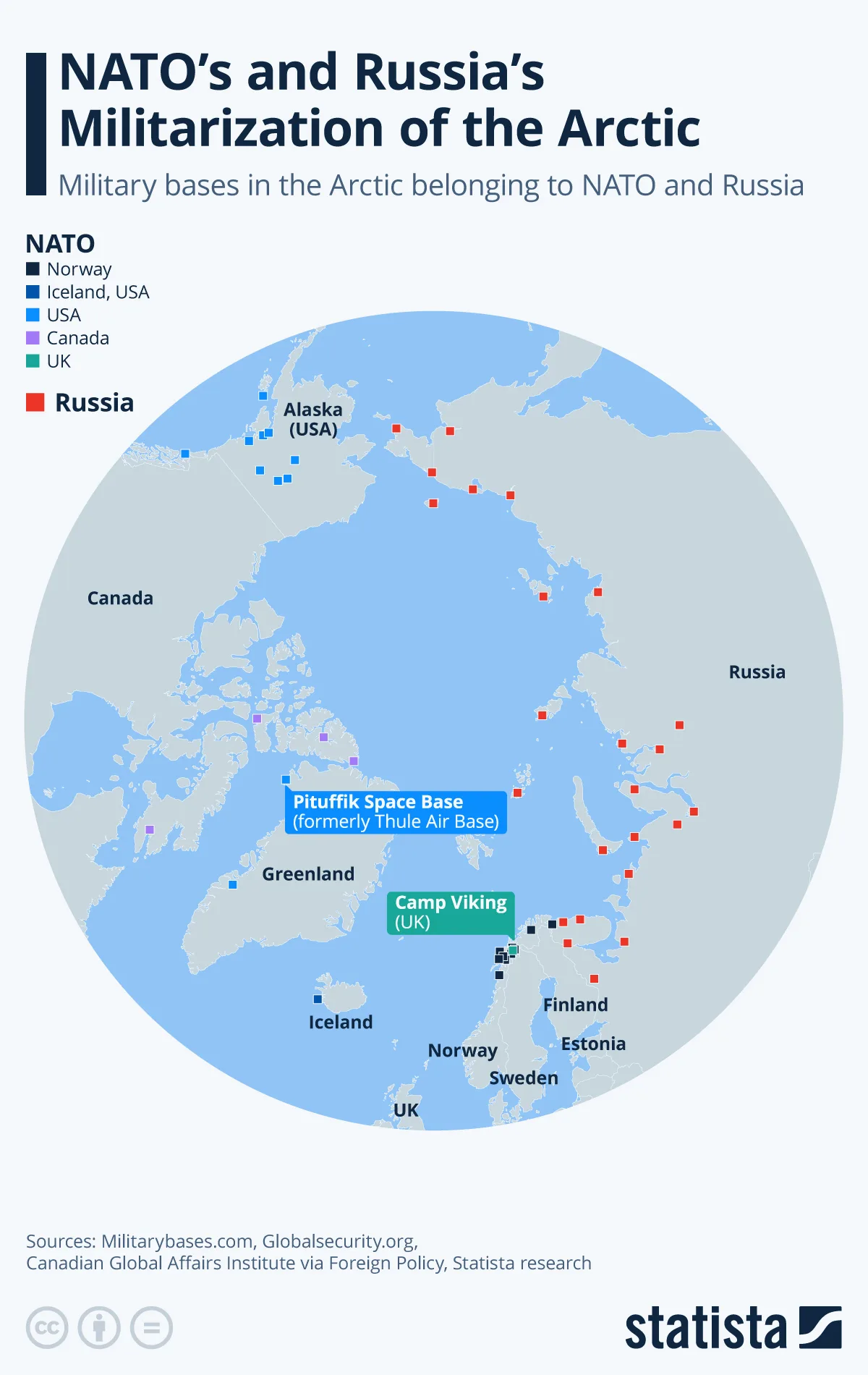
    The military landscape is increasingly defined by the construction and enhancement of military bases across the Arctic. Norway, for example, operates 13 bases in the region, including the newly established Camp Viking, a training ground for UK Royal Marines Commandos. The United States maintains several military installations in Alaska, along with bases in Greenland and Iceland.

    The Question of Expansion

    Despite past suggestions from U.S. President Donald Trump regarding the purchase of Greenland, the current U.S. administration has clarified that there are no immediate plans to augment America’s military presence in the region. The existing infrastructure is already substantial, comprising a mix of naval, air force, and ground forces directed at maintaining a presence in the Arctic.

    A Military Map of the Arctic

    Data recently published by Foreign Policy illustrates the considerable military presence in the Arctic, highlighting bases along with their strategic importance. The increased operational capabilities of both NATO and Russian forces point to a shared understanding of the region’s significance in global geopolitics.

    The Geopolitical Implications of Arctic Militarization

    As the Arctic transforms from a peaceful cooperative zone to an arena of strategic military maneuvers, the balance of power among Arctic nations is being tested. Russia’s military investments and aggressive posturing combined with NATO’s growing footprint amplify concerns about regional stability. The interplay of these military forces creates a complex geopolitical dynamic that could escalate tensions or potentially lead to conflict in an area long considered neutral.


    By understanding the current military postures and cooperative challenges in the Arctic, stakeholders can better navigate the evolving geopolitical landscape defined by competition over resources, strategic routes, and national security interests.

  • Russia Leads with 57 Icebreakers, NATO Has 47

    Russia Leads with 57 Icebreakers, NATO Has 47

    The Strategic Importance of Icebreakers in Global Geopolitics

    Introduction to Icebreakers

    Icebreakers are specialized vessels designed to navigate through ice-covered waters. They play a crucial role in ensuring safe passage for trade routes, conducting scientific research, and maintaining national security in polar regions. As climate change continues to alter global shipping routes by reducing ice cover, the significance of icebreakers is becoming increasingly apparent.

    Russia’s Dominance in Icebreaker Fleet

    In the competitive arena of icebreaking capabilities, Russia has established itself as a leader. According to data compiled by the International Institute for Strategic Studies (IISS), Russia boasted a fleet of 57 icebreakers and ice-capable patrol ships as of 2022. This superior number greatly surpassed that of any other nation, highlighting Russia’s strategic positioning in Arctic waters.

    The Role of Russian Icebreakers

    Russian icebreakers serve multiple purposes, including:

    • Supporting maritime navigation in ice-laden waters
    • Conducting research missions in collaboration with various scientific institutions
    • Ensuring military readiness and sovereignty across Arctic territories

    The Emergence of the ICE Pact

    Recognizing the strategic importance of icebreakers, Canada, the United States, and Finland announced the formation of a trilateral partnership known as the "ICE Pact" in July 2024. The pact aims to collaboratively develop a fleet of up to 90 icebreakers in the upcoming years.

    Objectives of the ICE Pact

    The objectives of the ICE Pact encompass various facets:

    • Scientific Missions: These icebreakers will facilitate essential research in polar regions, contributing to global understanding of climate change and ecological studies.
    • National Security: The pact is also perceived through the lens of defense, as these vessels will reinforce the respective nations’ capabilities to project power and maintain sovereignty in the Arctic.

    Comparative Analysis of Global Icebreaker Fleets

    The competitive landscape of icebreaker fleets is not limited to Russia and the ICE Pact nations. Other countries have also made strides in establishing their icebreaking capabilities.

    NATO’s Collective Icebreaker Count

    As of 2022, the NATO alliance, which includes Sweden and Finland among its members, had a total of 47 icebreakers. This collective strength is aimed at ensuring the security of navigation routes in the Arctic and maintaining a strategic posture in the face of Russian influence.

    The Growing Fleet of China

    China is also making significant advancements in its icebreaker capabilities. With a current fleet of three icebreakers, including a planned fourth polar research icebreaker expected to be delivered in 2025, China is positioning itself as a growing player in Arctic exploration and navigation.

    The Implications of Icebreaker Activities

    The expansion of icebreaker fleets has broad implications for international relations and climate policy. As nations vie for control over increasingly accessible shipping lanes, particularly in the Arctic, the stakes are high.

    Geopolitical Tensions in the Arctic

    With heightened activities around icebreaking capabilities, geopolitical tensions could rise as countries assert their claims to Arctic territories. The icebreaker fleets serve as a symbol of national presence in these strategically important waters, influencing maritime law and territorial sovereignty.

    Icebreakers as a Tool for Environmental Research

    While icebreakers are often seen through a military and geopolitical lens, they are also invaluable for scientific research. The role of these vessels in facilitating climate research and ecological monitoring cannot be overlooked.

    Contributions to Climate Science

    Icebreakers enable scientists to conduct research in areas that would otherwise be impenetrable due to ice cover. This research is critical for understanding the impacts of climate change on polar ecosystems and global weather patterns.

    Conclusion

    With an evolving landscape in the realm of icebreaking capabilities, nations are actively adjusting their strategies to account for changing environmental conditions and international pressures. This ongoing competition and collaboration will undoubtedly shape the future of Arctic navigation and governance.