الوسم: Alaska

  • Scientists traced a fireball’s path in Alaska by ‘listening’ to it

    Scientists traced a fireball’s path in Alaska by ‘listening’ to it

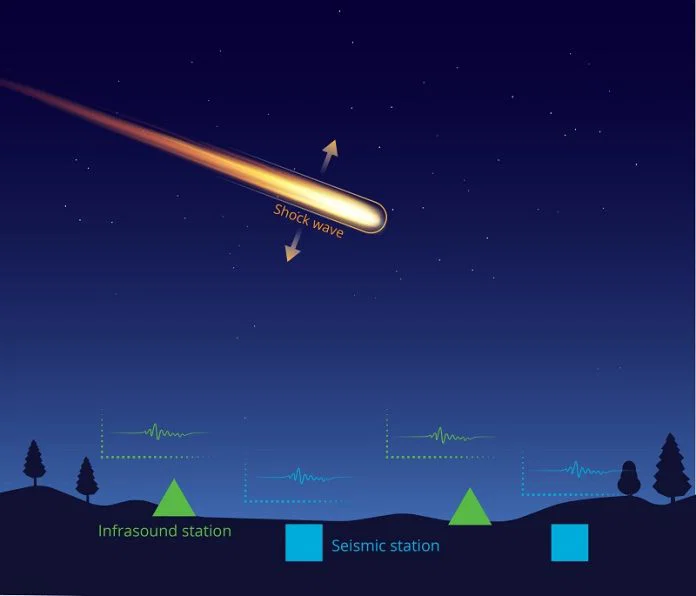
    When a bright fireball streaked across the sky over Alaska last spring, scientists anticipated that cameras and satellites would precisely track its origin and potential landing sites. However, many of these observational tools missed crucial details. Fortunately, the fireball left behind another valuable clue—powerful low-frequency sound waves that traveled hundreds of miles through the atmosphere.

    By analyzing these sounds alongside subtle ground vibrations, weather radar data, and videos shared by the public, researchers reconstructed the fireball’s trajectory. Their findings, published in the Journal of Geophysical Research: Planets, demonstrate that “listening” to a meteor can be just as effective as observing it visually.

    The investigation started on the day the fireball appeared. Logan Scamfer, then a research assistant at the University of Alaska Fairbanks, noticed unusual signals in data collected by earthquake monitoring stations. Initially, these signals didn’t resemble typical earthquake patterns. As he examined data from multiple monitoring stations across Alaska, he saw the same unusual pattern recurring.

    He also detected a distinct “N-wave,” a unique sound pattern often produced by shockwaves from fast-moving objects. This led him to suspect that a meteor had entered Earth’s atmosphere. News reports later confirmed many eyewitnesses had seen a bright fireball cross the sky.

    A month afterward, Scamfer began an internship at Sandia National Laboratories, working alongside physicist Elizabeth Silber, an expert in studying meteors via infrasound—sound waves of very low frequency that are inaudible to humans but can travel vast distances. Since cameras and satellites didn’t fully capture the event, the team relied heavily on the sound waves and ground vibrations recorded by various sensors.

    Alaska proved to be an ideal location for such work, due to its extensive network of seismic and infrasound sensors used mainly for monitoring earthquakes and volcanic activity. These instruments also detected the pressure waves generated by the meteoroid traveling at hypersonic speeds through the atmosphere.

    In total, 57 sensors recorded signals from the fireball, including earthquake and infrasound stations, some detecting the event from as far as 580 kilometers away. By analyzing the timing of these signals, scientists mapped the meteoroid’s path, pinpointed where it disintegrated, and estimated the probable crash site for meteorite fragments. This information was shared with a NASA scientist, who utilized Doppler weather radar to locate the falling debris cloud.

    The team also corroborated their findings with dashcam and security camera footage provided by citizen scientists, enhancing the accuracy of their reconstruction. They estimate the meteoroid entered the atmosphere at roughly 19 degrees and traveled between 80,000 and 90,000 kilometers per hour. The energy released from the explosion was equivalent to about 38 tons of TNT, and the object probably originated from the asteroid belt between Mars and Jupiter.

    This study represents the first successful effort to locate meteorite debris on weather radar primarily using sound and seismic data. This innovative method offers a promising tool for planetary defense, especially when fireballs occur during daylight hours or in regions inaccessible to cameras.

    By integrating sound, seismic signals, radar data, and citizen videos, scientists demonstrated that even without clear visual evidence, a fireball’s story can still be uncovered—if one knows how to listen.

  • Rubio and Lavrov set stage ahead of Trump-Putin meeting

    Rubio and Lavrov set stage ahead of Trump-Putin meeting

    The US Secretary of State, Marco Rubio, had a phone call on Tuesday with Russian Foreign Minister Sergei Lavrov to coordinate the upcoming summit in Alaska between President Donald Trump and President Vladimir Putin, according to the State Department. Both parties reaffirmed their dedication to making the event successful, with Putin requesting the meeting, scheduled for Friday in Alaska.

    Ukrainian President Volodymyr Zelensky has called this meeting a “personal victory” for Putin, who has been largely isolated by Western countries since launching his invasion of Ukraine in February 2022.

    In an earlier radio interview on Tuesday, Rubio dismissed criticism surrounding the summit. He explained that Trump feels the need to meet face-to-face with Putin to assess him directly, saying, “President Trump wants to look him in the eyes. He needs to hear him speak one-on-one.” Rubio emphasized that a meeting for Trump is not a sign of concession but a necessary step for understanding.

    Trump has previously indicated that any peace agreement would involve some territorial exchanges that benefit both Russia and Ukraine, which has historically relied heavily on the U.S. for military aid. However, since the contested regions are within Ukraine’s borders, Zelensky and European Union leaders worry that Ukraine might be pressured to cede more territory than Russia.

    The Biden administration has lowered expectations for significant breakthroughs at the Alaska summit, describing it mainly as a “listening exercise” with Putin. Zelensky and most European allies stress that lasting peace depends on Ukraine’s direct involvement in negotiations, with any deal respecting international law, Ukraine’s sovereignty, and territorial integrity.

    Ahead of the summit, Zelensky and his European counterparts will participate in a virtual meeting with Trump on Wednesday to highlight these concerns. This marks the first U.S.-Russia summit since 2021.

    Zelensky has stated that any genuine peace must begin with Russia agreeing to a ceasefire first, and he rejects any Russian proposals for Ukraine to withdraw from eastern Donbas or abandon its defensive positions.

    Regarding Zelensky’s absence from the Alaska talks, a White House spokesperson explained that Putin was the one who proposed the bilateral meeting, which Trump accepted to better understand how to bring the conflict to an end. The spokesperson added, “This is for the president to gain a clearer picture of the situation. Both countries need to agree to any deal.”

  • Magnitude 7.1 Earthquake Hits Alaska Peninsula

    Magnitude 7.1 Earthquake Hits Alaska Peninsula

    A representation of the Richter scale measuring earthquakes. — Reuters/File

    LOS ANGELES: A 7.3-magnitude earthquake hit off the coast of Alaska on Wednesday, leading to a tsunami warning issued by the U.S. Geological Survey (USGS).

    The quake struck around 12:37 PM local time (2037 GMT), with its epicenter approximately 54 miles (87 kilometers) south of Sand Point, as reported by the USGS. It occurred at a relatively shallow depth of 20.1 kilometers.

    In the aftermath of the tremor, officials issued a tsunami warning for the southern regions of Alaska and the Alaska Peninsula.

    “A tsunami has been confirmed, and impacts are anticipated,” stated the National Tsunami Warning Center based in Palmer, Alaska.

    The specific warning area included “South Alaska and the Alaska Peninsula, as well as the Pacific coasts from Kennedy Entrance, Alaska (40 miles southwest of Homer) to Unimak Pass, Alaska (80 miles northeast of Unalaska),” as indicated by the center.

    For now, initial data shows that tsunami alerts have not been extended to other areas, according to the NTWC.

    Alaska is situated within the seismically active Pacific Ring of Fire.

    In March 1964, the state experienced a massive 9.2-magnitude earthquake, the largest ever recorded in North America, which devastated Anchorage and caused a tsunami that impacted the Gulf of Alaska, the U.S. West Coast, and Hawaii.

    That disaster claimed over 250 lives due to both the earthquake and resulting tsunami.

    In July 2023, a separate 7.2-magnitude earthquake occurred off the Alaskan Peninsula, but fortunately, there were no significant damages reported.