Tag: airstrikes

  • Cairo Talks Challenge Trump’s Gaza Peace Plan Amid Renewed Israeli Airstrikes

    Cairo Talks Challenge Trump’s Gaza Peace Plan Amid Renewed Israeli Airstrikes

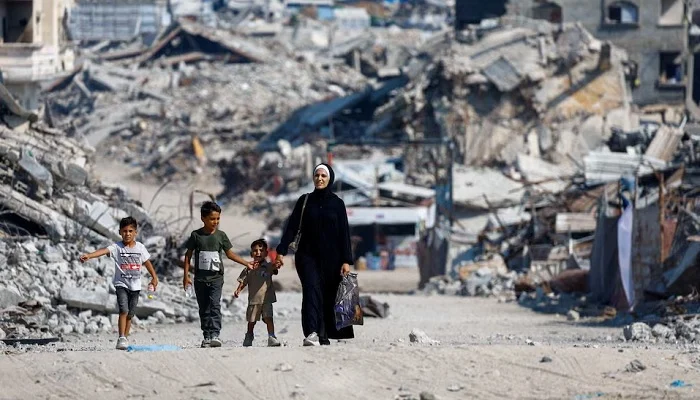
    Palestinians walk past the rubble of residential buildings destroyed during the conflict in Gaza City, August 15, 2026.— Reuters

    – Trump’s proposal calls for an immediate halt to military operations in Gaza.
    – Envoys are set to meet with Netanyahu on Monday, according to an Israeli official.
    – Israel claims it targeted militants in its recent Gaza strikes.

    Donald Trump’s representatives met with mediators from Egypt, Qatar, and Turkey in Cairo on Sunday, an anonymous diplomatic source revealed. The goal was to push forward with the U.S. president’s peace initiative for Gaza, despite ongoing Israeli airstrikes in the region.

    Hamas officials attended some of the talks that Trump’s envoy and his son-in-law, Jared Kushner, as well as Nickolay Mladenov—Trump’s representative for Gaza—conducted with mediators.

    An Israeli official stated that Kushner and Mladenov were scheduled to meet with Prime Minister Benjamin Netanyahu on Monday. Netanyahu had previously dismissed Trump’s recent peace plan for Gaza as “unacceptable” on August 9.

    The Israeli source expressed concerns over Washington’s insistence on ending targeted killings of Hamas fighters, as the group works to rebuild its strength.

    Trump’s peace proposal demands an immediate end to hostilities in Gaza, envisioning Hamas disarming as Israeli forces withdraw and Gaza undergoes reconstruction under a new civilian Palestinian government.

    Israel has resumed airstrikes after a brief reduction earlier this month. The military reported hitting two militants from Islamic Jihad and Hamas in Khan Younis and Nuseirat, injuring at least five Palestinians in the process. Medics noted that one of the wounded in Khan Younis later died from their injuries.

    Another strike targeted a different fighter, hitting an apartment in Nuseirat in central Gaza and wounding several individuals, according to medical personnel.

    Earlier, Hamas leader Khalil Al-Hayya met with Egypt’s intelligence chief, Hassan Rashad, in Cairo. Hamas spokesperson Hazem Qassem mentioned that Al-Hayya would update mediators on alleged violations of the ceasefire by Israel.

    Last month, Trump announced a major breakthrough in his effort to end the conflict. Hamas indicated it had agreed to the peace plan to avoid further fighting but emphasized that Israel must first meet its commitments by withdrawing its forces and ceasing attacks.

    Five Arab nations along with Turkey, Pakistan, and Indonesia condemned Israel’s rejection of the plan. In a joint statement issued Sunday, they warned that this move jeopardizes Trump’s peace efforts.

    Netanyahu’s Likud party, which faces tough polls ahead of the October 27 national election, claimed that Arab countries aim to topple Netanyahu so that his political opponents can “give them everything they want.”

    Hamas also called on mediators and the Peace Board—established under Trump’s plan—to pressure Israel into fulfilling its initial obligations, ending ceasefire violations, and approving the next phase of the roadmap.

    A ceasefire in October halted the intense two-year conflict that began after Hamas launched an attack on Israel on October 7, 2023. However, the ceasefire failed to stop all Israeli attacks entirely.

    Since October 2025, Israeli forces have killed over 1,250 Palestinians in Gaza, most of whom were civilians. The exact number of militants among the dead remains unclear, as Hamas typically does not disclose such details. Meanwhile, four Israeli soldiers have been killed by Gaza-based fighters during the same period, according to Israeli reports.

  • Iranian Leaders Killed in US-Israel Conflict

    Iranian Leaders Killed in US-Israel Conflict

    During the US-Israeli conflict with Iran, a series of airstrikes resulted in the deaths of several high-ranking officials from the Islamic Republic, starting with Supreme Leader Ali Khamenei. In March, President Donald Trump announced that the campaign had succeeded in forcing a regime change; however, Iran quickly adapted by replacing its slain leaders and continuing its resistance against the US and Israel.

    With an agreement announced Monday to cease hostilities between Washington and Tehran, here is a summary of the key figures who were martyred during the conflict:

    Supreme Leader Ayatollah Ali Khamenei
    Iran’s top leader since 1989 was killed within the first hour of the conflict on February 28 in a strike targeting a meeting of senior officials in Tehran, which also claimed the lives of his daughter-in-law, daughter, and at least one grandchild. His son Mojtaba, who is reportedly injured, survived and has assumed the role of Supreme Leader, but has yet to make a public appearance. Khamenei’s funeral is scheduled for July 9 in Mashhad, his hometown, after three days of ceremonies in Tehran and Qom.

    Security Chief Ali Larijani
    Larijani, a crucial figure for decades despite not being a cleric, was martyred in an Israeli strike on March 17, likely in the Tehran area, which also killed members of his family. The previous week, he publicly demonstrated defiance by attending a pro-government rally in Tehran.

    Revolutionary Guards Commander Mohammad Pakpour
    Pakpour, who had previously commanded the Guards’ ground forces, took on the role of chief commander in June 2025 after Hossein Salami was martyred in Israel’s 12-day war against Iran. He was killed on the war’s first day and has been succeeded by former interior and defense minister Ahmad Vahidi.

    Navy Commander Alireza Tangsiri
    A veteran of the Iran-Iraq war, Tangsiri had led the Guards’ navy since 2018 and was among the highest-profile officials within the Islamic republic. Israel’s defense minister characterized him as the individual responsible for operations like mining and blockading the Strait of Hormuz.

    Advisor Ali Shamkhani
    A longstanding member of Iran’s armed forces since the 1980s, Shamkhani was killed in an airstrike on the first day of the war. His funeral was held publicly in Tehran’s Tajrish Square.

    Intelligence Minister Esmail Khatib
    Khatib, a cleric, was targeted and killed by an Israeli strike early on March 18 in Tehran. Since taking the role in 2021, rights groups have accused him of playing a key part in suppressing protests.

    Defense Minister Aziz Nasirzadeh
    With a service history dating back to the Iran-Iraq war, Nasirzadeh was martyred during the first day of the conflict after serving as defense minister since 2024.

    Basij Commander Gholamreza Soleimani
    Leading the Basij—a volunteer paramilitary group associated with the Revolutionary Guards notorious for protest suppression—Soleimani was killed in an airstrike on March 17.

    Spokesman Ali Mohammad Naini
    Naini was martyred in March during what the Guards described as a “cowardly” attack by the US and Israel. Before his death, he had publicly praised Iran’s missile program, claiming it continued robustly despite the war.

    Head of Military Office Mohammad Shirazi
    Killed on the conflict’s first day, Shirazi was responsible for coordinating between different branches of Iran’s security forces under the Supreme Leader.

    Armed Forces Chief Abdolrahim Mousavi
    Mousavi, also killed on the war’s first day, took office in June 2025 after his predecessor Mohammad Bagheri died during the 12-day conflict. He oversaw coordination between the Guard units and the regular army.

  • US Congress Briefing Unveils Heavy Spending on Iran War

    US Congress Briefing Unveils Heavy Spending on Iran War

    During a congressional briefing this week, officials in President Donald Trump’s administration estimated that the initial six days of hostilities with Iran have cost the United States at least $11.3 billion. This figure, shared with lawmakers in a closed-door session on Tuesday, does not encompass the total expenses of the conflict but provides a snapshot of early costs amid growing concerns for additional funding. Some aides anticipate the White House will soon submit a request to Congress for supplementary war funds, with estimates ranging from $50 billion to possibly higher, reflecting apprehensions about underestimating the true financial burden.

    Publicly, the administration has yet to offer a comprehensive assessment of the conflict’s cost or an estimate of its expected duration. President Trump, during a visit to Kentucky on Wednesday, declared that “we won” the war but emphasized that U.S. forces will remain engaged until the mission is fully accomplished.

    The $11.3 billion figure was initially reported by the New York Times. The campaign, which began on February 28 through combined U.S. and Israeli airstrikes, has resulted in approximately 2,000 casualties, primarily Iranians and Lebanese. As the violence has extended into Lebanon, global energy markets and transportation routes have been disrupted, creating a ripple effect on international stability.

    According to officials, roughly $5.6 billion of munitions were expended within the first two days of the strikes. Members of Congress, who may soon authorize additional military funding, have expressed concern over the depletion of U.S. military reserves—especially at a time when the defense industry is already facing supply challenges. Last week, Trump met with executives from seven defense contractors to discuss replenishing stockpiles.

    Democratic lawmakers are demanding that administration officials testify under oath about the planning and duration of the conflict, along with future strategies for Iran once active hostilities cease.

  • Key Iranian Figures Killed in US-Israel Military Attacks

    Key Iranian Figures Killed in US-Israel Military Attacks

    Several high-ranking Iranian officials, including Supreme Leader Ayatollah Ali Khamenei, have been killed in Israel and U.S. airstrikes, which Tehran describes as “unprovoked and unwarranted.” As protesters gathered near the Green Zone in Baghdad, loud explosions echoed through the city. The Israeli military claimed it was targeting locations within the city center again, while additional blasts were heard in Jerusalem, Riyadh, Dubai, Doha, and Manama.

    Iran’s President Masoud Pezeshkian condemned Khamenei’s assassination as a “declaration of war against Muslims” and stated that Iran sees it as its lawful duty to seek retribution against those responsible for this “historic crime.”

    State media in Iran confirmed the deaths of several senior leaders, including:

    – Ayatollah Ali Khamenei, Supreme Leader of Iran
    – Ali Shamkhani, representative of the Supreme Leader on the Supreme Defense Council
    – General Abdolrahim Mousavi, Chief of Staff of Iran’s Armed Forces
    – Major General Mohammad Pakpour, Commander-in-Chief of the Islamic Revolution Guards Corps (IRGC)
    – Aziz Nasirzadeh, Minister of Defense
    – Gholamreza Rezaian, Iran’s police intelligence chief

    In addition, Khamenei’s daughter, son-in-law, and granddaughter also lost their lives in the strikes carried out by the U.S. and Israel.

  • Israeli Airstrike Targets Area Near Syrian Presidential Palace

    Israeli Airstrike Targets Area Near Syrian Presidential Palace

    This image captures smoke billowing after strikes on Syria’s defense ministry in Damascus on July 16, 2025. — Reuters

    An Israeli airstrike targeted an area near the presidential palace in Damascus, the capital of Syria, on Wednesday, as reported by a Reuters witness.

    The assault occurred as the Israeli military initiated new strikes in the vicinity of the Syrian military and defense ministry headquarters, according to state television, following previous attacks.

    Live footage broadcasted by Al Jazeera displayed extensive damage to the defense ministry in Damascus, highlighting Israel’s ramped-up offensive in Syria, including the capital.

    Earlier on Wednesday, Israeli Defense Minister Israel Katz issued a warning to the Syrian government to “stay away from the Druze,” following violent clashes in the Druze-majority city of Sweida.


    This is a developing story and will be updated with new information.