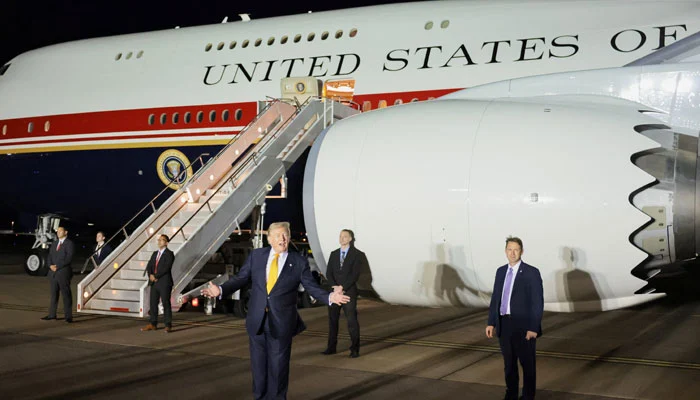
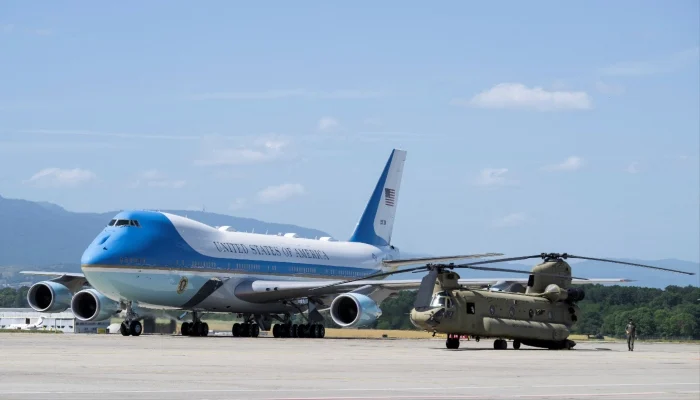
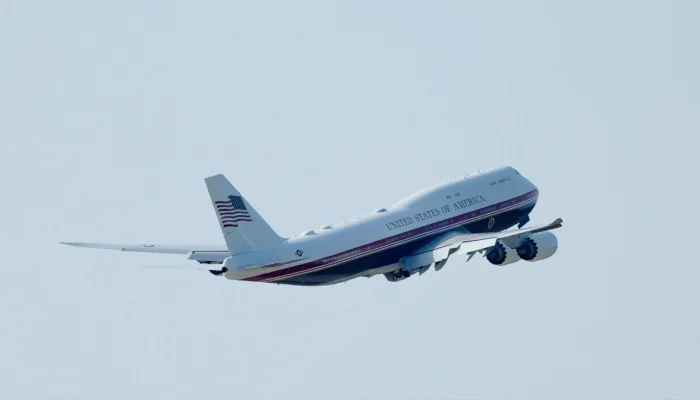
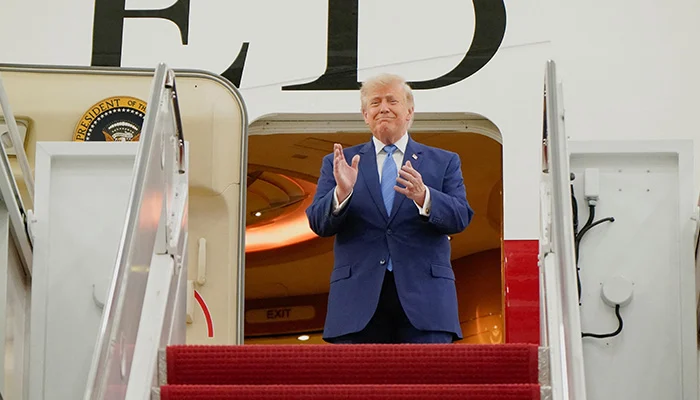
A catering truck is stationed across from Air Force One just before President Donald Trump departs Ankara for Washington following the NATO leaders’ summit at Ankara Esenboğa Airport, Turkey, July 8, 2026. — Reuters
– Trump departed Turkey aboard a C-32A jet due to credible, immediate threats.
– The threat surfaced on the final day of his NATO summit visit: source.
– Air Force One left separately with Rubio, Bessent, and others.
A credible threat involving a shoulder-fired missile targeting Air Force One led the Secret Service to covertly switch President Donald Trump to a smaller government aircraft during his recent trip to Turkey, a source familiar with the operation revealed Wednesday.
The concern arose on the last day of Trump’s stay in Ankara for the NATO summit amid rising tensions with Iran. Officials considered the threat credible and imminent, prompting an extraordinary effort to hide the President’s movements.
While the source did not specify the origin of the intelligence, they mentioned the plans were rushed and devised at the last minute. Another official stated there was no concrete plan by adversaries to carry out the attack, only an intent, which allowed the plane to take off as scheduled.
Trump and a small team of aides discreetly transferred from the large presidential aircraft to a less conspicuous C-32A jet using a catering truck, while Air Force One departed separately carrying senior officials and the press pool, the first source said.
Trump told reporters Tuesday that the Secret Service advised him to make the switch, which was carried out without incident during a flight from Ankara to a refueling stop in the UK. He claimed the alternative plane was at greater risk, suggesting it was a more likely target, but did not provide proof.
Experts, like Douglas Birkey of the Mitchell Institute for Aerospace Studies, indicated the threat could involve new heat-seeking missiles that target aircraft engines by homing in on heat signatures. These types of weapons are increasingly concerning for military planning because they are more challenging to detect than radar-guided missiles and can come unexpectedly, as they don’t emit detectable radio waves.
One suspected version, the Iranian SA-67, features a simple rail launcher and uses heat and laser guidance. The Russian-made 9K333 Verba shoulder-mounted missile also employs heat-seeking technology.
### Secretive Travel Operations
U.S. Presidents, including Trump, have occasionally traveled secretly when visiting war zones or high-risk areas to ensure security, usually with advance notice given to accompanying journalists. For instance, some members of the press were informed ahead of President George W. Bush’s 2003 trip to Baghdad, while others were misled into thinking he was spending Thanksgiving with family before suddenly appearing in Iraq.
The first official stated that the Secret Service did not have the luxury of time in Turkey, emphasizing they were scrambling to prevent what was believed to be a credible, imminent threat.
The Washington Post first reported details of this operation in the recent week, over a month after it took place. The New York Times noted concerns among U.S. officials that Iranian operatives knew Trump’s exact whereabouts in Ankara, including the specific hotel floor.
On the day of departure, the small “decoy” aircraft carried Secretary of State Marco Rubio (who was briefed on the maneuver), Treasury Secretary Scott Bessent, White House Communications Director Steven Cheung, several aides, and the press pool, which included Reuters journalists. Alongside Trump, deputy chief of staff Dan Scavino, assistant Natalie Harp, and Oval Office operations chief Walt Nauta moved via the catering truck.
Some skeptics have questioned whether this covert move placed aides and traveling journalists at risk aboard the presumed “secure” plane. The first source justified the secrecy, citing escalating tensions with Iran, which borders Turkey.
Turkish officials have yet to comment publicly on the threat.