Tag: AI tools

  • 20% of Americans Use AI Tools Daily: A Growing Trend

    20% of Americans Use AI Tools Daily: A Growing Trend

    The Explosive Rise of AI Tools in Everyday Life

    The Surge in Popularity of Generative AI

    The advent of generative AI has been nothing short of revolutionary, particularly after the public release of ChatGPT in late 2022. Since then, these AI tools have quickly become synonymous with cutting-edge technology, showcasing the impressive capabilities of artificial intelligence in ways that resonate with everyday consumers. As we delve into how these tools are integrated into daily routines, it’s crucial to explore both their usage and the perceptions surrounding them.

    Understanding the Current Landscape of AI Utilization

    Statistics on AI Engagement

    Recent statistics reveal an intriguing picture of AI adoption among consumers. According to a Statista Consumer Insights study, approximately 30% of U.S. adults reported using AI chatbots like ChatGPT or Meta AI within the past year leading up to August 2024. This indicates a noteworthy level of interest and preliminary engagement with generative AI tools, especially in a landscape that promises rapid growth and innovation in AI technology.

    Real vs. Perceived Integration of AI Tools in Daily Life

    Everyday Applications of AI

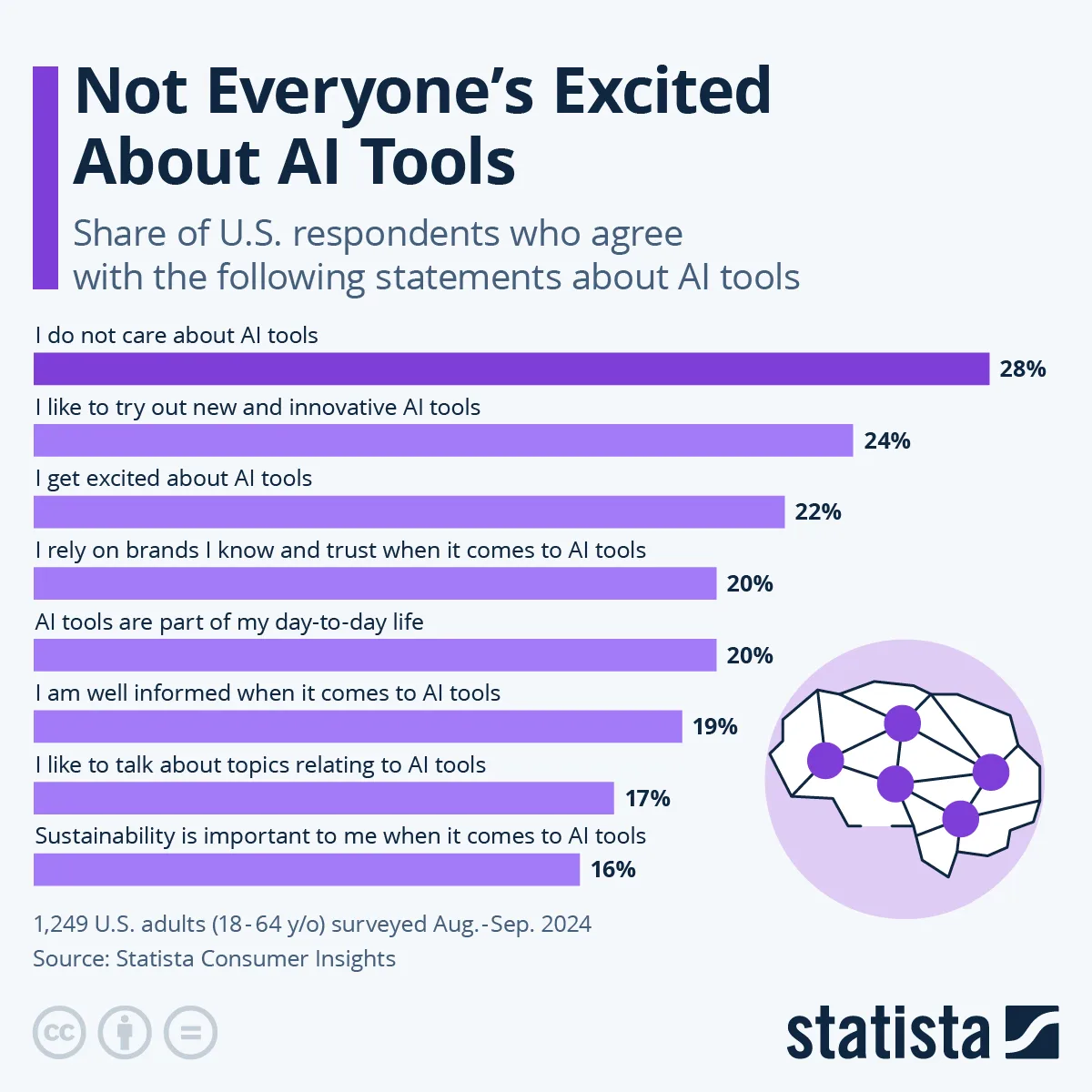
    While many individuals are experimenting with AI tools, the actual integration of these tools into daily life presents a more complex narrative. The same Statista survey highlighted that only 20% of Americans consider AI tools an integral part of their everyday routines. This statistic might seem modest; however, it highlights a crucial distinction between trying out new technologies and genuinely incorporating them into one’s lifestyle.

    Regional Variations in AI Engagement

    Interestingly, the survey results reveal significant regional variations in the adoption and integration of AI tools. For instance, countries like Brazil and India show considerably higher percentages—33% and 41%, respectively—of respondents reporting that AI tools are part of their daily lives. This disparity may stem from differing access to technology, cultural attitudes toward innovation, or even the specifics of local market conditions.

    The Invisible Yet Pervasive Role of AI

    AI in the Background

    An essential factor often overlooked in conversations about AI adoption is how its presence is often unnoticed in daily applications. While explicit usage of AI chatbots might be low, many services and tools that people frequently interact with—think social media platforms, online shopping experiences, and navigation apps—are imbued with AI functionalities. In many cases, consumers might not perceive these encounters as direct interactions with AI, leading to an undervaluation of its role in their lives.

    Examples of AI in Daily Services

    Some common examples include personalized shopping recommendations on e-commerce websites, AI-driven customer service chatbots, and virtual assistants like Siri and Google Assistant. These tools work continually in the background, enhancing user experience without users explicitly recognizing their reliance on AI technology.

    Addressing the Barriers to Wider AI Adoption

    Awareness and Understanding

    One of the primary barriers to widespread AI adoption is a lack of awareness and understanding about what these tools can offer. As generative AI continues to evolve, it is essential to improve consumers’ education on AI benefits, safety, and ethical considerations. Bridging this knowledge gap can lead to greater acceptance and usage in everyday life.

    The Role of Trust in AI Adoption

    Another factor plays a significant role in how people engage with AI technologies: trust. Consumers are often hesitant to use new technologies that they do not fully understand or that have not yet established a track record of reliability and safety. Building consumer trust and illustrating the tangible benefits of AI tools can facilitate deeper integration into daily routines.

    The Future of AI in Everyday Life

    While current statistics show that approximately 20% of Americans actively engage with AI tools in their day-to-day activities, the trend indicates that these figures are likely to grow. As generative AI continues to develop, and as more applications become viable and user-friendly, we can expect a clearer picture of how these tools will shape our futures, especially in everyday life. The journey from mere trial to meaningful application is one that holds exciting potential for both consumers and AI developers alike.

  • Microsoft Adds Copilot+ AI Tools for Intel and AMD PCs

    Microsoft Adds Copilot+ AI Tools for Intel and AMD PCs

    If you invested in a new AI-powered Copilot+ PC equipped with the latest Intel or AMD processor, and noticed the absence of certain features, your wait is finally over. Several of those Copilot+ enhancements are now becoming available for devices that utilize Intel and AMD processors.

    It’s been nearly a year since Microsoft unveiled the Copilot+ PC classification, designed to prioritize AI capabilities. Up until now, Qualcomm was the exclusive chip supplier for these devices.

    In late 2024, competing chip manufacturers entered the Copilot scene with the release of AMD’s Ryzen AI 300 series and Intel’s Core Ultra 200V series processors. However, many features remained inaccessible to those using Intel and AMD machines.

    That situation is finally changing today. Microsoft announces that Copilot tools such as Live Captions, Cocreator, Restyle Image, and Image Creator will now be available on Copilot+ hardware powered by Intel and AMD.

    What is changing?

    Starting with Live Caption, this functionality provides captions for videos, audio, and real-time interactions like meetings conducted in English. It can also translate text from over 40 different languages into English, as well as 27 languages into Chinese.

    In the future, a new feature called Voice Access will enable users to manage their PC using natural language commands. This feature is already rolling out to Copilot+ devices with Qualcomm chips, with support for AMD and Intel hardware anticipated soon.

    For creative tasks, the AI-powered Cocreator feature is now available in Paint across all device types. Microsoft claims it helps make artistic creation and image enhancement more intuitive and accessible. Users can blend text-based editing with freehand drawing, providing added flexibility.

    Through the Photos app, users of Intel and AMD machines will also gain access to the Restyle Image and Image Creator tools. The Image Creator function allows for generating images based on text descriptions, similar to how you would interact with ChatGPT to create Ghibli-inspired art. The Restyle tool, meanwhile, applies artistic effects to images in a preset manner.

    All of these AI features will be available on AMD and Intel-powered Copilot+ PCs with the March 2025 Windows update. It’s intriguing to consider why these capabilities were initially absent from Intel and AMD devices, even though they satisfied the minimum AI performance criteria.

    Unfortunately, this trend of missing features is not expected to end soon. Recently, Microsoft announced enhancements to the Windows Search experience, which will significantly simplify locating files, photos, and settings. Regrettably, this improvement will only be available for Snapdragon-based Copilot+ devices.

  • Google Offers Pixel 9 Owners New AI Tools And Scam Protection

    Google Offers Pixel 9 Owners New AI Tools And Scam Protection

    Google is taking significant steps to protect Pixel users from scammers. Starting in March, it will roll out new scam detection capabilities within the Phone by Google and Google Messages apps, powered by artificial intelligence.

    A recent update on the Google Store revealed that this new feature is designed to recognize conversation patterns typically associated with scams.

    As Google explains, “Your phone can utilize on-device processing to pinpoint conversation cues commonly linked to scammers, such as a supposed ‘bank representative’ urgently requesting money transfers, gift card payments, or sensitive details like PINs and passwords.”

    When such suspicious activity is detected, users will receive an instant alert stating, “Suspicious activity detected for this call.” They will then have the option to choose between “End call” or “Not a scam.”

    Similarly, users will find that the scam detection feature in Google Messages functions in a comparable manner.

    As reported by 9to5Google, this feature aims to shield users from dubious text messages that may appear innocuous but could ultimately lead to fraud. Messages regarding package deliveries or enticing job offers are among the most common offenders.

    Any identified scam messages will be automatically sorted into the “Spam & Blocked” folder.

    The scam detection function for the Phone by Google app was initially introduced in a beta version last November, with the beta for Google Messages launching a month prior.

    These advanced scam detection features utilize Google’s Gemini Nano AI model on the Pixel 9 series, while earlier models, including the Pixel 6, Pixel 7, and Pixel 8, rely on other Google machine learning models.

    Launched in late 2023, Gemini Nano represents Google’s push to enhance mobile technology with advanced AI capabilities. This innovative on-device AI model is engineered for efficiency, allowing complex tasks to be executed without relying on cloud services. By focusing on local processing, it prioritizes user privacy while delivering quicker and more responsive interactions.

    Noteworthy features of Gemini Nano include enhanced text processing abilities, smart replies, summarization, and improved grammar correction. The model also expands accessibility features and enables real-time, on-device scam detection during calls.

    A key characteristic of Gemini Nano is its multimodal capability, allowing it to interpret and process diverse information types, such as images and sounds. This sophisticated model is uniquely integrated into the Pixel 9 series and is driven by the Google Tensor G4 chip. Its local operation minimizes latency and safeguards sensitive user data.

    These two exciting updates are anticipated to be part of the March Pixel Feature Drop.

    Upcoming scam detection feature for Pixel Phone in March 2025.
    Google
  • OpenAI Unveils Operator AI for Task Automation in Booking and Shopping

    OpenAI Unveils Operator AI for Task Automation in Booking and Shopping

    OpenAI has introduced Operator, an innovative AI agent that can independently perform tasks online.

    This development is a significant advancement in the company’s mission to improve AI agents, a technology that Sam Altman, CEO of OpenAI, has described as essential for the future by 2025.

    Operator is a versatile AI tool capable of executing a variety of online tasks, including booking travel, making restaurant reservations, and shopping.

    Initially, it will be available to US users subscribed to the $200 Pro plan, with plans to extend the research preview to users on Plus, Team, and Enterprise plans in the near future.

    OpenAI also aims to broaden access to more regions, although users in Europe will need to wait a bit longer. The tool can be accessed at the dedicated site, operator.chatgpt.com, with intentions for future integration into all ChatGPT platforms.

    Operator operates by controlling a specialized web browser, allowing it to perform tasks autonomously.

    Users can observe the process, which mimics human interactions on websites, such as navigating menus, pressing buttons, and completing forms.

    Image courtesy of OpenAI

    Powered by OpenAI’s Computer-Using Agent (CUA) model, Operator combines the visual capabilities of GPT-4 with sophisticated reasoning skills. This model can manage a wide array of online tasks without the need for developer-facing APIs.

    Its features extend to shopping, delivery services, dining, and travel bookings, with partnerships established with companies such as DoorDash, eBay, Instacart, Priceline, StubHub, and Uber to comply with their terms of service.

    Before completing any action that has external consequences—like making purchases or sending emails—the CUA will request user confirmation, allowing users to review the actions beforehand.

    Despite its advanced functionalities, OpenAI is aware that the CUA has limitations. Currently, Operator finds it challenging to manage complex or specialized tasks, such as creating intricate slideshows or overseeing detailed calendar systems.

    Tasks that involve highly customized or non-standard web interfaces can also be problematic. Furthermore, activities like banking transactions necessitate user oversight to ensure they are conducted accurately.

    While Operator can handle a broad range of tasks independently, OpenAI has implemented certain security protocols to mitigate the risk of misuse.

    For instance, users must enter sensitive information such as credit card numbers manually, and for particularly sensitive activities like checking email, active supervision is required to prevent unnoticed errors.

    There are also certain restrictions on the number of tasks Operator can execute. OpenAI has instituted dynamic rate limits for simultaneous tasks, along with an overall daily usage cap.

    Additionally, some operations such as sending emails and deleting calendar events are restricted for security reasons, although these limitations may be revised in the future.

    While Operator is OpenAI’s most advanced AI agent thus far, its development has been relatively slow compared to competitors like Rabbit, Google, and Anthropic. The advancement of such technologies raises serious safety concerns, especially regarding potential misuse.

    To address these risks, OpenAI has incorporated safeguards into Operator, including monitoring systems that halt operations if suspicious actions are detected, along with ongoing updates to its security measures.

    The launch of Operator signifies a landmark achievement in the evolution of AI agents, regarded as the next significant leap in artificial intelligence. Unlike conventional virtual assistants like Siri or Alexa, AI agents possess the ability to execute actions and tasks autonomously, reshaping how users interact with online services and the digital landscape.

  • 29% of U.S. Adults Uninterested in AI Tools

    29% of U.S. Adults Uninterested in AI Tools

    The Rise of AI Tools: A Mixed Reception

    The release of AI-powered tools like ChatGPT in late 2022 marked the beginning of a significant shift in how industries and consumers interact with technology. This period has been likened to a modern-day gold rush, as businesses and tech enthusiasts flock towards innovations promising to revolutionize various sectors. However, as highlighted by recent surveys, the enthusiasm surrounding AI tools is far from universal.

    The Enthusiasm Gap for AI Tools

    In a survey conducted by Statista Consumer Insights, a noteworthy finding emerged: nearly 30% of U.S. adults expressed indifference towards AI tools. This statistic raises questions about the perceived utility of AI amongst the general public.

    Disparity in User Engagement

    While a portion of the population remains skeptical, others are eager to engage with these new technologies. The survey revealed that around 24% of respondents actively enjoy trying out innovative AI tools, and 22% stated that they feel excited about these advancements. Conversely, 20% of individuals reported that AI tools have already integrated into their daily routines, suggesting that a significant portion of the public is experiencing the benefits of AI.

    The Role of Big Tech

    Prominent figures in the technology sector, like Jensen Huang of Nvidia, have been vocal about the transformative potential of AI. Huang describes this era as one of unprecedented opportunity, highlighting the billions of dollars being invested by major companies to build the necessary infrastructure for AI advancements.

    Investment and Innovation

    Such investments aim to create a robust foundation for launching advanced AI applications and tools. Corporations are not just betting on AI’s future; they are actively shaping it. However, the divergence in consumer sentiment indicates a gap between corporate enthusiasm and public reception.

    Consumer Doubts and Concerns

    Despite the powerful potential of AI tools, there are underlying concerns among consumers that may contribute to the observed indifference.

    The Fear of Job Displacement

    A significant source of apprehension stems from fears surrounding job security and automation. As AI tools become more capable, concerns about losing jobs to machines can create skepticism towards embracing these technologies wholeheartedly.

    Privacy and Ethics

    Moreover, the implications regarding data privacy and ethical use of AI technology weigh heavily on consumers’ minds. Users may hesitate to adopt AI tools if they feel their personal information could be compromised or misused.

    The Future of AI in Consumer Life

    As the “era of AI” evolves, it’s crucial to understand how the technology will continue to integrate into daily experiences.

    Early Adaptation among Consumers

    The 20% of individuals who are already utilizing AI tools in their everyday lives indicates a budding relationship with the technology. With improved understanding and education about AI, this number may grow, necessitating a dialogue about ethical practices and transparency in the use of these tools.

    Bridging the Enthusiasm Divide

    Moving forward, there may be significant opportunities to bridge the gap between AI innovators and consumers. Educating the public about AI’s potential benefits, addressing fears, and ensuring ethical guidelines could help foster a more inclusive and positive perception of AI tools. By emphasizing the ways AI can enhance daily life rather than disrupt it, stakeholders can work towards a more enthusiastic reception of these transformative technologies.

  • ChatGPT Leads with 1M Users as AI Landscape Evolves Rapidly

    ChatGPT Leads with 1M Users as AI Landscape Evolves Rapidly

    The Rise of ChatGPT: A Game Changer in AI Landscape

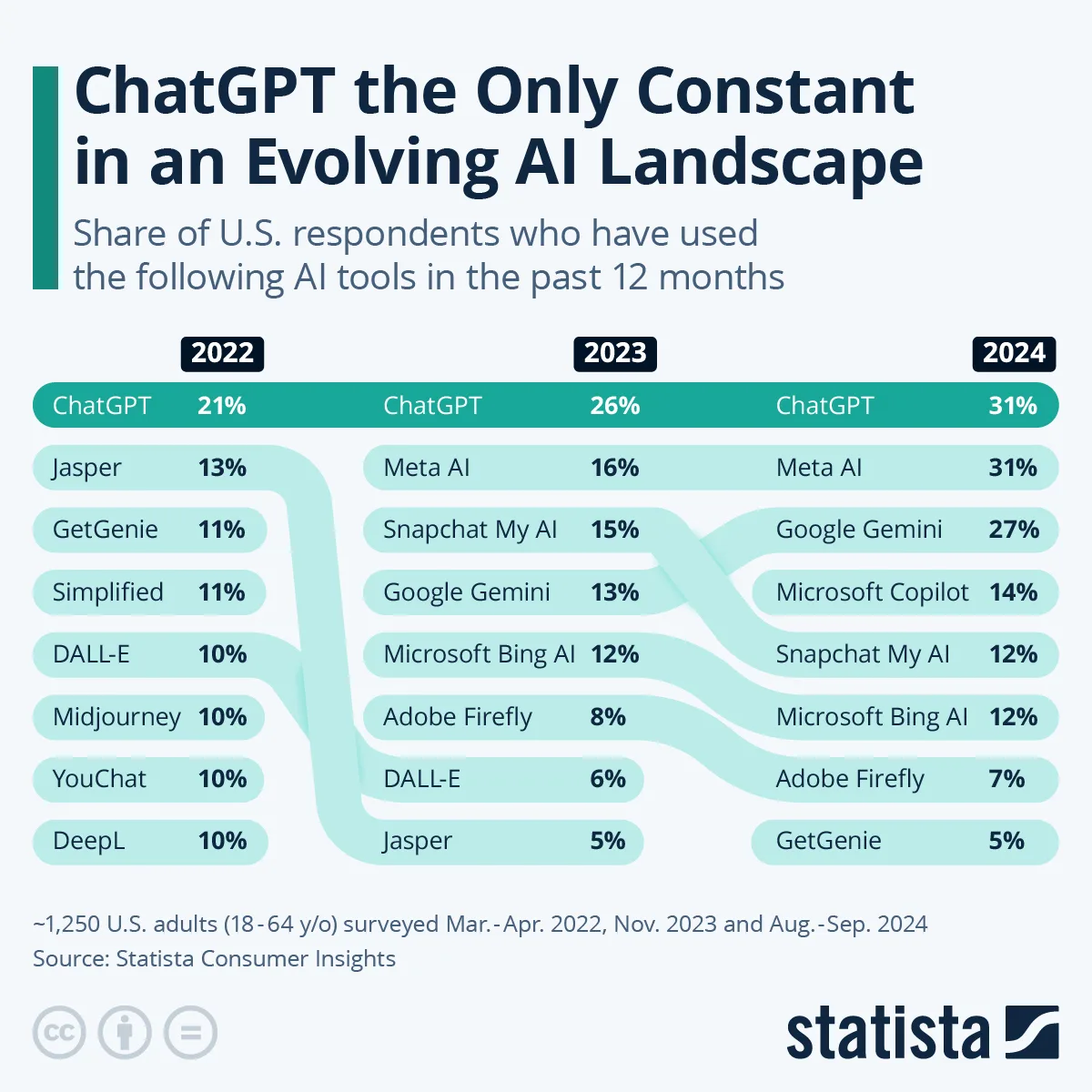
    When ChatGPT launched in November 2022, it marked a monumental shift in the way people interact with artificial intelligence. While several AI tools existed prior to its release, none captivated public attention as swiftly or intensely. The phenomenon that unfolded after the debut of ChatGPT was like wildfire; within just a few days, over a million users had signed up for the service, fascinated by its generative capabilities.

    ChatGPT: The Pioneer of Generative AI

    Generative AI Revolution

    ChatGPT stands out as the first generative AI tool to achieve mass adoption globally. This was a significant milestone, as it allowed users from various backgrounds to explore the potential of large language models in real-time. The allure of engaging with an AI that could understand and generate human-like text opened doors to a new world of possibilities in creativity, communication, and problem-solving.

    The Impact of Mass Adoption

    The rapid embrace of ChatGPT showcased not just its capabilities but also the broader acceptance of AI tools in everyday life. As organizations, professionals, and students began to leverage AI for various applications, the landscape transformed dramatically. Businesses explored creative ways to integrate AI, spurring innovation across multiple sectors.

    The AI Ecosystem Craze

    Emergence of Competing Tools

    Following the success of ChatGPT, a multitude of AI-powered tools began entering the market at an unprecedented pace. From creative applications like Adobe Firefly, which specializes in image generation and enhancement, to comprehensive productivity suites such as Microsoft Copilot, the variety of AI offerings reflects the diverse needs of consumers. Despite this influx, none have yet rivaled the mainstream acceptance that ChatGPT achieved.

    Survey Insights: ChatGPT’s Lead

    According to surveys conducted by Statista Consumer Insights across 2022, 2023, and 2024, ChatGPT has consistently led the AI landscape in user preference and adoption rates. While competitors have emerged and the environment continues to evolve, ChatGPT’s early success has allowed it to maintain a first-mover advantage. The data underscores the significance of initial market presence and user trust in technology adoption.

    The Competitive Landscape

    Meta AI: A Close Contender

    While ChatGPT has reigned supreme, its position has been challenged by other players, particularly Meta AI. According to the 2024 survey, Meta AI has begun to close the gap, signaling intensifying competition in the space. This development raises intriguing questions about the factors that contribute to user loyalty in AI tools and how competing platforms can effectively capture market share.

    Apple’s Entry: A Potential Game Changer

    Another key player poised to impact the AI landscape is Apple, which announced its entry into the market in late 2024. With a substantial installed device base and a loyal customer following, Apple’s foray into AI could drastically reshape the adoption curve. The brand’s reputation for quality and innovation means its AI offerings may garner considerable attention.

    Future of AI Tools

    Continuous Evolution of AI

    As the market for AI tools continues to grow, it is important to track the evolving dynamics between established leaders like ChatGPT and emerging challengers. The pace of innovation is rapid, with new features and capabilities being introduced regularly. Future developments will likely focus on improving user experience, ensuring responsible AI use, and expanding applications across domains.

    The Importance of User Adoption

    Ultimately, user adoption will hinge on how well these tools meet the needs of individuals and organizations. Factors such as ease of use, reliability, and the effectiveness of AI solutions will play crucial roles in influencing future market positions. As these AI tools evolve, they will shape the contours of the digital landscape, fostering an environment rich in creativity and efficiency.

  • iOS 18 Brings Top AI Tools In December, Siri Will Wait Longer

    iOS 18 Brings Top AI Tools In December, Siri Will Wait Longer

    The Apple Intelligence toolkit has experienced a mixed rollout, featuring both postponed functionalities and lackluster enhancements. However, it appears that the most promising set of AI tools unveiled by Apple during WWDC earlier this year will soon be available.

    According to the latest edition of his PowerOn newsletter, Mark Gurman from Bloomberg states that the iOS 18.2 update is expected to launch through the stable channel in the first week of December.

    This latest version of iOS is already undergoing beta testing and introduces an exciting trio of AI enhancements designed for the iPhone. One notable feature is Siri’s integration with OpenAI’s ChatGPT, which facilitates complex queries being processed through the chatbot.

    Another addition is Visual Intelligence, which enables users to simply point their phone’s camera at their surroundings and extract useful information about what they see. Currently, it can perform tasks such as identifying different dog breeds or reading details off a poster.

    Considering the extensive integration with OpenAI’s technology, it’s likely that Visual Intelligence will evolve to include capabilities similar to the latest version of ChatGPT, expanding its multi-modal understanding.

    Siri offloading user query to ChatGPT.
    Nadeem Sarwar / Digital Trends

    The iOS 18.2 beta also includes creative features like the Image Playgrounds app, allowing users to produce playful images based on their own snapshots. Furthermore, the new custom Genmoji system is part of the upcoming update.

    Mr. Gurman notes that with the iOS 18.4 release, Siri is poised to undergo a significant transformation that has fans excited about the digital assistant’s potential resurgence in the AI landscape. He mentions, “Siri will be able to access users’ data and respond to inquiries based on the information displayed on their screens.”

    Currently, Google’s Gemini can access both local text and media files and provide responses based on that information. Its deep integration with the Workspace platform enables it to reference documents in Google Drive and other essential tools, like Docs.

    Similarly, the Notebook LM tool can engage with YouTube videos and third-party web page URLs without requiring a subscription.

    In Apple’s scenario, Siri—enhanced by OpenAI’s technology—will be able to answer queries using information retrieved from local files and data stored on the device. This could include accessing travel details from emails, scheduling items from calendar events, and extracting business information from PDFs and spreadsheets.

    Visual Intelligence on iPhone.
    Jesse Hollington / Digital Trends

    Moreover, a significant feature will be enhanced integration with third-party applications, enabling the digital assistant to complete tasks in those apps using only voice or text commands.

    Apple plans to allow users to explore other third-party options like Gemini in the future. Additionally, Siri will be able to provide answers based on the content visible on the user’s screen.

    The release of iOS 18.4 is anticipated sometime in April of next year. This timeframe coincides with when Apple is expected to unveil the next-generation iPhone SE, featuring an updated design, enhanced processing capabilities, and support for Apple Intelligence.