الوسم: agreement

  • ثقة المستهلكين في الذكاء الاصطناعي للتسوق تتراوح بين 34٪ و44٪

    فوائد الذكاء الاصطناعي للمستهلكين أثناء التسوق

    مقدار التوفير الحقيقي الذي يتوقعه المستهلكون من استخدام الذكاء الاصطناعي
    ——————————————————-

    وفقًا لاستطلاع حديث أجرته شركة “ستاتيستا إنسايدر” حول آراء المستهلكين، والذي تم نشره ضمن تحديث واقع المستهلك لعام 2026، أشار 44٪ من الأمريكيين إلى رغبتهم في أن يسهم الذكاء الاصطناعي في مقارنة الأسعار والعثور على أقل الأسعار الممكنة. يعكس هذا الرقم الوعي المتزايد لدى المستهلكين بقوة أدوات الذكاء الاصطناعي في تحقيق وفورات مالية ملموسة أثناء التسوق.

    هل يثق المستهلكون في قدرات الذكاء الاصطناعي لاتخاذ القرارات؟
    —————————————————–

    على الرغم من رغبة المستهلكين في الاستفادة من الذكاء الاصطناعي لتوفير المال، إلا أن معظمهم يميل إلى الاعتماد على نتائج هذه الأدوات بشكل محدود عند اتخاذ قرارات الشراء. حيث أظهرت الدراسة أن 41٪ من المستهلكين مستعدون لاكتشاف منتجات جديدة عبر الذكاء الاصطناعي، مما يدل على ثقتهم بشكل جزئي في قدراته كمساعد استكشاف. بالإضافة إلى ذلك، أبدى 34٪ من المشاركين استعدادهم للدفع أكثر إذا قدمت خوارزميات الذكاء الاصطناعي مبررات مقنعة لاقتناء منتج معين، مما يعكس تأييدًا لقدرته على تقديم الحجج والتوصيات التي قد تؤثر على قرار الشراء.

    مدى ثقة المستهلكين في أن يدير الذكاء الاصطناعي عمليات الشراء
    —————————————————

    لكن عند الحديث عن الثقة، تظهر الاستطلاعات أن المستهلكين يترددون في الاعتماد بشكل كامل على الذكاء الاصطناعي لاتخاذ قرارات الشراء بدلاً منهم. إذ قال 42٪ منهم إنهم لا يثقون تمامًا في قدرة الذكاء الاصطناعي على أن يتولى مهمة اتخاذ القرار بشكل مستقل. ومع ذلك، فإن بعض الفئات أكثر استعدادًا للسماح للذكاء الاصطناعي بتنفيذ عمليات الشراء في مجالات معينة، وعلى رأسها الملابس والإكسسوارات، حيث عبر 27٪ من المشاركين عن استعدادهم للسماح لهذه التكنولوجيا بإجراء عمليات شراء بشكل مستقل.

    نسبة الشراء من خلال توصيات الذكاء الاصطناعي خلال العام الماضي
    ————————————————————-

    وفي سياق العمليات الشرائية، أشار 37٪ من المشاركين إلى أنهم قاموا بشراء منتجات استنادًا إلى توصيات الذكاء الاصطناعي خلال السنة الماضية. من بين هؤلاء، 16٪ قالوا إنهم أتموا عملية شراء واحدة استجابةً لتوصية، في حين أن 21٪ أكدوا أن لديهم عمليات شراء متعددة تم توجيهها بواسطة الذكاء الاصطناعي. يوضح ذلك أن الاعتماد على التوصيات المدعومة بالذكاء الاصطناعي يتزايد شيئًا فشيئًا، رغم أن الثقة الكاملة لم تتبلور بعد.

    الخلاصة: توازن بين الفوائد والشكوك
    ————————————-

    يتضح من خلال البيانات أن المستهلكين يرحبون بفوائد الذكاء الاصطناعي في تحقيق وفورات مالية وتقديم خيارات وتوصيات مخصصة، لكنهم يظلّون حذرين بشأن الاعتماد الكلي على هذه التكنولوجيا لاتخاذ قرارات شراء بشكل مستقل. إن الثقة في الذكاء الاصطناعي تتطلب مزيدًا من التطوير والشفافية لجعله أداة أكثر أمانًا وموثوقية في سوق التسوق الحديث.

  • Saudi Arabia and Ukraine Agree on Air Defense Partnership

    Saudi Arabia and Ukraine Agree on Air Defense Partnership

    During President Volodymyr Zelensky’s visit to Saudi Arabia, Ukraine and Saudi Arabia signed an air defense agreement as both nations face threats from Iranian drone attacks, according to two senior officials speaking to AFP. Kyiv is aiming to utilize its experience in intercepting Russian drones to assist Gulf countries, which are experiencing similar threats from Iranian-made Shahed drones used by Russia against Ukraine.

    One official explained that the purpose of the agreement is for Ukraine to help these countries develop their air defense systems, which they currently lack. The official added that the deal, signed on Thursday, involves more than just interceptors; it encompasses building an integrated system that combines various air defense components, leveraging Ukrainian expertise, AI, and comprehensive data analysis to counter drones like the Shaheds.

    Ukraine has been defending itself against nightly Russian drone assaults for four years using a combination of low-cost interceptors, electronic jamming equipment, and anti-aircraft weapons. Kyiv has also proposed trading its interceptors for more advanced, costly missile systems used by Gulf nations to shoot down Iranian drones, emphasizing the need for more of these missiles to defend against Russian missile strikes.

    Zelensky confirmed via social media that the two countries had reached a significant understanding regarding defense cooperation, and he had met with Crown Prince Mohammed bin Salman. Zelensky expressed willingness to share Ukraine’s expertise and systems with Saudi Arabia, noting that both nations have capabilities of mutual interest. He did not specify the exact details of the agreement but highlighted the importance of the cooperation.

    Additionally, Zelensky met with Ukrainian experts specializing in anti-drone technology, who have been deployed to the region following US and Israeli strikes on Iran that triggered retaliatory drone and missile attacks from Tehran. Zelensky praised the Ukrainian specialists for their quick sharing of extensive knowledge, asserting that Ukraine’s unique expertise attracts global interest.

    A memorandum on defense procurement was also signed between the Saudi and Ukrainian defense ministries in Jeddah. Saudi Assistant Minister of Defense for Executive Affairs Dr. Khaled Al-Biyari and Ukrainian Chief of the General Staff Lieutenant General Andrii Hnatov formalized the arrangement, aimed at enhancing defense collaboration.

  • Saudi Arabia and Qatar agree on high-speed rail connection

    Saudi Arabia and Qatar agree on high-speed rail connection

    Saudi Arabia and Qatar have signed an agreement to build a high-speed rail connecting their capitals, highlighting a warming of relations between the two Gulf nations once at odds. The “high-speed electric passenger railway” will link Riyadh and Doha, with plans to include the cities of Al-Hofuf and Dammam along the route. The train is expected to reach speeds over 300 km/h (186 mph), making the trip between Riyadh and Doha approximately two hours, compared to about 90 minutes by direct flight.

    The project is scheduled for completion within six years and aims to serve around 10 million passengers annually. The deal was signed during Emir Sheikh Tamim bin Hamad Al Thani’s visit to Riyadh by Saudi Crown Prince Mohammed bin Salman and Qatar’s emir, marking a significant step in the recent improvement of Gulf relations.

    Relations between Saudi Arabia, the UAE, Bahrain, and Egypt with Qatar had been severed in June 2017 but were fully restored in January 2021 after a summit in AlUla. Prince Mohammed’s visit to Doha in December 2021 was the first since the thaw began. Since then, leaders from both countries have met regularly and collaborated on diplomatic efforts, including advocating for a ceasefire in Gaza. Riyadh also expressed support for Qatar following Israeli strikes on Doha over the summer.

  • Trump brokered Azerbaijan-Armenia peace deal threatens Moscow’s influence

    Trump brokered Azerbaijan-Armenia peace deal threatens Moscow’s influence

    Azerbaijan and Armenia formalized a peace accord brokered by the United States during a meeting with President Donald Trump on Friday, aiming to strengthen economic connections after years of conflict. This agreement, which could be a breakthrough if maintained, signals a notable shift in regional relations and is likely to challenge Moscow’s influence, given its historical interest in the area.

    At the signing ceremony at the White House, Trump remarked, “It’s been 35 years of fighting, and now these nations are moving toward friendship. They are committed to lasting peace.” He was joined by Azerbaijani President Ilham Aliyev and Armenian Prime Minister Nikol Pashinyan.

    The longstanding rivalry stems from the late 1980s when Nagorno-Karabakh—a mountainous Azerbaijani region predominantly inhabited by ethnic Armenians—seceded from Azerbaijan with Armenian backing. Azerbaijan regained full control over the territory in 2023, forcing nearly all of the 100,000 ethnic Armenians to flee to Armenia.

    The agreement involves the two countries pledging to cease hostilities, establish diplomatic relations, and uphold each other’s territorial sovereignty. It also grants the U.S. exclusive development rights to a strategic transit corridor through the South Caucasus, promising to boost energy exports and resource exchanges.

    In addition, the U.S. has negotiated separate agreements with each nation to expand cooperation in energy, trade, and technology sectors, including artificial intelligence. Restrictions on defense collaborations between Azerbaijan and the U.S. have also been lifted.

    Both Azerbaijani and Armenian leaders lauded Trump for his role in brokering peace, with Aliyev suggesting Trump deserves the Nobel Peace Prize. “Who else, if not President Trump, should receive this honor?” Aliyev stated.

    While Trump has depicted himself as a global peacemaker—claiming credit for ceasefires and peace agreements in Southeast Asia, Africa, and South Asia—he has yet to resolve conflicts in Ukraine or the Gaza Strip.

    U.S. officials emphasized that this accord was achieved through multiple visits to the region and lays a foundation for broader normalization. They see it as the first resolution of several frozen conflicts near Russia’s borders since the Cold War’s end, sending a strong regional message.

    The peace deal could dramatically transform the South Caucasus, a resource-rich area neighboring Russia, Europe, Turkey, and Iran, characterized by oil and gas pipelines, closed borders, and ethnic tensions. Armenia has agreed to grant the U.S. long-term exclusive development rights for the transit corridor, which has already attracted interest from nine companies, including three U.S. firms.

    Advocates like Daphne Panayotatos from the rights organization Freedom Now have urged the Biden administration to use this momentum to push for the release of approximately 375 political prisoners in Azerbaijan. Despite the country’s rising prominence, especially after hosting the UN climate summit, Azerbaijan maintains a firm stance against Western criticism of its human rights practices, describing such concerns as unacceptable interference.

  • Google AI Chief: Global Agreement on AI ‘Difficult to Reach’

    Google AI Chief: Global Agreement on AI ‘Difficult to Reach’

    Demis Hassabis Highlights Need for Global AI Regulation

    LONDON: Demis Hassabis, the chief innovator behind Google’s DeepMind and the 2024 Nobel Prize winner in Chemistry, stressed the necessity of enhanced global collaboration on artificial intelligence (AI) regulation during a recent speech. He pointed out the challenges of achieving such cooperation amid today’s complex geopolitical landscape.

    As AI technology permeates various sectors, significant ethical concerns have emerged—from combating the dissemination of false information to its ramifications on jobs and the potential loss of control over technology.

    Speaking at the South by Southwest (SXSW) festival in London, Hassabis—recognized for his groundbreaking work in AI—also discussed the implications of artificial general intelligence (AGI). This advanced form of AI has the potential to match or exceed human capabilities.

    Hassabis remarked, “The key is to establish some international cooperation because this technology transcends borders and will be implemented in every nation.”

    He underscored that a multitude of countries are currently engaged in AI research, developing data centers, or utilizing these technologies. For any regulatory measures to be effective, he believes, a collective international effort is essential, although he acknowledged that this cooperation appears challenging in the current geopolitical climate.

    During a February summit in Paris, representatives from 58 nations, including China, France, India, the European Union, and the African Union Commission, advocated for improved coordination in AI governance. However, the United States cautioned against what they termed “excessive regulation,” with Vice President JD Vance warning that it could stifle a transformative industry.

    The UK also opted out of signing the summit’s call for an “open,” “inclusive,” and “ethical” approach to AI.

    On Monday, Hassabis promoted the idea of implementing “smart, adaptable regulations” that can evolve alongside the technology and its emerging challenges.

  • Trump Claims China Has Completely Broken US Tariff Agreement

    Trump Claims China Has Completely Broken US Tariff Agreement

    US President Donald Trump waving while walking with Chinese President Xi Jinping. — Reuters/File

    On Friday, U.S. President Donald Trump accused China of breaching a tariff agreement with the United States.

    “China has completely violated its agreement with us, which isn’t surprising to some. So much for being Mr. Nice Guy!” Trump stated in a post on his Truth Social platform.

    Trump claims China has violated tariff agreement

    U.S.-China trade negotiations have been “somewhat stalled,” according to U.S. Treasury Secretary Scott Bessent who spoke with Fox News on Thursday. He noted that the involvement of both President Trump and Chinese President Xi Jinping may be necessary to finalize a deal.

    Just two weeks after productive talks led to a temporary easing of the trade conflict between the two largest economies, Bessent remarked that subsequent progress has been slow, but he anticipates more discussions within the next few weeks.

    The agreement to suspend high tariffs for 90 days had triggered a significant surge in global stock markets. However, it did not address the core issues that led to Trump imposing tariffs on Chinese goods, which mainly revolve around long-standing U.S. concerns regarding China’s state-controlled, export-driven economic model—those matters are left for future negotiations.

    Earlier this month, the United States and China mutually reduced high tariffs on each other’s products for 90 days during negotiations held in Geneva.

    As part of the deal, the U.S. agreed to lower its tariffs on Chinese goods to 30%, while China would reduce its own tariffs to 10%—a reduction of over 100 percentage points.

    This move was seen as a significant de-escalation in trade tensions, given that U.S. tariffs on Chinese imports had previously soared as high as 145% and even 245% on certain items.

    However, analysts cautioned earlier that the potential return of tariffs after the 90-day period could add further uncertainty to the economic landscape.

    “Reducing tariffs further will be challenging, and the risk of renewed escalation remains,” warned Yue Su, Principal Economist at The Economist Intelligence Unit, in comments to AFP.

    Trump’s fluctuating tariff policies have severely impacted U.S. companies that depend on Chinese manufacturing, and while a temporary easing might provide some relief, it is not expected to resolve the larger issues at play.

    Beijing officials have acknowledged that the trade uncertainties are further straining China’s economy, which is already struggling due to a prolonged real estate crisis and weak consumer spending.


    With additional contributions from AFP

  • US and Ukraine Reach Agreement on Strategic Minerals, No Signing Yet

    US and Ukraine Reach Agreement on Strategic Minerals, No Signing Yet

    US Treasury Secretary Scott Bessent. Reuters/File

    KYIV/WASHINGTON: Ukraine and the United States announced on Wednesday that they are poised to finalize a minerals agreement after months of complex negotiations. However, a last-minute obstacle has raised questions about the timing of the deal.

    “We are ready to sign. The Ukrainians decided to make a few last-minute adjustments last night,” US Treasury Secretary Scott Bessent told reporters at the White House.

    “We believe they will reconsider, and we are prepared to proceed if they are.”

    A Ukrainian official was en route to Washington for the signing, but sources indicated that the US is urging Ukraine to sign two additional documents, which Kyiv considers premature.

    Bessent asserted that the US had not attempted to modify the agreement reached over the weekend.

    This agreement aims to provide the United States with access to Ukraine’s mineral resources, playing a vital role in Kyiv’s strategy to strengthen ties with US President Donald Trump and his administration, as Trump seeks a peace resolution in the ongoing conflict with Russia.

    Two sources informed Reuters that the signing could still occur later on Wednesday. Earlier, Ukraine’s First Deputy Prime Minister Yulia Svyrydenko was confirmed to be traveling to the US to sign the agreement, as stated by the country’s prime minister.

    A draft of the main minerals agreement, reviewed by Reuters, indicated that Ukraine had successfully negotiated the elimination of a clause requiring repayment to the US for past military aid—something Ukraine had strongly opposed.

    Since Russia’s invasion in 2022, the US has been Ukraine’s largest military supporter, contributing over €64 billion ($72 billion) according to the Kiel Institute in Germany.

    Trump reiterated on Wednesday that the US should receive compensation for past assistance to Kyiv, which aligns with efforts to secure access to Ukraine’s abundant rare earth minerals.

    “I expect they will honor the deal. … We haven’t fully realized the benefits of that arrangement yet, but I suspect we will,” Trump remarked after a cabinet meeting on Wednesday.

    Ukrainian officials are optimistic that signing the deal championed by Trump will bolster American support for Kyiv amidst the ongoing war, now in its third year.

    The draft agreement would grant the US preferential access to new deals related to Ukraine’s natural resources, although it does not automatically provide Washington with a stake in Ukraine’s mineral wealth or its gas infrastructure.

    “This is indeed a strategic agreement … a truly equitable and beneficial international agreement for joint investments in Ukraine’s development and reconstruction,” Prime Minister Denys Shmyhal stated.

    The draft does not include specific security guarantees from the US, which was one of Ukraine’s initial ambitions. Separately, Ukraine has been discussing with European allies the establishment of an international force to ensure its security in light of a potential peace agreement with Russia.

    Joint Fund

    The minerals draft proposes the establishment of a joint reconstruction fund between the US and Ukraine, which would receive 50% of the profits and royalties generated from new natural resource permits granted to Ukraine.

    The draft does not specify how the revenue from the fund will be utilized, who will benefit, or who will control spending decisions.

    Shmyhal mentioned on television that once the primary agreement is signed, both parties will agree on two additional technical documents regarding details like fund administration.

    He affirmed that Ukraine would maintain full control over its resources under the agreement, with the fund aimed at investing in Ukraine’s growth over the next decade.

    “Ukraine will only contribute from new licenses and newly accrued royalties on mineral resources. This will constitute our contribution, 50% of which will go to this fund,” he explained.

    Shmyhal added that the US might count future military assistance to Ukraine as part of its contribution to the fund, excluding prior aid.

    The two nations signed a memorandum on April 18, marking the first step toward finalizing the minerals development agreement. The memo stated that both sides aimed to conclude their discussions by April 26 and finalize the agreement as soon as possible.

    Trump and his administration have warned this month about potentially abandoning peace efforts between Russia and Ukraine unless clear progress is made soon.

  • 29% of U.S. Adults Uninterested in AI Tools

    29% of U.S. Adults Uninterested in AI Tools

    The Rise of AI Tools: A Mixed Reception

    The release of AI-powered tools like ChatGPT in late 2022 marked the beginning of a significant shift in how industries and consumers interact with technology. This period has been likened to a modern-day gold rush, as businesses and tech enthusiasts flock towards innovations promising to revolutionize various sectors. However, as highlighted by recent surveys, the enthusiasm surrounding AI tools is far from universal.

    The Enthusiasm Gap for AI Tools

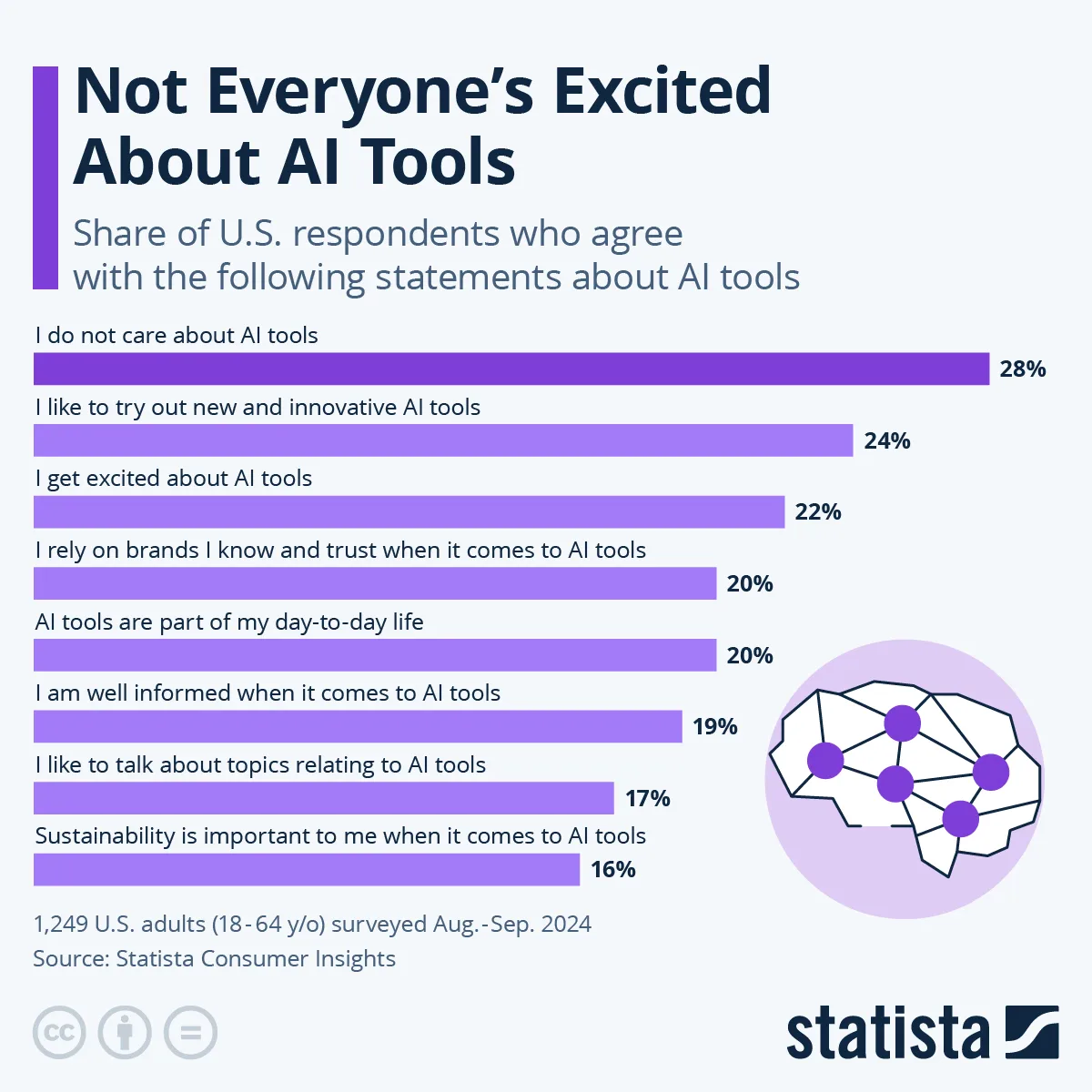
    In a survey conducted by Statista Consumer Insights, a noteworthy finding emerged: nearly 30% of U.S. adults expressed indifference towards AI tools. This statistic raises questions about the perceived utility of AI amongst the general public.

    Disparity in User Engagement

    While a portion of the population remains skeptical, others are eager to engage with these new technologies. The survey revealed that around 24% of respondents actively enjoy trying out innovative AI tools, and 22% stated that they feel excited about these advancements. Conversely, 20% of individuals reported that AI tools have already integrated into their daily routines, suggesting that a significant portion of the public is experiencing the benefits of AI.

    The Role of Big Tech

    Prominent figures in the technology sector, like Jensen Huang of Nvidia, have been vocal about the transformative potential of AI. Huang describes this era as one of unprecedented opportunity, highlighting the billions of dollars being invested by major companies to build the necessary infrastructure for AI advancements.

    Investment and Innovation

    Such investments aim to create a robust foundation for launching advanced AI applications and tools. Corporations are not just betting on AI’s future; they are actively shaping it. However, the divergence in consumer sentiment indicates a gap between corporate enthusiasm and public reception.

    Consumer Doubts and Concerns

    Despite the powerful potential of AI tools, there are underlying concerns among consumers that may contribute to the observed indifference.

    The Fear of Job Displacement

    A significant source of apprehension stems from fears surrounding job security and automation. As AI tools become more capable, concerns about losing jobs to machines can create skepticism towards embracing these technologies wholeheartedly.

    Privacy and Ethics

    Moreover, the implications regarding data privacy and ethical use of AI technology weigh heavily on consumers’ minds. Users may hesitate to adopt AI tools if they feel their personal information could be compromised or misused.

    The Future of AI in Consumer Life

    As the “era of AI” evolves, it’s crucial to understand how the technology will continue to integrate into daily experiences.

    Early Adaptation among Consumers

    The 20% of individuals who are already utilizing AI tools in their everyday lives indicates a budding relationship with the technology. With improved understanding and education about AI, this number may grow, necessitating a dialogue about ethical practices and transparency in the use of these tools.

    Bridging the Enthusiasm Divide

    Moving forward, there may be significant opportunities to bridge the gap between AI innovators and consumers. Educating the public about AI’s potential benefits, addressing fears, and ensuring ethical guidelines could help foster a more inclusive and positive perception of AI tools. By emphasizing the ways AI can enhance daily life rather than disrupt it, stakeholders can work towards a more enthusiastic reception of these transformative technologies.