الوسم: 5G

  • Is 5G the Fast Solution We’ve Been Counting On?

    Is 5G the Fast Solution We’ve Been Counting On?

    PUBLISHED February 8, 2026


    KARACHI:

    Is your mobile internet running slower than molasses? Over the past year, many users across Pakistan have faced the same frustration. Videos that once loaded instantly now pause for a moment too long. Calls freeze mid-conversation. Refreshing a page takes longer than it should and becomes irritating. It’s not a sudden collapse but a gradual slowdown—something that slips into daily routines unnoticed, until suddenly it’s impossible to ignore.

    In Karachi, especially during peak hours, the frustration is evident. Late evenings in Defense and Clifton, lunch breaks in Saddar, and morning commutes around Shahrah-e-Faisal often reveal noticeable drops in speed. Lahore’s Gulberg and Johar Town, Islamabad’s Blue Area and G-10 report similar issues. Signal bars may still appear full, but the experience feels weaker, more stretched out.

    Part of this change has quietly emerged since the pandemic. COVID did more than temporarily push work and education online; it permanently changed internet usage. Ride-hailing apps became daily essentials. Small businesses migrated orders and customer engagement to messaging platforms. Payments became digital. Content creation, live streaming, and short-video apps started consuming constant streams of data. Even outside major cities, smartphones have become workplaces, classrooms, and storefronts all in one.

    For freelancers, this slowdown has real consequences. Uploads stall. Video calls drop temporarily. Cloud-based tools become unreliable. Students face buffering during classes. Small businesses reliant on social media find themselves retrying actions that once worked flawlessly.

    This strain is no longer limited to big cities. In smaller towns and rural areas, mobile internet has become the primary gateway to services, markets, and information. What was once a support tool is now an essential utility, expected to work reliably all the time.

    A common concern among users is: the internet used to be better—not necessarily faster, but more reliable and steady under load. The question now is simple: why does a network that once seemed sufficient now feel overwhelmed?

    Why 5G alone won’t fix Pakistan’s internet

    As frustration grows, a familiar solution is becoming the topic of public debate—launching 5G. Politicians, advertisers, and everyday conversations often see 5G as an easy switch that will make internet faster, smoother, and ready for the future.

    This assumption is understandable. Each previous upgrade brought clear benefits. 3G made basic browsing possible. 4G enabled streaming videos and smooth calls. As a result, 5G is seen as the next big leap—an automatic fix for buffering and dropped calls.

    But this view is incomplete. It confuses technology with capacity. A new standard doesn’t automatically create more space; it only determines how efficiently that space is used. If the current network is already crowded, upgrading to 5G won’t significantly ease the pressure.

    Mobile internet depends on limited radio frequencies. Every streamed video, phone call, ride request, or payment consumes part of that shared pool. When this pool is stretched thin, the network doesn’t fail but degrades: speeds slow down, delays increase, and reliability weakens, especially during busy hours. While newer tech can handle data more efficiently, it cannot create capacity where none exists.

    That’s why the promise of 5G often sounds larger than its immediate impact. In many countries, 5G’s most transformative uses require dense infrastructure, compatible devices, and long-term investments. For most users relying on smartphones for work and communication, what’s more urgent is a reliable internet connection that functions consistently.

    As discussions about Pakistan’s digital future intensify, industry experts and regulators agree that the problem isn’t the lack of a new technology but the exhaustion of the current infrastructure.

    Understanding why mobile internet slows down begins with “spectrum.” In simple terms, spectrum refers to invisible radio frequencies that transmit data between your phone and a nearby tower. Unlike fiber cables, which can be physically expanded, spectrum is finite. Only a limited amount exists, and it must be shared among all users in an area.

    When few people are connected, the experience feels smooth. As more join in, that shared space becomes congested. The network doesn’t break; it divides capacity among users, causing individual connections to slow. This is why internet performance dips during peak hours and in densely populated areas. The core issue isn’t just access but whether enough spectrum exists to handle current data demands.

    Operator reality: Pakistan has hit the limit

    For Pakistan’s mobile operators, the recent slowdown isn’t a surprise. It’s the result of a system stretched beyond its original limits, as one senior executive from a major telecom company explained.

    “Think of spectrum as the width of a road,” he said. “If the number of cars keeps increasing, traffic slows down. You can’t ignore that logic. To move more cars smoothly, you need a wider road. What we’ve done here is add more cars without widening the road.”

    That analogy captures the fundamental issue: while data usage has surged over the past decade, the available spectrum hasn’t expanded proportionally. As a result, networks are forced to split limited capacity among an increasing number of users—especially in busy urban centers.

    He pointed out that this explains why many feel 4G no longer performs as it did. “There’s nothing wrong with 4G technology itself,” he said. “The load has increased dramatically. When thousands of people are streaming, making calls, booking rides, and uploading content simultaneously, the network has no choice but to share bandwidth. People remain connected, but speeds decrease.”

    From the industry’s perspective, deploying 5G isn’t an immediate fix without additional spectrum and device compatibility. Rolling out 5G without addressing these issues would benefit only a small percentage—maybe 2-3%—of users, turning it into a premium feature rather than a universal solution.

    Financial aspects also matter. Next-generation networks require long-term investments, often with payback periods of five to ten years. In Pakistan, where affordability is limited and compatible 5G devices are costly, returns hinge on device prices falling enough for many to upgrade. “If people can’t afford new devices, they won’t upgrade,” the executive said. “And if users don’t upgrade, operators will hesitate to invest.”

    This creates a familiar stalemate: operators hesitate without broader user adoption; users avoid buying new devices without coverage. Breaking this cycle depends on increasing capacity and making devices affordable. Initiatives like handset financing or installment plans could accelerate adoption, but progress remains uneven without such measures.

    The immediate focus, he added, should be on practical solutions—expanding spectrum, reducing congestion, and restoring current network performance. Only then can a slow, sustainable transition to 5G happen. “The real test isn’t announcing 5G,” he said. “It’s whether the internet actually works better for everyday users.”

    What the industry and regulator agree on

    Despite some disagreements, both the industry and regulator concur on the core issue: capacity, not technology, is the main constraint. Both agree that spectrum scarcity has become a structural challenge, and that networks are handling far more data than they were originally designed for, especially in densely populated areas.

    Both sides also agree that improving 4G performance is a higher priority than rushing into a nationwide 5G rollout. While they see 5G as inevitable, they acknowledge it’s not a quick fix for everyday connectivity. Device affordability is crucial—no matter how advanced the network, if consumers can’t access it, benefits remain limited. Adoption has to happen gradually.

    Finally, both emphasize the importance of long-term investment certainty. Expanding networks needs a stable policy environment. “This isn’t a one-year project,” a senior industry figure said. PTA officials support this, stressing predictable rules and phased obligations to turn new spectrum into sustainable improvements.

    Where they differ mainly is in the sequencing and implementation, not understanding of the core problem.

    The unresolved questions

    Despite consensus on the diagnosis, many questions linger on how quickly these policy plans will translate into improvements on the ground—especially regarding device affordability and implementation speed.

    Regulators are confident that the ecosystem will adapt once spectrum is allocated. They expect handset makers to develop affordable models, prices to fall, and supply chains to diversify, leading to greater demand. Historically, demand and supply have gradually realigned with technological shifts.

    The industry is more cautious. While device prices are expected to drop eventually, the timeline matters. Without affordable 5G devices arriving soon, adoption will remain limited, weakening the business case for operators to invest heavily. The concern is not whether prices will drop but whether they will do so fast enough to justify ongoing investments.

    Implementation also involves challenges—building new infrastructure, sourcing equipment, dealing with regulatory approvals, and ensuring supply chain readiness. Any delays in these areas could slow progress significantly.

    Rural areas pose particular challenges. While regulators say coverage will improve nationwide, operators tend to focus initial upgrades where usage and revenue potential are highest—in urban centers. The risk isn’t exclusion but slow expansion, with rural areas trailing behind.

    Underlying everything is uncertainty about reliance solely on market forces. Supportive policies, financing options, and device subsidies could accelerate progress, but they are still developing. Without these, Pakistan’s digital progress may be incremental rather than transformative.

    What success will actually look like

    With the spectrum auction scheduled for March 10, 2026, expectations are already rising. However, PTA officials caution that results won’t be immediate. The changes ahead are significant but will take time to realize.

    Once spectrum is allocated, networks will need time to order equipment, import hardware, upgrade sites, and integrate new bands. PTA estimates that noticeable improvements should begin within six months—less congestion in busy areas as new infrastructure comes online. Still, these gains will be gradual, not sudden.

    “This isn’t an overnight switch,” said Shahzad. “But once spectrum is assigned, operators know where the congestion is. They’ll act quickly because they’re competitive.”

    That market competition is key. Early improvements by some will likely push others to follow, creating a cycle of investment rather than a single upgrade. To support this, PTA has adjusted the auction’s financial terms. Unlike before, there won’t be an upfront fee; operators will get a one-year moratorium, followed by phased payments over several years. The aim is to prioritize infrastructure expansion over immediate revenue.

    PTA consulted international experts to develop this approach, aiming for a balance between spectrum pricing, rollout goals, and long-term connectivity benefits. The focus is on sustained progress rather than quick wins.

    Ultimately, the real measure of success is whether internet quality improves in everyday life—fewer dropped calls, faster uploads, less buffering, and smoother video calls. These everyday experiences matter most because they impact work, study, and daily communication. Better internet isn’t about headlines; it’s about consistent, reliable service that supports economic growth and social connection.

  • Denim Antenna Brings 5G Connectivity To Your Clothes

    Denim Antenna Brings 5G Connectivity To Your Clothes

    Scientists have developed an innovative, compact antenna that offers 5G and Wi-Fi capabilities, specifically designed for integration into smart clothing rather than traditional devices like smartphones or smartwatches. This advanced 2-port multiple-input-multiple-output (MIMO) antenna is woven into a fabric and intended for close proximity to the human body. Its size is remarkably small, measuring just 24 x 24mm, allowing it to be conveniently concealed in a shirt pocket.

    The research highlights that this antenna can be manufactured using a variety of materials, such as denim, cotton, felt, and even silk. The denim version tested is flexible in both horizontal and vertical axes without compromising performance. It delivers ample gain for everyday usage and is safe for direct contact with the body. Its ability to operate on dual-band Sub-6 5G and Wi-Fi frequencies—specifically 3.5GHz for 5G and 5.2GHz for Wi-Fi—distinguishes it from other recent single-band wearable antennas lacking MIMO features. The study elaborates on the significance of this technology:

    “With the expansion of 5G and 6G networks, the fundamental nature of communication will rely on MIMO antennas, which enable dependable connectivity through low path losses, high channel capacities, greater data transfer rates, and extended communication ranges—all without increased power requirements.”

    Smart clothing could have important applications not only in military and space exploration contexts but also in health and sports sectors. The dual-band antenna enables sensors embedded in clothing to gather and transmit vital health data independently, eliminating the necessity for smartphones or smartwatches. This innovation reduces the need for additional devices and enhances the versatility of wearable technology. Moreover, a built-in antenna in smart garments could facilitate connectivity with other wearables and pave the way for true smart clothing featuring integrated flexible displays.

    Importantly, the antenna’s Specific Absorption Rate (SAR) has been evaluated to assess how much energy is absorbed by the human body, ensuring safety. Its low-power characteristics ensure it remains well below the threshold for safe exposure levels, according to the research team, categorizing it as harmless. However, details about how the antenna receives power are not addressed, an essential consideration for the future development of smart clothing. Although this advancement is still a research initiative and hasn’t yet been commercialized for everyday use, it represents a significant progression in the field.

    While connected clothing remains on the fringes of mainstream adoption, notable examples include Google’s Project Jacquard and the subsequent Levi’s Trucker and Sherpa jackets, as well as a connected backpack by Saint Laurent. By enhancing functionality through the inclusion of antennas, we may see a broader range of smart clothing products introduced in the future.

  • Should I Change My Channel Bandwidth Asus Router 5G?

    When you’re experiencing slow internet speeds or connectivity issues on your Asus 5G router, one of the first options to consider is adjusting the channel bandwidth. Since the 5GHz band offers more channels, tweaking these settings can improve performance, especially in crowded environments or multi-device households. Let’s delve into whether you should change your channel bandwidth and how to do it effectively.

    Understanding Channel Bandwidth

    What Is Channel Bandwidth?

    Channel bandwidth refers to the width of the communication channel in terms of frequency. On a 5GHz network, it determines how much data can be transmitted at a given time. The available options typically include:

    • 20 MHz: Offers the most stability, ideal for environments with many devices.
    • 40 MHz: Balances performance and stability, suitable for moderate usage.
    • 80 MHz: Maximizes speeds, but can lead to interference in dense areas.
    • 160 MHz: Provides the highest speed for devices that support it, but also the most interference risk.

    Why Change the Bandwidth?

    Changing the bandwidth of your Asus router can:

    • Reduce Interference: Larger bandwidths can cause more interference from neighboring networks.
    • Enhance Speed: A wider channel can significantly increase speed if you have compatible devices.
    • Adapt to Environment: Higher traffic areas may benefit from narrower channels to maintain stability.

    Factors to Consider Before Changing

    Before you decide to make changes to your Asus router’s channel bandwidth, consider the following factors:

    Network Environment

    • Device Density: In homes with multiple devices, opting for a smaller bandwidth like 20 MHz may be more stable.
    • Interference: If you live in a densely populated area, wider channels may lead to increased interference.

    Devices in Use

    • Compatibility: Ensure that your devices support the bandwidth you intend to use. For example, not all devices may benefit from 160 MHz.

    Usage Patterns

    • Light vs. Heavy Usage: If your primary activities include browsing and streaming, adjusting to a higher bandwidth could offer benefits. However, for general use, a stable setting may suffice.

    How to Change the Channel Bandwidth on Your Asus Router

    Steps to Change Bandwidth

    1. Log in to Router Interface:

      • Open a web browser and type in the router’s IP address (usually 192.168.1.1).
      • Enter your username and password (default is often “admin/admin”).

    2. Navigate to Wireless Settings:

      • Look for the "Wireless" section on the main menu.
      • Click on "5GHz" to adjust the settings.

    3. Adjust Channel Bandwidth:

      • Find the "Channel Width" option.
      • Select your preferred value (20, 40, 80, or 160 MHz).

    4. Apply Changes:

      • Save or apply your settings and reboot your router if necessary.

    Tips for Optimal Setup

    • Use a Wi-Fi Analyzer: To find interference, use an app that can help visualize network congestion.
    • Experiment Gradually: Change the settings one at a time; test your internet speed after each adjustment.
    • Firmware Updates: Keep your router firmware updated to ensure optimal performance and security.

    Monitoring Performance

    After modifying the channel bandwidth, monitor your network performance. Tools like speed tests can help assess any improvements in speed and stability. Additionally, check your devices to see if they maintain steady connections without excessive drop-offs.

    Final Note on Making Changes

    Although adjusting your Asus router’s channel bandwidth can improve your internet experience, remember to tailor the settings to your specific environment and usage needs. Careful assessment of the surrounding factors will help you make the best choice.

  • T-Mobile Revamps Its 5G Home Internet Plans

    T-Mobile Revamps Its 5G Home Internet Plans

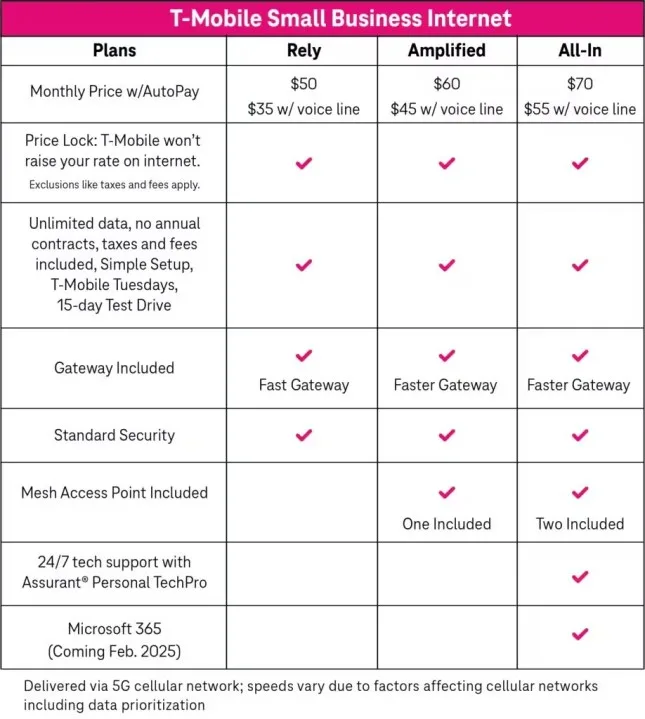
    As we gear up for the upcoming year, T-Mobile has unveiled notable changes to its 5G home and small business internet offerings. The revamped plans commence at just $35 per month for customers who enroll in AutoPay and possess a voice line, making them marginally more affordable than the existing options.

    The first option is the T-Mobile Rely Internet plan, which delivers fundamental home Wi-Fi service at an appealing price point, accompanied by a Price Lock guarantee. Next, the T-Mobile Amplified Internet plan enhances the experience with faster internet speeds and bolstered cybersecurity for residential users, or it includes a mesh device tailored for small business clients.

    Moving on to the T-Mobile All-In Internet plan, this package encompasses everything available in the Amplified plan, in addition to subscriptions to Hulu (with ads) and the Paramount+ Essential Monthly Plan for residential customers. Small business subscribers will benefit from two mesh devices, Microsoft 365, and a variety of other perks.

    Here’s a summary of the pricing structure:

    • T-Mobile Rely Internet: $50 per month with AutoPay, or $35 per month if paired with any T-Mobile voice line.
    • T-Mobile Amplified Internet: $45 per month with AutoPay and a voice line, or $60 per month without.
    • T-Mobile All-In Internet: $55 per month with AutoPay and a voice line, or $70 per month without.

    These new packages appear to be more customer-centric, offering added benefits and competitive pricing compared to the existing plans, which will still be available until the new ones launch next week.

    Currently, the Home Internet Unlimited package provides an all-you-can-use, high-speed home internet service for $50 each month with AutoPay. For those needing greater capacity, the Home Internet Plus plan is available at an additional $20 per month, delivering faster speeds suited for larger families and multiple devices.

    In his announcement of these new plans, Allan Samson, T-Mobile’s chief broadband officer, stated, “While some internet providers increase rates by as much as $50 a month once the promotional period ends, we’re rolling out new plans that provide customers with more options and greater value, ensuring that as long as they stay on their eligible 5G Internet package, they won’t experience unexpected price hikes.”

    The Rely, Amplified, and All-In Internet plans will be available starting Wednesday, December 11. Customers can enroll online or at physical locations, with small business users having the option to sign up at T-Mobile stores.

    This year, T-Mobile has frequently made headlines, many of which were less than favorable. In October, the company reached a settlement with the Federal Communications Commission (FCC) over past data breaches that impacted 130 million customers between 2021 and January 2024. Furthermore, in August, the company attracted criticism for imposing additional monthly charges of up to $5 per line on customers with legacy data plans.

    As T-Mobile continues its journey, it remains the third-largest carrier in the U.S., trailing behind Verizon and AT&T.

  • Is AT&T Offering Free 5G Phones?

    As the demand for 5G technology continues to rise, many consumers are on the lookout for ways to upgrade their devices without breaking the bank. One of the major carriers in the United States, AT&T, has been making headlines for its offers related to 5G smartphones. This article delves into whether AT&T is truly offering free 5G phones and what this means for prospective customers.

    AT&T’s Current Promotions

    AT&T’s strategy for attracting new customers often includes promotions that may feature discounted or even free devices, specifically when they switch their services or add a line. Here’s a look at their recent offerings:

    Promotional Offers

    • Limited-Time Deals: AT&T tends to roll out promotional campaigns that may include no-cost options for select 5G smartphones, especially for customers transferring from other carriers.
    • Trade-In Discounts: Customers can reduce the overall cost of a new 5G phone significantly by trading in an older device. In some instances, this can result in the new phone being essentially free.
    • Bundled Packages: When combined with specific unlimited data plans, customers might find options where the cost of the phone is waived or substantially discounted.

    Eligible Devices

    AT&T frequently updates its list of eligible devices under promotional offers. Currently, the phones that may be featured include:

    List of Popular 5G Models

    • Samsung Galaxy S22
    • iPhone 13 and iPhone 14
    • Google Pixel 6 and Pixel 7
    • OnePlus 9 and OnePlus 10

    These devices are among the top-rated in the market, making the option for getting one for free all the more appealing.

    Conditions and Requirements

    While the idea of obtaining a free 5G phone is attractive, customers should be aware of the fine print associated with these offers. Here are common requirements:

    Key Conditions

    • Contract Commitment: Most offers will necessitate a service agreement that often spans 24 to 36 months.
    • New Customers Only: Many promotions are specifically targeted at new subscribers, meaning current customers might not be eligible for the same benefits.
    • Credit Approval: Potential buyers may need to pass a credit check to qualify for promotional pricing on devices.

    How to Access These Offers

    For those interested in exploring AT&T’s 5G phone deals, here are the recommended steps:

    Steps to Take Advantage of Promotions

    1. Visit the AT&T Website: The official site will have the latest promotional offers laid out clearly.
    2. Check for Eligibility: Review the details regarding which devices are eligible and what specific plans need to be considered.
    3. Store Visit: Sometimes, promotions are more favorable in-store. Visiting an AT&T location can provide access to exclusive deals not found online.
    4. Ask Questions: Don’t hesitate to inquire about any hidden fees or additional terms that might apply.

    Customer Experiences

    Consumer feedback regarding AT&T’s promotional offers can vary widely. Here are some overall sentiments:

    Common Feedback

    • Positive Experiences:

      • Many customers highlight the satisfaction of receiving a high-value device without upfront costs.
      • Quick activation and good customer service are frequently praised.

    • Negative Experiences:

      • Some users express frustration over long-term contracts that lock them in for extended periods.
      • Hidden fees associated with the service contracts can lead to unexpected costs.

    As consumers explore the possibility of getting free 5G phones through AT&T, it’s crucial to read through all details of any promotions. By being informed and understanding the terms involved, customers can make savvy decisions about their mobile services.

  • iPhone 16 Beats Galaxy S24 In 5G Speed Test Results

    iPhone 16 Beats Galaxy S24 In 5G Speed Test Results

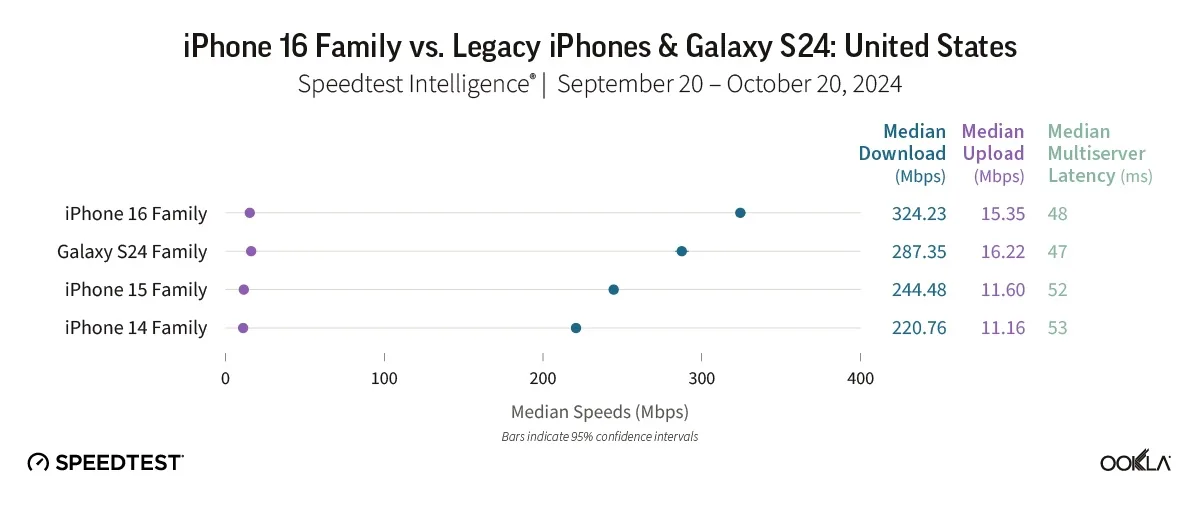
    Recently, Ookla conducted a series of tests evaluating the 5G speed and latency of the iPhone 16 lineup. The findings revealed that these devices delivered outstanding performance, outshining both their predecessors and key rivals, including the Samsung Galaxy S24 series.

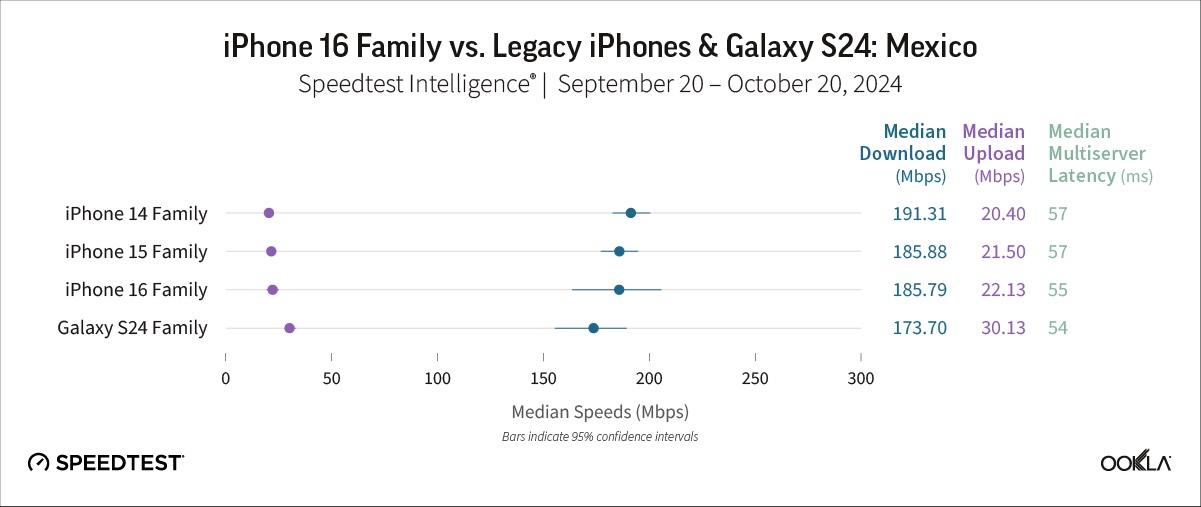
    Data from Speedtest, gathered across 11 countries, indicated that the iPhone 16 series significantly exceeded the performance metrics of the earlier iPhone 14 and iPhone 15 models in terms of both speed and latency. When compared to the Samsung Galaxy S24, the iPhone 16 achieved a range of results but maintained a strong overall performance.

    Particularly notable was the iPhone 16’s marked advantage in median 5G download speeds in five of the studied countries. Conversely, the Samsung Galaxy S24 family showed the fastest median 5G multiserver latency in eight countries, while the iPhone 16 led in 5G latency in just one region.

    Moreover, the Galaxy S24 excelled in median 5G upload speeds in eight out of the 11 countries assessed, while the earlier iPhone 14 and 15 models generally recorded the slowest upload speeds.

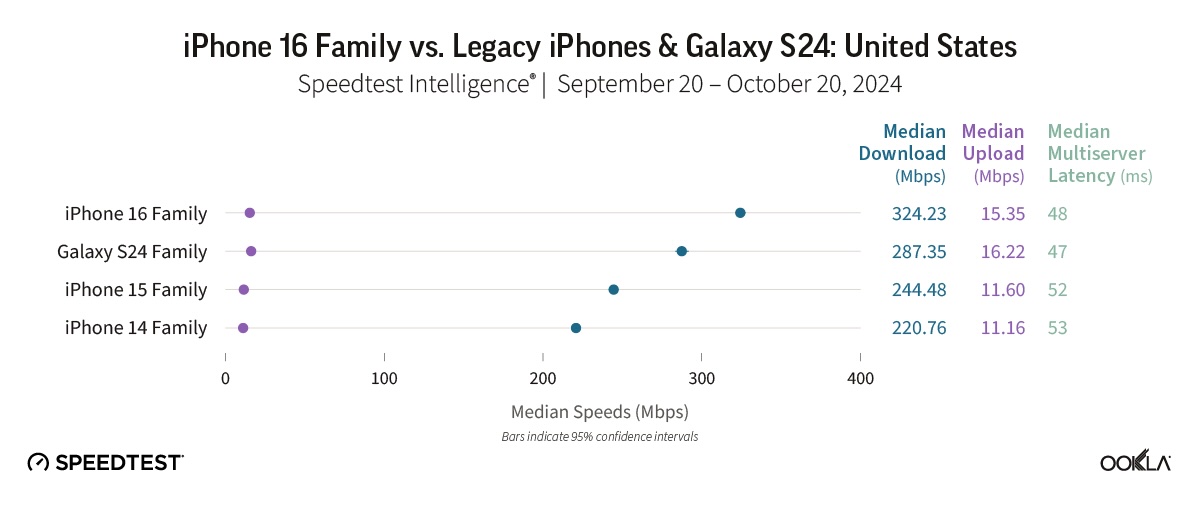
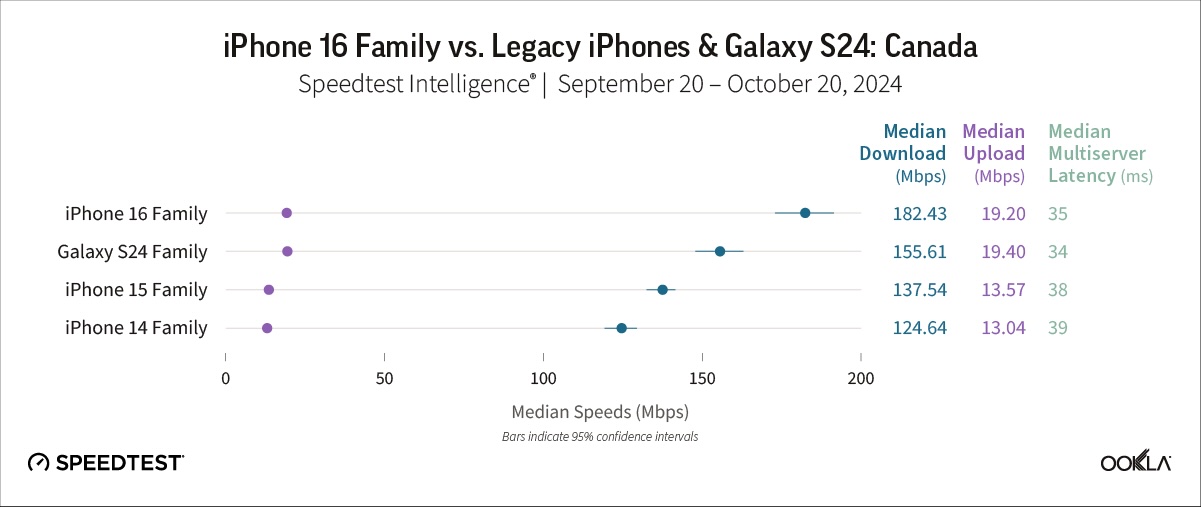
    On the whole, the iPhone 16 models displayed significant speed improvements over previous generations of both Apple and Samsung devices in various markets, including Canada, France, Taiwan, and, notably, the United States. In the U.S., the iPhone 16 achieved a median download speed of 324 Mbps, surpassing the Galaxy S24, which registered a median speed of 287 Mbps. A similar trend was observed in Canada, where the iPhone 16 delivered an 182 Mbps download speed compared to the Galaxy S24’s 156 Mbps.

    The speed and latency evaluations were conducted from September 20, the launch day for the iPhone 16, until October 20, covering regions such as the United States, India, Taiwan, Belgium, France, Germany, Canada, Mexico, the Philippines, Colombia, and Brazil.

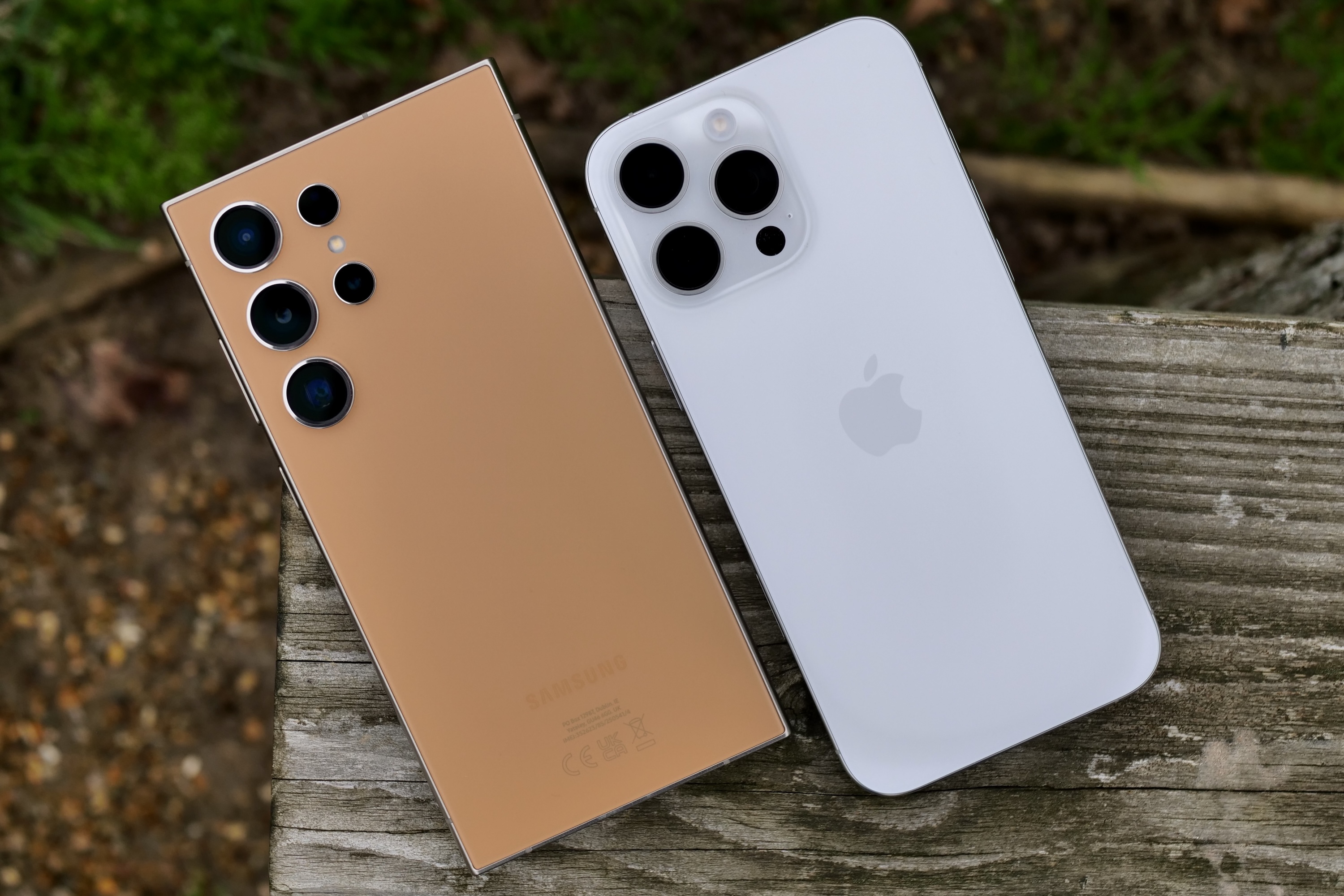
    The back of the Samsung Galaxy S24 Ultra and Apple iPhone 16 Pro Max.
    The Samsung Galaxy S24 Ultra (left) and Apple iPhone 16 Pro Max Andy Boxall / Digital Trends

    With Black Friday approaching, Ookla notes that the results suggest upgrading from an older iPhone could be beneficial for those seeking optimal 5G performance, at least in certain regions. They emphasize that the iPhone 16’s impressive performance makes a compelling case for an upgrade.

    However, they also caution: “Should users in those regions upgrade right away? Not necessarily. The choice to upgrade involves factors beyond network performance, including pricing, new features, and various other considerations. Nevertheless, the initial data on the 5G capabilities of the iPhone 16 series is certainly promising early on.”

    The iPhone 16 series includes the iPhone 16, iPhone 16 Plus, iPhone 16 Pro, and iPhone 16 Pro Max. These models are remarkable for being the first in the iPhone line to support Apple Intelligence. Each variant also features the company’s new Camera Control system, among other enhancements.

  • Nothing CMF Phone 1: Is It 5G or Not?

    Nothing CMF Phone 1: Is It 5G or Not?

    The CMF Phone 1 is a new entrant in the smartphone market, and many potential buyers are curious about its features, especially its connectivity capabilities.

    One of the key questions is whether the CMF Phone 1 supports 5G technology. The CMF Phone 1 is a smartphone that aims to offer a balance of performance, features, and affordability.

    It has gained attention for its sleek design, impressive specifications, and competitive pricing.

    Does Nothing CMF Phone 1 has 5G?

    Yes! CMF Phone 1 supports 5G!

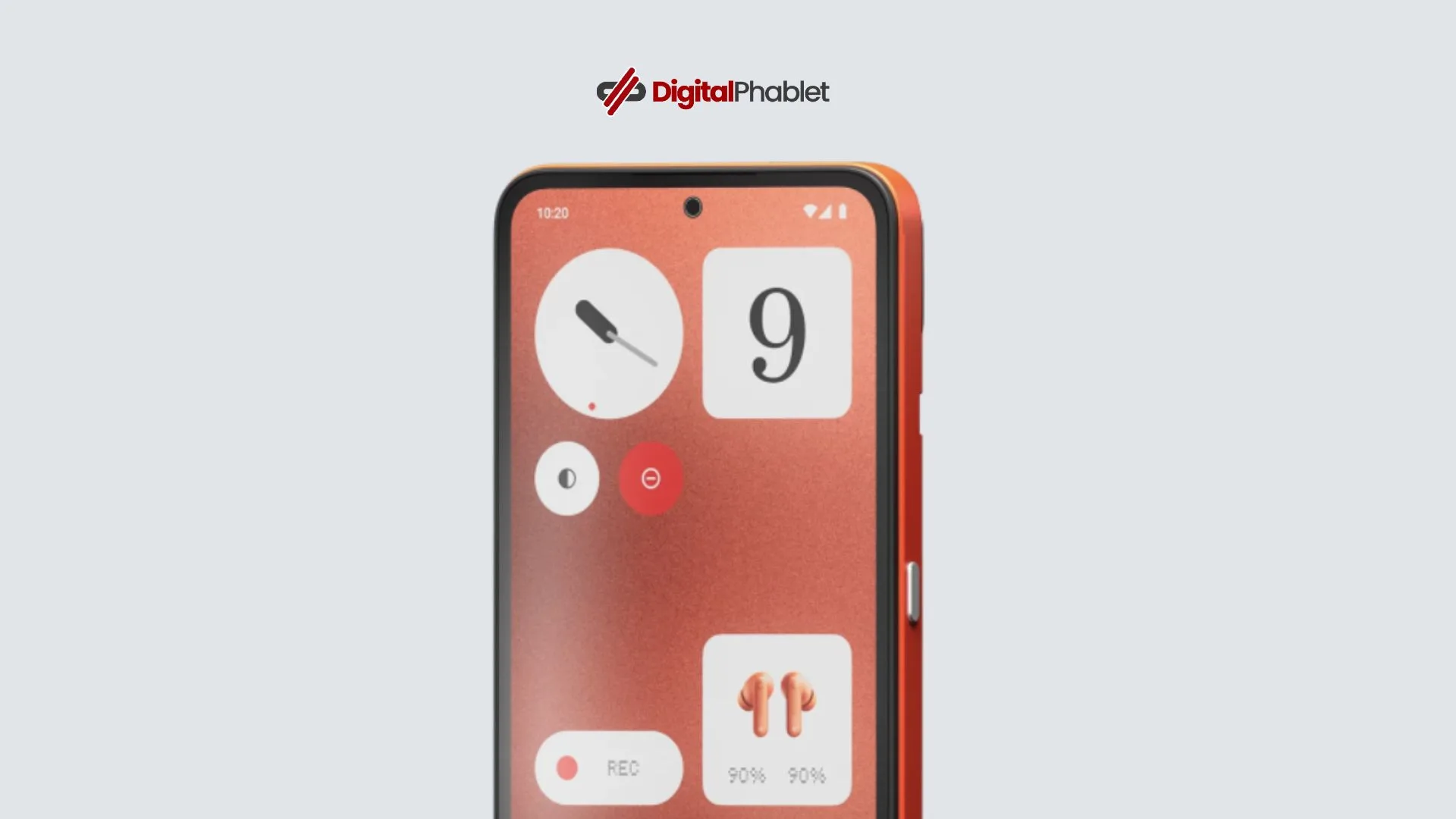
    CMF Phone 1 orange backside

    Key Features

    Some of the standout features of the CMF Phone 1 include:

    • Display: High-resolution display with vibrant colors and sharp clarity.
    • Camera: Advanced camera system with multiple lenses for versatile photography.
    • Battery Life: Long-lasting battery with fast charging capabilities.
    • Performance: Powerful processor and ample RAM for smooth multitasking and gaming.

    The CMF Phone 1 is designed to work with a variety of network types, making it a versatile choice for users around the world. Here are the key network compatibility details:

    • 2G: The phone supports traditional 2G networks, ensuring basic connectivity in areas with limited network coverage.
    • 3G: Compatibility with 3G networks allows for better internet speeds and more reliable voice calls.
    • 4G LTE: The CMF Phone 1 supports 4G LTE, providing fast internet speeds and improved overall connectivity.
    • 5G Bands: The phone supports multiple 5G bands, ensuring compatibility with various 5G networks around the world. This allows users to take advantage of the latest in mobile connectivity technology.
    • Speed and Performance: With 5G support, the CMF Phone 1 can deliver blazing-fast internet speeds, low latency, and improved overall performance, making it ideal for streaming, gaming, and other data-intensive activities.

    Benefits of 5G on the CMF Phone 1

    Faster Internet Speeds

    One of the primary benefits of 5G is significantly faster internet speeds compared to 4G. This means quicker downloads, smoother streaming of high-definition videos, and faster loading times for websites and apps.

    Lower Latency

    5G technology offers lower latency, which is the delay between sending and receiving data. This is particularly beneficial for real-time applications like online gaming, video conferencing, and augmented reality experiences.

    Improved Network Reliability

    5G networks are designed to handle more devices simultaneously without a drop in performance. This means more reliable connectivity in crowded areas, such as stadiums, concerts, and urban centers.

    How to Ensure 5G Connectivity on the CMF Phone 1

    Check Carrier Compatibility

    Before purchasing the CMF Phone 1, it’s important to check if your mobile carrier supports 5G in your area and whether the phone is compatible with your carrier’s 5G bands. Most major carriers are expanding their 5G networks, but coverage can vary.

    Update Software

    Ensure that your CMF Phone 1 is running the latest software updates. Manufacturers often release updates that improve network performance and add new features, including better support for 5G.

    5G Plan

    To take full advantage of 5G, you may need to subscribe to a 5G data plan from your carrier. These plans are designed to provide the necessary data speeds and allowances for 5G connectivity.

    The CMF Phone 1 is indeed equipped with 5G technology, making it a future-proof choice for users who want to experience the fastest mobile internet speeds available.

  • iPhone 14 Pro 5G is 38% Faster Than iPhone 13 Pro

    Perhaps you should upgrade to the iPhone 14 Pro 5G if you currently use an iPhone 13 Pro and want faster 5G.

    Apple’s introduction of 5G hasn’t exactly been smooth if you’re using an iPhone 13 Pro.

    While 5G ruined the iPhone 12‘s battery life, it was worse than the iPhone 11, and while improvements were made with the iPhone 13, it seems Apple has finally hit its stride with the iPhone 14 Pro. But if you want a faster 5G, maybe the iPhone 14 Pro is worth it.

    Over 5G networks, the iPhone 14 Pro is 38% faster than its predecessor, the iPhone 13 Pro.

    5G Speed Test: iPhone 14 Pro vs iPhone 13 Pro

    Using SpeedSmart’s data, the new iPhone 14 Pro is faster for both downloads and uploads (by 38%). The latency has also been significantly reduced.

    T-mobile

    iPhone 13 ProiPhone 14 Pro
    Download173.81 Mbps255.91 Mbps
    Upload22.51 Mbps28.25 Mbps

    Verizon

    iPhone 13 ProiPhone 14 Pro
    Download126.33 Mbps175.56 Mbps
    Upload21.64 Mbps27.28 Mbps

    Both upload and download speeds are way faster on the iPhone 14 Pro than the iPhone 13 Pro. There’s a lot to like about this. Your phone will run faster and feel better. There’s more to it than that.

    There’s a better latency on the iPhone 14 Pro too

    What’s the deal with latency on phones? A phone’s latency is how long it takes to connect to a carrier’s servers – in this case, the iPhone 14 Pro. Latency gets lower the shorter the time. The iPhone 14 Pro’s latency is 37.09ms versus 52.24ms for the iPhone 13 Pro. That’s a big performance boost.

    Why does the iPhone 14 Pro perform so well over 5G? It’s all thanks to Qualcomm’s Snapdragon X65 modem. It handles 10Gbps (vs 7.5Gbps on the X60), and it’s more efficient, so it consumes less power than the X60. Latency is how long it takes to connect to a carrier’s servers – in this case, the iPhone 14 Pro. Latency gets lower the shorter the time. The iPhone 14 Pro’s latency is 37.09ms versus 52.24ms for the iPhone 13 Pro. That’s a big performance boost.

    As a result, you’ll get faster 5G connections, less battery drain, and better latency when streaming on apps like Netflix, online gaming portals, and/or watching or playing games live.

    You’ll notice a noticeable difference in your life with the iPhone 14 Pro’s improved modem

    Apple seems content with Qualcomm’s excellent hardware for iPhone modems, as it does with CPUs. Although an Apple-designed modem is likely at some point, it doesn’t seem likely anytime soon since Apple has a “multi-year” deal with Qualcomm.

    Find all the best deals on the iPhone 14 Pro right here.

  • Lenovo Launches World’s First 5G Laptop, Lenovo Flex 5G

    Lenovo is introducing its Lenovo Flex 5G in the race of 5G laptops, which is to be released by the 18th of June at $1,399.99 as the world’s first 5G laptop as the Verizon exclusive. 

    (المزيد…)
  • Can 5g Radiation cause Coronavirus? Big Question Answered!

    5G cause Coronavirus? Since the moment when the invention of 5G mobile technology came into existence, a lot of controversial ideas have emerged.

    (المزيد…)
  • RealMe X50 5G Cheapest 5G Smartphone With Price and Review

    The manufacturer Realme has put the small dishes in the big with the RealMe X50 5G Pro: not only is it the first smartphone to integrate the new mid-range 5G processor from Qualcomm, but it is also very well equipped.

    (المزيد…)
  • Google Is Manufacturing a 5G Pixel Smartphone

    5G Pixel Smartphone is on the way! As most of the world is moving towards 5G, and now google smartphones have joined the 5G race as they continue to work on 5G Pixel smartphones. The latest Google Pixel 4 will have about Two versions.

    (المزيد…)
  • Huawei Mate 20 X 5G smartphone Network speed is 6 times faster than 4G

    Since the issuance of 5G licenses, domestic mobile phone manufacturers and operators have adopted various methods to “start” their own 5G products.

    (المزيد…)
  • 6G is 100 Times Faster Than 5G, Can be Used In Sea, Air and Space

    Ren Zhengfei, the founder of Huawei, is already starting to talk about 6G by talking about its flow and its uses. Thanks to the terahertz frequencies, this new network could reach 100x speeds above 5G and could create a new global way of communicating.

    (المزيد…)
  • Pakistan Became First Country to Launch 5G Services In South Asia

    Pakistan has become the first country to initiate 5G services in South Asia beating India, Bangladesh, and other countries.

    (المزيد…)
  • 5G Is Not Harmful To Health In Comparison with 4G, Statistics

    5G is not harmful to health after Federal Communications Commission compared it with 4G and said using 4G is more harmful, but 5G is relatively more secure than 4G.

    (المزيد…)
  • Apple Is Planning To Release a 5G MacBook in 2020

    2019, considered the first year of 5G technology, as 5G war in the smartphone industry has started. Not long ago, Huawei, Samsung, Xiaomi and other eight major mobile phone manufacturers rushed to the 5G terminal, Tian Feng International analyst Guo Mingxi recently released the 5G iPhone news.

    (المزيد…)