الوسم: 2018

  • China-India Trade: $95B Deficit and $125B Total Commerce

    China-India Trade: $95B Deficit and $125B Total Commerce

    The Resurgence of Shein in India: A Look at the Market Dynamics

    The Comeback of Shein

    After a five-year hiatus, Shein has made its triumphant return to the Indian market. Originally banned in June 2020, the fast-fashion brand faced the government’s wrath due to national security concerns and data protection issues amid geopolitical tensions. The closure of the Shein platform was part of a broader crackdown on various Chinese apps, following violent clashes along the Himalayan border.

    On February 1, 2025, industry magnate Mukesh Ambani’s Reliance Industries successfully re-launched Shein’s operations in India. This re-entry comes under a revamped agreement stipulating that all products available through the Shein India app must be designed and produced locally. The launch initially covers major cities like Delhi, Mumbai, and Bengaluru, with ambitions for nationwide expansion.

    The Trade Landscape Between China and India

    Trade Imbalance

    The relationship between China and India is characterized by a significant trade imbalance. In 2022, China exported an astounding $110 billion worth of goods to India, dominating sectors like electronics and machinery, which accounted for nearly half of the total exports. On the flip side, India’s exports to China were considerably lower, totaling approximately $15.3 billion. The primary Indian exports included raw materials such as oil, minerals, metals, and chemical products, which are less valuable compared to the high-demand electronics.

    Growth of the Trade Deficit

    The trade deficit between the two nations has been on a steep upward trajectory, ballooning by 61 percent from 2018 to 2022. It grew from around $59 billion to nearly $95 billion within this short period. This figure highlights the increasing economic dependency of India on Chinese imports, particularly as the bilateral trade soared to a total of $125.3 billion in 2022.

    Components of the Trade Equation

    Electronics and Machinery

    China’s role as the primary supplier of electronic goods and machinery to India cannot be overstated. The introduction of advanced technologies and electronic devices has been a driving factor behind India’s expanding demand for Chinese products. This dependency poses challenges for India’s local manufacturing initiatives, as the nation strives to enhance its own production capabilities.

    Raw Materials and Minerals

    Conversely, India’s exports to China, driven mainly by raw materials, depict a much less lucrative trade scenario. Although these materials are essential for various industries, they lack the high value assigned to finished electronic goods. The imbalance is indicative of the pressing need for India to diversify its exports and enhance its production standards to compete on a global scale.

    The Future of Sino-Indian Trade Relations

    As Shein finds its place back in the Indian market, it exemplifies a growing trend of foreign companies seeking to navigate the complexities of the Indian business environment. The emphasis on local manufacturing resonates with India’s push for self-reliance, as exemplified by initiatives like "Make in India." This approach signals a significant shift towards balancing trade relations while fostering local talent and production capabilities.

    Emerging strategies are likely to shape the trading dynamics between India and China as both nations continue to adapt to changing global market conditions and domestic policies. Awareness of trade figures, sectors, and the balance between exports and imports will be crucial for stakeholders navigating this intricate economic landscape.
  • 2023 Survey: Only 32% Want Less Misinformation Online

    2023 Survey: Only 32% Want Less Misinformation Online

    The Shift in Meta’s Approach to Fact-Checking

    The landscape of social media is ever-evolving, and the latest announcement by Meta, the parent company of Facebook, Instagram, Threads, and WhatsApp, underscores a significant transition in how the platform addresses misinformation. Recently, Meta disclosed its decision to terminate its third-party fact-checking program in the United States, choosing instead to implement a community-based approach known as "community notes." This move parallels a similar shift made by X (formerly Twitter) under Elon Musk’s leadership and marks a departure from established professional fact-checking practices.

    The Context of the Change

    Meta’s pivot towards community notes represents a broader trend in social media governance. This strategic shift is informed by the growing sentiments among users regarding freedom of expression. The company acknowledges the growing frustration over perceived overreach in content moderation, which some critics label as a form of censorship. Meta’s Chief Global Affairs Officer, Joel Kaplan, emphasized the commitment to maintaining platforms as spaces for free expression, highlighting that the presence of all types of content—good, bad, and ugly—is indicative of this commitment.

    Meta’s Public Stance on Content Moderation

    The rationale behind Meta’s decision is grounded in a desire to return to the principles of free expression. Mark Zuckerberg, Meta’s CEO, has openly admitted that the transition comes with risks: "The reality is that this is a trade-off," he noted. By scaling back on professional oversight, the company anticipates a reduction in the inadvertent removal of posts and accounts deemed innocent. However, this also implies a potential rise in the prevalence of false information on its platforms—a concern that critics have raised repeatedly.

    The Public’s Perspective on Misinformation

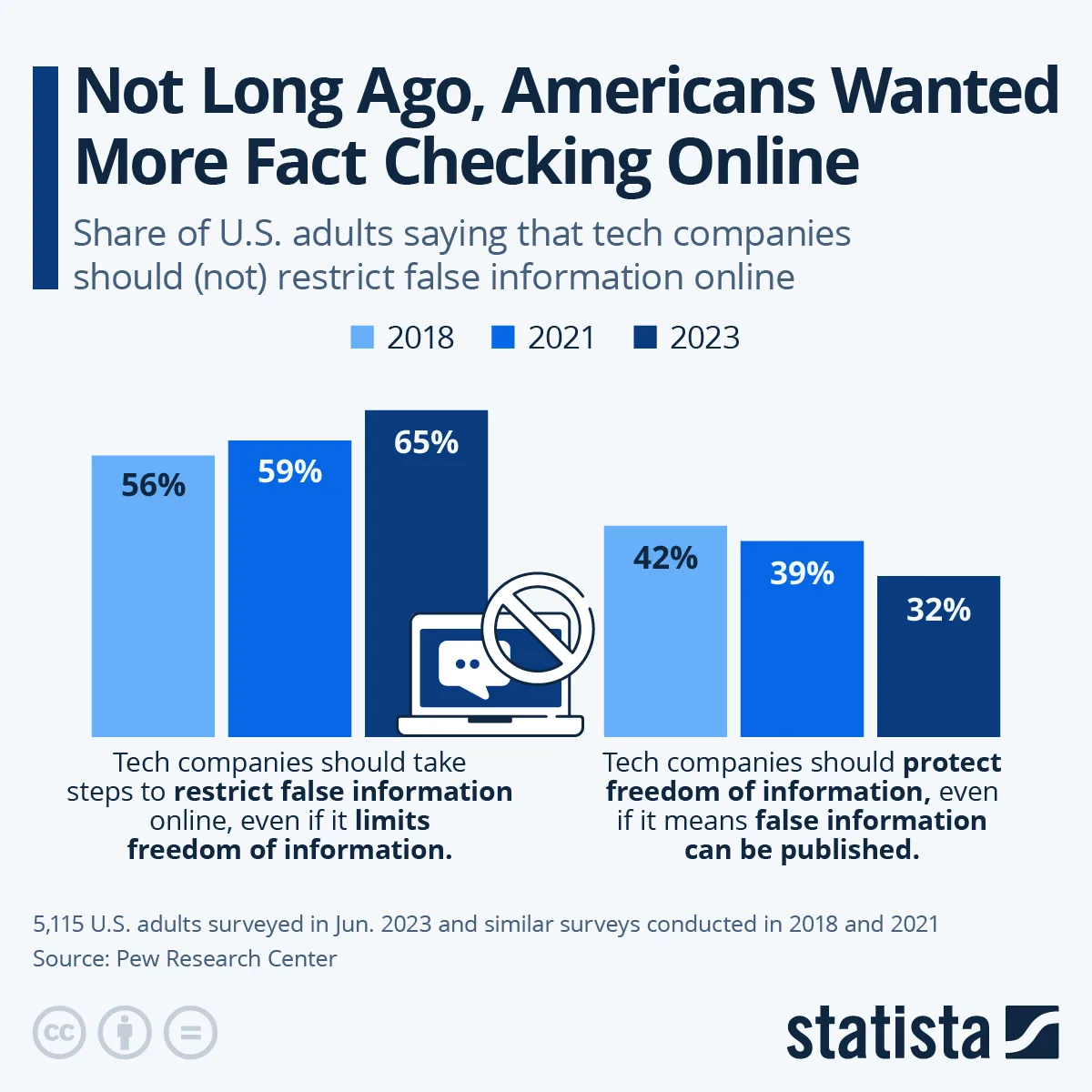
    The 2023 Pew Research Center survey sheds light on evolving public sentiment regarding misinformation online. This survey revealed a striking trend: a significant majority of Americans now desire increased restrictions on false information. Only 32 percent of respondents expressed a preference for upholding freedom of expression over combating misinformation, a marked shift from previous years. In earlier surveys from 2018 and 2021, a larger share of respondents had leaned towards free expression, indicating a growing urgency to address the issues related to misinformation online.

    Implications for Social Media Platforms

    Critics argue that Meta’s abandonment of thoroughly vetted fact-checking systems poses an imminent risk of misinformation proliferation on its platforms. This development is particularly concerning against the backdrop of a politically charged environment, where the lines between fact and opinion often blur. By opting for community-driven checks, Meta may inadvertently validate misinformation campaigns that thrive in the absence of robust oversight.

    The Political Landscape Influencing Meta’s Decision

    Interestingly, Meta’s recent policy change appears to align with political currents, particularly with the anticipated return of a Trump administration. Mark Zuckerberg’s move could be seen as an attempt to rebuild rapport with a segment of the political spectrum that has long criticized the company’s content moderation policies. Historically, platforms like Facebook have faced accusations of stifling conservative voices, prompting calls for reform in their content governance strategies.

    Comparison with Other Social Media Platforms

    As Meta adopts a community-focused approach, it joins other platforms that have taken similar stances. The transition of X under Elon Musk’s leadership showcased a willingness to scale back on formal fact-checking methodologies in favor of user-led management of misinformation. This trend raises crucial questions about accountability and the efficacy of crowd-sourced methods in addressing the pervasive challenge of misinformation on social media.

    Meta’s decision to prioritize community notes signals a fundamental shift in how social media giants navigate the delicate balance between free expression and the fight against misinformation. The implications of this shift are likely to resonate well beyond the digital realm, influencing public discourse, political dialogue, and the overall landscape of information sharing in the years to come.