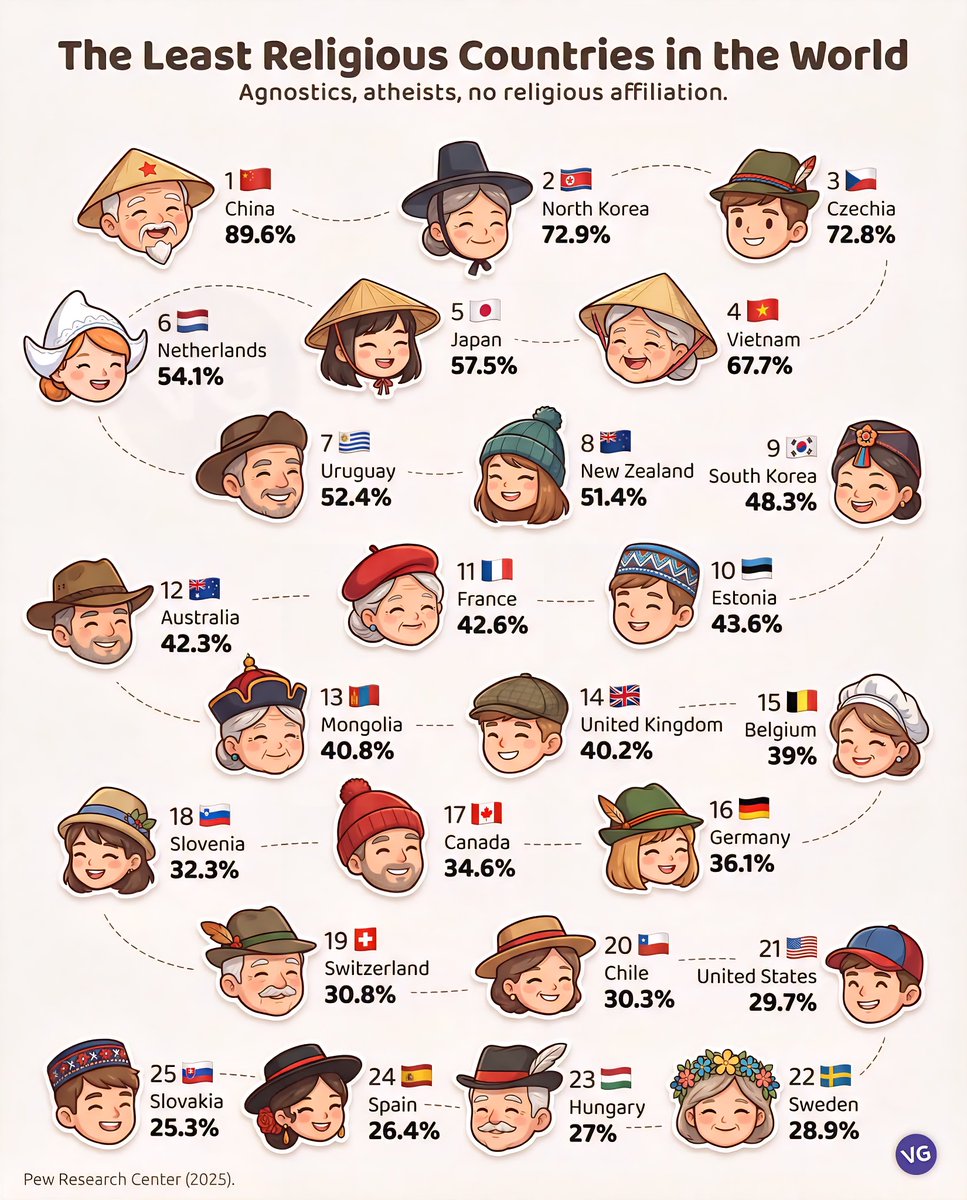
Top 25 Countries with the Lowest Religious Affiliation in 2025
-
China Dominates as the Least Religious Country
In 2025, China leads as the nation with the highest percentage of religious disaffiliation, with approximately 89.6% of its population identifying as atheist, agnostic, or non-religious. This staggering figure underscores the country’s unique cultural and political landscape, where religious practice has historically been suppressed or discouraged. -
North Korea: A Highly Secular Society
Following closely, North Korea exhibits a deeply secular society, with nearly 73% of its population reporting no religious affiliation. State ideology, combined with strict government control, influences the widespread non-religion prevalent in the country. -
Czechia Continues Its Secular Trend
Czechia, known for its rich history of religious upheaval, remains one of the least religious countries in 2025, with about 72.8% of residents reporting no religious belief. Its long-standing secular culture is reflected in the nation’s education and social norms. -
Vietnam’s Increasing Dissociation from Religion
Vietnam sees about 67.7% of its population identifying as non-religious—an increase influenced by modernization, government policies, and shifting cultural attitudes toward traditional faiths. -
Japan’s Significant Secular Shift
In Japan, 57.5% of people identify as non-religious, highlighting a cultural shift that emphasizes tradition over organized faith, with many viewing religion more as cultural practice than spiritual conviction. -
European Countries Show Growing Secularism
Countries like the Netherlands (54.1%), France (42.6%), and Germany (36.1%) exhibit significant portions of their populations with no religious affiliation, reflecting broad societal acceptance of secular lifestyles and skepticism toward organized religion. -
South America’s Unexpected Trends
Uruguay (52.4%) and Chile (30.3%) present interesting cases where increased secularism coincides with historical religious influences, illustrating ongoing cultural shifts. -
Oceania’s Changing Religious Landscape
New Zealand (51.4%) and Australia (42.3%) continue to embrace secular identities, influenced by diverse immigrant populations and emphasis on individualism over traditional religious adherence. -
South Korea’s Evolving Religious Scene
Nearly 48.3% of South Koreans identify as non-religious, reflecting cultural changes and declining influence of traditional faiths amid rapid modernization. -
Estonia: Europe’s Least Religious Nation
Estonia leads the way in Europe, with 43.6% of its population reporting no religious belief, emphasizing a highly secular society driven by progressive values. -
North America’s Shift Towards Secularism
The United States, with 29.7%, and Canada (34.6%), have seen notable increases in secular identities, driven by generational change and societal debates over religious influence. -
Eastern and Central Europe’s Mixed Trends
Hungary (27%) and Slovakia (25.3%) showcase diverse religious landscapes, with substantial portions of populations moving away from traditional faiths.
Understanding the Numbers
These percentages, derived from Pew Research Center’s 2025 survey, reflect the proportion of people who identify as atheist, agnostic, or having no religious affiliation. The trend indicates a clear shift towards secularism across many parts of the world, influenced by cultural evolution, government policies, globalization, and generational change.
The Future of Religion in Global Societies
As secularism continues to grow, discussions around societal values, community cohesion, and the role of faith in public life are more relevant than ever. Countries once deeply rooted in religious traditions are experiencing transformation, reshaping cultural identities and influencing global trends.
Note: The percentages illustrated are based on the most recent data available from Pew Research Center, 2025.