Breaking Down the Global Satellite Count in 2025
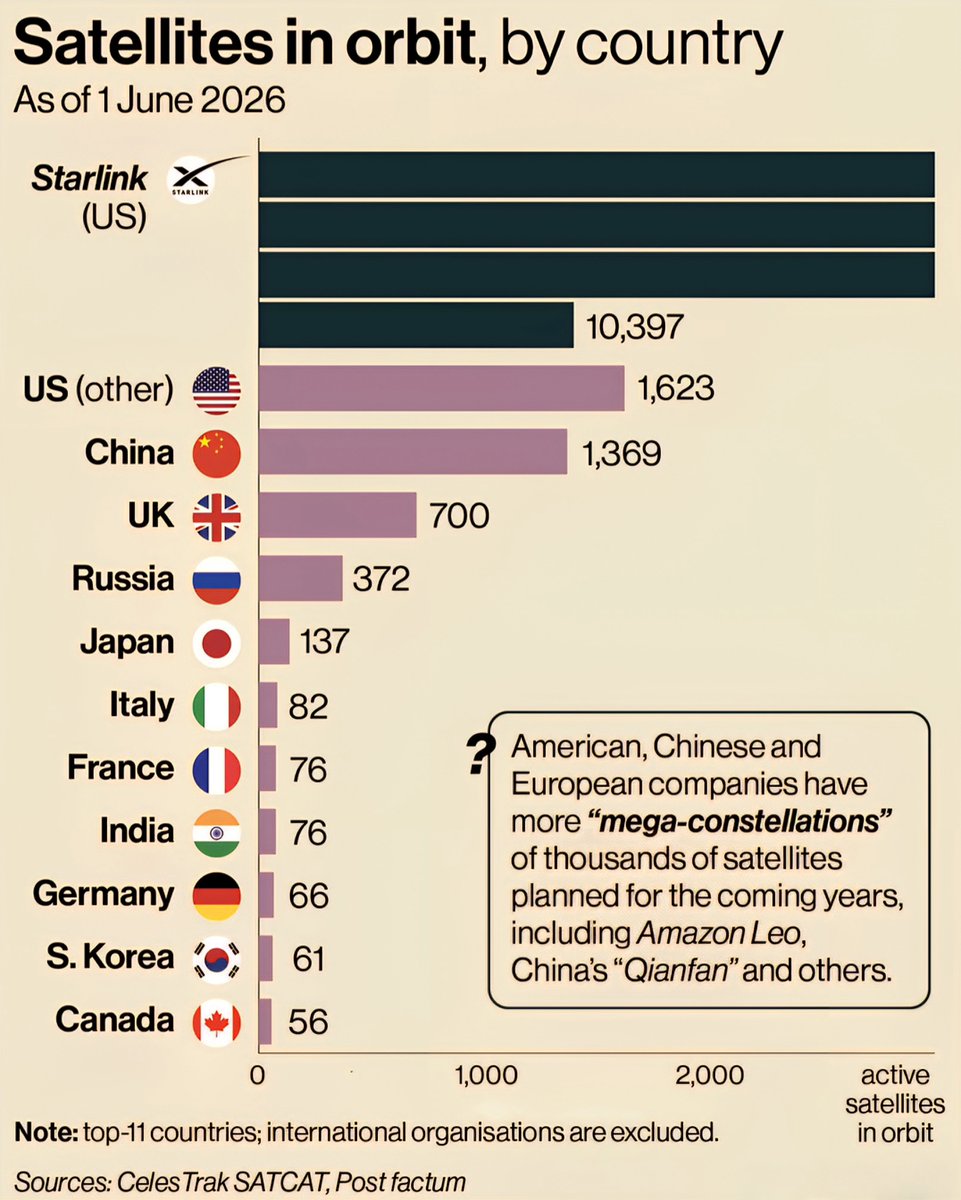
The world of space technology continues to evolve rapidly, with an increasing number of satellites orbiting Earth, powering everything from communications to navigation systems. As of 2025, here’s a detailed look at which countries stand out in satellite deployment, showcasing their advancements in space exploration and satellite services.
The United States Leads with Over 12,000 Satellites
The United States maintains a commanding presence in space, with its satellite count exceeding 12,000. This includes the dominant Starlink constellation, operated by SpaceX, which alone accounts for approximately 10,400 satellites designed to provide global internet coverage. Besides Starlink, the US operates approximately 1,600 other satellites dedicated to military, scientific, and commercial purposes.
This extensive satellite network underscores the nation’s focus on maintaining technological supremacy, ensuring secure communications, weather monitoring, and national defense capabilities.
China Continues Rapid Expansion, Crossing 1,300 Satellites
China’s space agency has been aggressively increasing its satellite constellation, reaching around 1,370 satellites in orbit. The country has focused heavily on both military and commercial satellites, including the BeiDou navigation system, which rivals GPS.
China’s rapid growth in satellite deployment reflects its strategic ambitions to become a leading space power, with significant investments in space technology for economic development, surveillance, and scientific research.
The United Kingdom’s Growing Presence: 700 Satellites
The UK has seen a substantial increase in satellite deployment, crossing the 700-mark. This rise is driven by initiatives targeting satellite communications, Earth observation, and the burgeoning space startup scene. The UK’s investment in space tech is aimed at boosting its capabilities in global broadband, data analytics, and maritime surveillance.
British companies and agencies are steadily expanding their footprint, indicating a robust interest in commercial satellite services and space innovation.
Russia Maintains Over 370 Satellites in Orbit
Russia continues to sustain a significant satellite constellation, with over 370 satellites in orbit. Many of these are part of the GLONASS navigation system, similar to GPS, which supports military and civilian navigation. Russia also utilizes satellites for reconnaissance, communication, and space science.
Despite facing international challenges, Russia’s sustained satellite presence underlines its ongoing commitment to maintaining strategic space assets.
Japan and South Korea Boost Their Satellite Programs
Japan hosts approximately 137 satellites, primarily for Earth observation, communications, and scientific research. Its space program emphasizes technological innovation, with satellites supporting disaster monitoring and environmental management.
South Korea’s satellite fleet includes about 61 units focused on navigation, communication, and technological development. The country aims to enhance its space capabilities to support economic growth and national security.
European Nations: France, Italy, and Germany
-
France has about 76 satellites in space, with substantial contributions to Earth observation through programs like the Sentinel satellites and further investments in space science.
-
Italy operates around 82 satellites, with a focus on telecommunication, Earth monitoring, and scientific missions.
-
Germany maintains 66 satellites, emphasizing climate monitoring, scientific research, and defense applications.
These European nations continue to collaborate through the European Space Agency (ESA), jointly expanding their orbital assets and capabilities.
Canada’s Niche in Space: 56 Satellites
Canada’s satellite presence is modest but impactful, with 56 satellites mainly used for environmental monitoring, communication, and scientific exploration. The country’s unique contribution involves polar orbit missions, supporting Arctic research and climate change studies.
The Satellite Race in Numbers
Total Satellite Count as of June 1, 2026, based on CelesTrak SATCAT data
| Country/Region | Number of Satellites |
|---|---|
| United States (Starlink & Others) | 12,020+ |
| China | 1,370 |
| United Kingdom | 700 |
| Russia | 372 |
| Japan | 137 |
| Italy | 82 |
| France | 76 |
| India | 76 |
| Germany | 66 |
| South Korea | 61 |
| Canada | 56 |
This snapshot exemplifies the rapid expansion of satellite networks globally, driven by technological innovation, economic ambitions, and strategic imperatives.
As space continues to become a pivotal frontier for technological and geopolitical endeavors, countries keep pushing their satellite capabilities to secure a competitive edge. With space technology advancing at a breathtaking pace, the figure of over 12,000 operational satellites marks only the beginning of an era where orbital domains are increasingly central to daily life on Earth.
Source: CelesTrak SATCAT, as of June 1, 2026.