The Disputed Kashmir Region: A Closer Look at Claims by China, India, and Pakistan
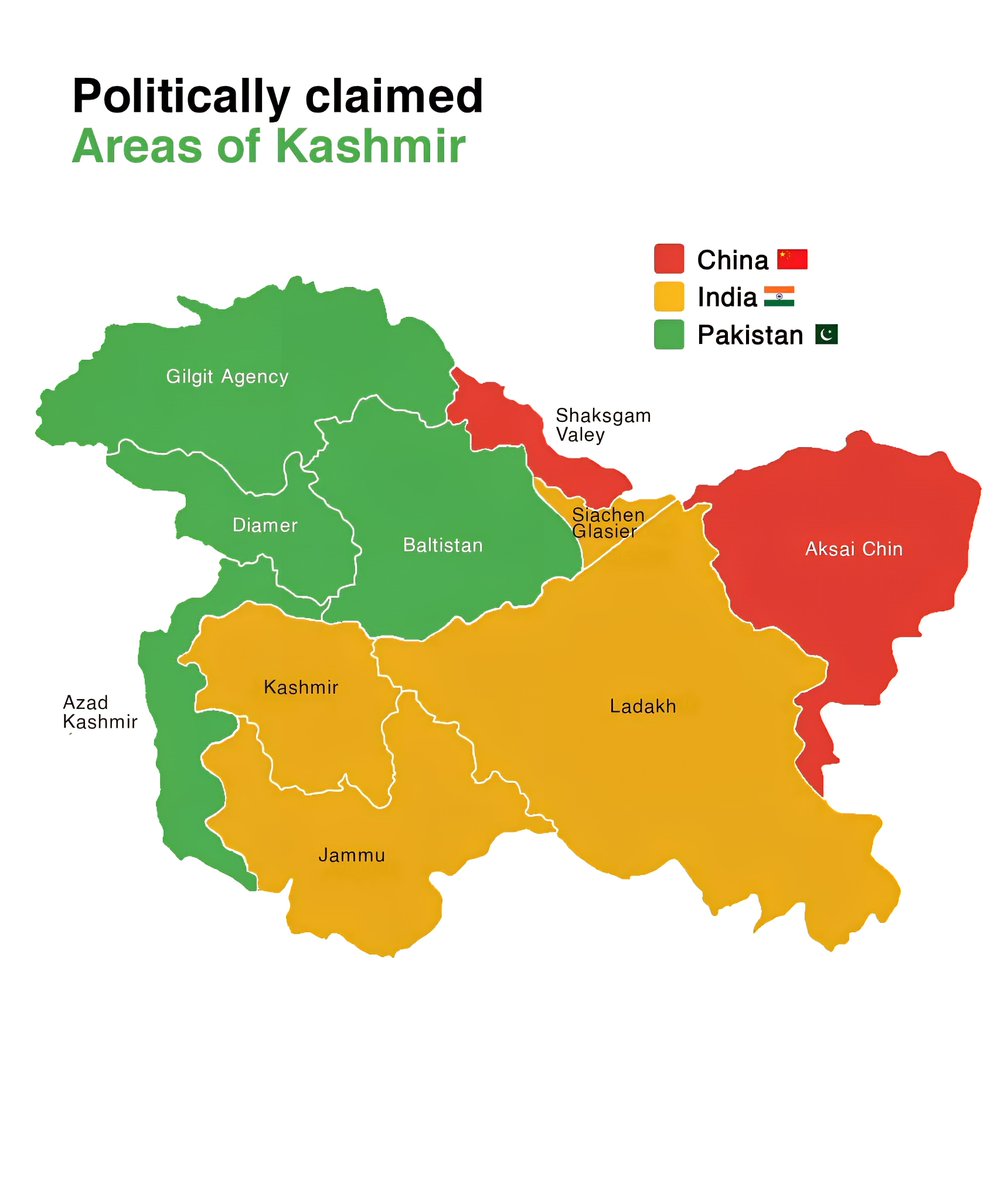
Kashmir remains one of the most delicate and contentious regions in global geopolitics in 2025. The area is embroiled in overlapping claims by three nuclear-armed nations: India, Pakistan, and China. The conflict over Kashmir has deep historical roots, complex alliances, and ongoing geopolitical tensions. Here’s a detailed breakdown of the current state of affairs, emphasizing the claims made by each country.
1. India’s Sovereign Claim over Jammu and Kashmir
India considers the entire Kashmir region as an integral part of its territory. Following the partition of British India in 1947, the princely state of Jammu and Kashmir was supposed to choose between India and Pakistan. The Maharaja’s decision to accede to India, backed by a formal agreement, led to the incorporation of Jammu and Kashmir into India. Today, India administers the Union Territories of Jammu and Kashmir and Ladakh, asserting that these regions belong entirely to India under the Instrument of Accession.
India’s claim is based on historical sovereignty, legal agreements, and international recognition, although Pakistan disputes this, calling for a peaceful resolution through dialogue. Increased military presence and the abrogation of Article 370 in 2019 have further solidified India’s control but have also led to heightened tensions with neighboring Pakistan and local populations seeking greater autonomy or independence.
2. Pakistan’s Claim to the Pakistani-Administered Kashmir
Pakistan claims the western part of Kashmir, also known as Azad Kashmir and Gilgit-Baltistan, as Pakistani territory. The country has long supported the idea of a plebiscite for the people of Kashmir to decide their future, emphasizing the issues of self-determination and historical ties.
Pakistan argues that the original partition was unjust because it divided the Muslim-majority Kashmir region, with a significant portion remaining under Indian control. The line of control (LoC), which divides Indian and Pakistani-administered Kashmir, was established in 1949, but Pakistan continues to pressure for recognition of its claim. Despite ongoing military skirmishes and diplomatic efforts, Pakistan maintains that the entire Kashmir region should be considered an internationally recognized dispute, seeking greater international intervention for a resolution.
3. China’s Strategic and Territorial Ambitions in Kashmir
While China’s direct control over parts of Kashmir is limited compared to India and Pakistan, its territorial claims are prominent in the northern areas. China administers the Aksai Chin region, which was historically disputed territory, and it has its physical presence in the Shaksgam Valley, which was ceded by Pakistan to China in a 1963 border agreement.
China’s interest in Kashmir primarily revolves around strategic concerns. The region’s proximity to vital trade routes, including the China-Pakistan Economic Corridor (CPEC), and broader regional security ambitions influence Chinese policies. The Chinese government claims sovereignty over Aksai Chin, viewing it as an integral part of its Xinjiang region, despite India’s assertions of ownership. The presence of Chinese military infrastructure in these disputed zones underscores China’s desire to solidify influence and extend its strategic reach in South Asia.
4. The Impact of Disputed Claims on Regional Stability
The overlapping claims by India, Pakistan, and China have created a volatile geopolitical environment in South Asia. The region has experienced multiple wars, skirmishes, and diplomatic crises, with each nation asserting sovereignty over the contested territories.
In 2025, the situation remains tense, especially along the Line of Control between India and Pakistan. Despite diplomatic dialogues, border skirmishes, and international pressure, a mutually agreeable resolution remains elusive. The presence of nuclear weapons amplifies the stakes, raising concerns about escalation and regional instability.
5. Current Efforts and Future Prospects for Resolution
Various attempts at peace negotiations and confidence-building measures have been made over the decades. Recent developments in 2025 indicate increased engagement through multilateral forums, although progress is slow. Both India and Pakistan continue to seek international support for their respective positions, with China playing a significant diplomatic role.
However, residual distrust, external influences, and internal political dynamics complicate the possibility of an early resolution. The key to stability might lie in sustained dialogue, respecting the rights and aspirations of Kashmir’s inhabitants, and recognizing the complex historical and geopolitical realities of the region.
The Kashmir dispute remains one of the most complex conflicts in the modern world, with each claiming historical, strategic, and national ownership of the territory. As regional powers continue to navigate this turbulent landscape, the future of Kashmir remains uncertain, with peace efforts ongoing amid persistent tensions.