Understanding Global Perceptions of the U.S. and China in 2025: A Country-by-Country Breakdown
-
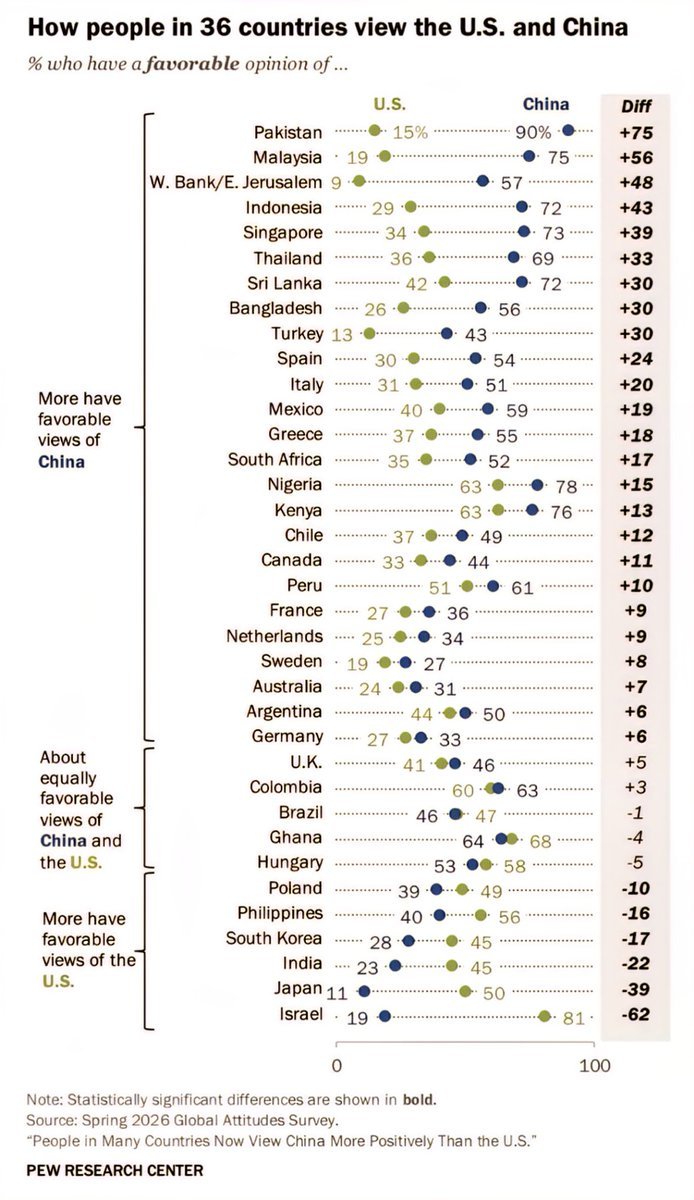
Pakistan: China’s Massive Lead Over the U.S.
In Pakistan, China’s favorable opinion soars at 90%, contrasting sharply with just 15% for the United States. This results in a substantial positive difference of +75%, underscoring China’s strong geopolitical influence and economic appeal in South Asia. -
Malaysia: A Similar Trend with Notable Differences
Malaysia reflects a similar pattern, favoring China at 75% versus only 19% for the U.S., marking a +56% difference. This indicates shifting alliances and perceptions, possibly fueled by economic partnerships. -
Palestine: Moderate Favor for China
In Palestine’s West Bank and East Jerusalem, 57% view China favorably, compared to a mere 9% for the U.S., a +48% difference. This could relate to China’s aid and investment dynamics in the region. -
Indonesia: Growing Affinity Toward China
Indonesia favors China at 72%, while only 29% hold a positive view of the U.S., resulting in a +43% gap. This reflects China’s deepening engagement in Southeast Asia. -
Singapore: The Chinese Favorability Remains Dominant
Singaporeans favor China at 73%, with the U.S. at 34%, showing a +39% difference. As a financial hub, Singapore’s perception highlights economic ties and regional influence. -
Thailand: Slightly More Favorable Toward China
Thailand’s favorability stands at 69% for China vs. 36% for the U.S., with a +33% difference, pointing to a growing regional alignment with Chinese initiatives like Belt and Road. -
Sri Lanka and Bangladesh: High Favorability for China
Sri Lanka favors China at 72%, and Bangladesh at 56%, both significantly ahead of U.S. opinion, emphasizing China’s investments and aid programs in South Asia. -
Turkey: A Shift in Perception
Turkey views China at 43% favorably, surpassing the U.S., which stands at just 13%. The +30% difference indicates Turkey’s strategic pivot towards China amid regional and economic considerations. -
European Perspectives: Mixed Feelings
Spain, Italy, France, and the Netherlands show moderate favorability for China, with differences ranging from +9% to +24%. This suggests nuanced perceptions, influenced by economic ties but also concerns about geopolitical tensions. -
North America and Latin America: Generally Favorable US Opinions
Canada and Mexico maintain higher favorability for the U.S., with +11% and +19% respectively, hinting at sustained alliances. In South America, Argentina and Colombia exhibit strong favorable views, while Brazil and Chile are more neutral. -
South Africa and West Africa: Diverse Views
South Africa (35%) and Nigeria (63%) favor the U.S. more strongly, though Nigeria also exhibits high favorability for China (78%). Ghana leans favorably to the U.S. at 68%, with a slight tilt toward China. -
Eastern Europe: Notable Shifts
Hungary (58%) prefers the U.S., while Poland (49%) shows a decreasing favorability toward the U.S., favoring China at 39%. These shifts reflect ongoing geopolitical realignments. -
Asia-Pacific: A Clear U.S. Lead
Japan (50%) and India (45%) remain more favorable to the U.S., with Japan’s favorability at 50% and India to 45%. South Korea favors the U.S. at 45%, despite China’s lower favorable perception (28%), suggesting regional security concerns. -
Israel: Unwavering Favorability Toward the U.S.
Israel continues its strong alliance, with 81% favoring the U.S. and only 19% for China, a -62% difference, emphasizing the close strategic ties. -
Emerging Trends: China’s Growing Influence
While many regions show a persistent favorability for China, notably in parts of Asia, Africa, and South Asia, perceptions in the West remain more divided, reflecting complex geopolitical dynamics. -
Overall Global Outlook
The 2026 Pew Research Center survey underscores the shifting landscape of international opinion, with China making significant inroads in developing countries, often overshadowing the U.S. in favorability. However, longstanding alliances and perceptions in North America, Europe, and Israel largely sustain a preference for American influence.
Source: Pew Research Center, Spring 2026 Global Attitudes Survey
In a world where perceptions drive diplomacy, economic partnerships, and international cooperation, understanding these attitudes offers vital insights into future global alignments in 2025.