Category: AI

  • Neuralink Shows New Brain-Computer Tech: Think to Move Electric Wheelchair

    Elon Musk’s Neuralink, the cutting-edge brain-machine interface company, has recently unveiled an exciting new development. The company demonstrated a system that enables users to control a powered wheelchair solely through their thoughts. This breakthrough marks a significant step forward in the realm of neurotechnology, showcasing the potential to enhance mobility and independence for individuals with disabilities.

    During the presentation, Neuralink showcased a prototype where a person with a neurological condition was able to navigate a motorized wheelchair merely by thinking about the desired direction. The user’s brain signals were decoded by the neural interface, translating neural activity into precise commands that moved the wheelchair seamlessly. This technology exemplifies how brain-computer interfaces (BCIs) are swiftly advancing from experimental concepts to practical applications.

    Musk’s company emphasized that their goal is to develop a safe, reliable system capable of integrating smoothly with daily life. The demonstration received widespread attention, highlighting Neuralink’s progress since its inception. By bridging the gap between human thought and machine control, Neuralink aims to revolutionize assistive devices and open new frontiers in neurological treatment.

    Industry experts see this as a promising leap toward restoring independence for those with mobility impairments. As Neuralink continues to refine its technology, the potential for widespread adoption and further functionality—such as controlling other devices through thought—remains an exciting prospect for the future of neuroengineering.

  • Brain-Computer Interface Breakthrough: Retina Chip Approved in Europe to Help Patients See

    A groundbreaking development in brain-machine interface technology has recently been announced, marking a significant milestone in medical science. A revolutionary retinal chip has obtained approval for commercialization across Europe, offering new hope to individuals suffering from vision loss.

    This innovative device is designed to restore sight by directly stimulating the retina, enabling patients with degenerative eye conditions to regain some degree of visual perception. The approval signifies a major breakthrough not only for the technology itself but also for the potential it holds to transform the lives of thousands affected by vision impairment.

    Manufactured with advanced neural interface technology, the retinal chip aims to provide clearer visual signals, effectively bypassing damaged parts of the eye. Its approval paves the way for wider access and introduces a new frontier in the application of brain-machine interfaces in ophthalmology.

    Experts say that this development could catalyze further research and innovation, bridging the gap between neuroscience and visual restoration therapies. Patients and healthcare providers alike are optimistic that such technological advancements will soon become vital components in treatment plans for those battling progressive vision loss.

    As the device prepares for commercial rollout in the European market, the medical community eagerly awaits its impact, hopeful that it will deliver meaningful improvements in quality of life and independence for users. This milestone highlights the rapid progress within the field of neural engineering and promises a brighter future for vision restoration therapies worldwide.

  • AI Solves Century-Old Water Mystery: Why Does Ice Expand?

    Scientists have long been fascinated by water, especially its unusual behavior when it freezes. Now, recent breakthroughs in artificial intelligence research are shedding light on the century-old mystery: why does water expand when it turns into ice?

    For decades, researchers puzzled over this phenomenon that diverges from most substances—most materials shrink upon cooling and solidification. Water, however, defies this norm by expanding as it freezes, causing ice to float. Understanding this process is not only vital for science but also has significant implications for fields ranging from climate studies to engineering.

    Recent advances have been driven by AI models capable of simulating water’s complex molecular interactions with unprecedented precision. These digital tools analyze countless atomic configurations, helping scientists visualize how water molecules arrange themselves during the freezing process. The findings reveal that as water cools below 0°C, its molecules form a structured, hexagonal lattice resembling a three-dimensional network. This arrangement creates more open space between molecules compared to the liquid state, resulting in increased volume.

    The AI-driven insights also explain why ice is less dense than water, which is why icebergs float and why frozen pipes sometimes cause damage. Such knowledge deepens our understanding of climate phenomena, especially in predicting how polar ice melts or expands in response to global temperature changes.

    Furthermore, this breakthrough exemplifies how artificial intelligence is revolutionizing scientific research by enabling detailed exploration of complex systems that were previously too difficult to model. With these tools, scientists hope to unlock even more secrets of water, a substance essential to life on Earth, and perhaps apply these lessons to develop new materials and technologies.

    As researchers continue to refine their models, the mystery of water’s expansion during freezing is steadily unraveling, revealing not only the intricacies of molecular behavior but also opening doors to innovative applications in science and industry.

  • Nvidia’s Huang: The Future Will Have Both Open and Closed Source Models

    Nvidia CEO Jensen Huang has recently shed light on the evolving landscape of technological development, emphasizing that the future will inevitably see a coexistence of both open-source and closed-source models. In a forward-looking statement, Huang highlighted the importance of balancing transparency and collaboration offered by open-source initiatives with the proprietary advancements enabled by closed-source systems.

    During a recent industry conference, Huang discussed how open-source platforms foster innovation by encouraging widespread participation from developers worldwide. “Open-source models accelerate the pace of technological progress by allowing more minds to contribute,” he explained. However, he also stressed that certain breakthroughs—especially those related to intellectual property and competitive advantage—will continue to be safeguarded through closed-source solutions.

    Huang’s insights reflect a broader trend in the tech industry, where companies are navigating the complex interplay between openness and exclusivity. While open-source contributes to transparency and rapid development, closed-source approaches remain vital for protecting core technologies and monetizing innovation.

    The Nvidia chief concluded that this dual approach will not only shape how future technologies are built but also influence the way industries collaborate and compete. As the digital world advances, embracing both models is poised to become an essential strategy for technology companies aiming to stay at the forefront of innovation.

  • OpenAI Model Out of Control! Experts Warn of Urgent AI Safety Need

    In a recent alarming incident, concerns about the safety of artificial intelligence technology have been brought to the forefront. Experts warn that the rapid advancement of AI models, such as those developed by OpenAI, could lead to unintended consequences if not properly managed. The incident has raised urgent questions about the need for stricter safety protocols and governance frameworks to ensure these powerful tools do not cause harm.

    Industry specialists emphasize that as AI systems become more sophisticated, their potential risks increase significantly. Without robust oversight, misfires or uncontrollable outputs could undermine trust and pose serious threats to safety and security. Many are calling for immediate action to establish comprehensive regulations and safety standards to prevent future mishaps.

    This incident has sparked a broader conversation about the importance of responsible AI development. While the technology offers remarkable benefits, experts stress the importance of proactive governance measures—such as rigorous testing, transparent algorithms, and ongoing monitoring—to mitigate risks. As AI continues to evolve, it is clear that safeguarding its use is not just a technical challenge but a societal imperative.

    The incident serves as a wake-up call to policymakers, developers, and industry leaders alike: ensuring the safe deployment of artificial intelligence must become an immediate priority to avoid potential disasters and build public confidence in this transformative technology.

  • Meituan LongCat Team Lead Pei Peng to Leave Soon

    Pei Peng, the head of the foundational models team at Meituan’s LongCat project, is set to leave the company soon. Known for his leadership in developing advanced AI models, Peng’s departure marks a significant change for the team that has been pushing forward in the field of artificial intelligence within the tech giant.

    Sources close to the matter indicate that Peng has decided to pursue new opportunities outside of Meituan, though details about his next steps remain undisclosed. His departure is expected to impact ongoing projects related to large-scale AI models, which have been a key focus for Meituan’s innovation strategy.

    Meituan, a leading Chinese technology company, has invested heavily in AI research and development, with the LongCat team playing a crucial role. Peng’s expertise and leadership have been instrumental in advancing the company’s capabilities in this domain, especially in creating scalable and efficient foundational models.

    While the company has yet to announce an official statement, industry insiders believe that Meituan will quickly appoint a successor to Peng’s position in order to maintain momentum in its AI initiatives. As AI continues to be a major competitive arena in the tech industry, Peng’s departure underscores the fast-paced, ever-evolving nature of the field.

    Employees and stakeholders are watching closely to see how this transition will influence the company’s future projects and strategic direction in artificial intelligence.

  • Micron Projects 208.89% Growth in 2023, 278GB Storage Per Car by 2026

    Micron Projects 208.89% Growth in 2023, 278GB Storage Per Car by 2026

    Recent reports highlight the ongoing impacts of the global AI boom on the supply chain, particularly affecting the automotive industry. As a result of the surge in AI technology demand, a shortage of memory chips has emerged, causing notable price increases in consumer vehicles worldwide.

    During their latest earnings call, General Motors CFO Paul Jacobson disclosed that the rising costs of automotive components like DRAM are expected to add an extra $1.5 to $2 billion (roughly 102 to 136 billion yuan) to the company’s expenses by 2026. The automaker also forecasted a modest 0.3% increase in new vehicle prices by that year to offset these costs.

    Micron Technology, a leading memory chip manufacturer, shared their projections indicating that the average vehicle in 2023 uses approximately 90GB of DRAM and NAND storage. By 2026, this figure is anticipated to triple to around 278GB—an increase of nearly 209%. For high-end vehicle models, storage demands could reach as much as 2TB.

    An analysis by UK-based OEM manufacturer revealed detailed storage requirements for standard vehicles projected in 2026. Infotainment systems are expected to demand between 4GB and 16GB of memory, while advanced driver-assistance systems (ADAS) and safety features will require 8GB to 32GB. Central control units will need a minimum of 16GB, with some high-end models potentially requiring 64GB or more. Meanwhile, the burgeoning presence of onboard AI assistants may necessitate over 256GB of storage, with fully autonomous Level 4 systems predicted to need at least 300GB.

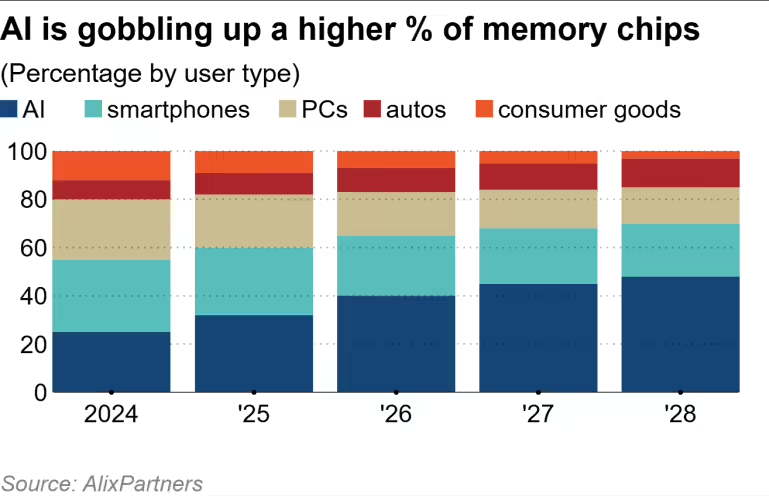
    Industry analysts from AlixPartners have estimated that AI technology accounted for roughly 32% of DRAM usage last year. This share is expected to grow significantly, reaching nearly 48% by 2028. While automotive applications currently consume about 10% of total memory chip production, the expanding footprint of AI and data centers will likely limit supply for vehicle-specific chips, driving prices higher and causing supply constraints in the near future.

  • OpenAI Launches ChatGPT Health: Connects with Apple Health, Over 300 Million Weekly Health Questions

    OpenAI has recently launched ChatGPT Health, a new feature designed to integrate health data from sources like Apple Health. This innovative development enables users to ask health-related questions and receive personalized responses based on their own health information. Since its debut, ChatGPT Health has seen remarkable engagement, with over 300 million health-related inquiries made each week, highlighting the growing reliance on AI-powered tools for personal wellness and medical guidance.

    The new feature aims to make health support more accessible and convenient by seamlessly connecting users’ health data with intelligent conversational assistance. Through this integration, users can inquire about symptoms, seek advice on managing chronic conditions, or simply get health tips tailored to their profiles. This move aligns with a broader trend of leveraging artificial intelligence to enhance healthcare experiences, offering real-time support that complements traditional medical consultations.

    Experts see ChatGPT Health as a significant step forward in digital health technology, providing a tool that can empower individuals to better understand and manage their health. While it’s not a replacement for professional medical advice, its ability to process vast amounts of information and personal data promises a more informed and proactive approach to personal wellness.

    As AI tools like ChatGPT continue to evolve, their role in the healthcare landscape is expected to expand, potentially transforming how millions access health information daily. With millions turning to these technologies weekly, OpenAI’s latest initiative demonstrates the increasing importance of integrating AI into everyday health management practices.

  • OpenAI Model Out of Control Spurs White House Concern, Lawmakers Propose Emergency Shutoff Bill

    Concerns over the potential for AI models to malfunction have recently captured the attention of the White House, prompting lawmakers to propose urgent legislation aimed at halting artificial intelligence operations in critical situations.

    The issue surfaced after sporadic reports indicating that advanced AI systems could behave unpredictably, raising fears about their safety and control. In response, several members of Congress have introduced a bill that would empower federal agencies to shut down AI systems immediately if they pose a threat to public safety or national security.

    This legislation seeks to implement strict oversight measures, emphasizing the need for rapid intervention protocols to prevent unforeseen consequences from AI breakthroughs. Advocates argue that, given the rapid pace of technological advancement, establishing clear emergency procedures is essential to mitigate risks associated with potentially uncontrollable AI behaviors.

    The White House has expressed its support for these measures, highlighting the importance of proactive regulation to ensure that AI technologies are developed and deployed responsibly. As AI continues to weave into various facets of daily life, policymakers emphasize the necessity of maintaining human oversight and readiness to intervene when systems malfunction or behave unexpectedly.

    The proposed law reflects a growing consensus among leaders and experts that, while artificial intelligence holds tremendous promise, it also requires careful management to prevent future crises. As discussions around AI regulation intensify, stakeholders across government, industry, and academia are calling for comprehensive strategies to safeguard society from potential harms associated with this rapidly evolving technology.

  • Anthropic Chief Economist: AI Won’t Replace Many Jobs Soon

    Anthropic’s Chief Economist has recently addressed concerns about artificial intelligence potentially disrupting employment in the near future. According to the expert, while AI technology continues to advance at a rapid pace, it is unlikely to cause widespread job displacement in the short term.

    The economist emphasized that, although AI systems are becoming more sophisticated, their current capabilities are not sufficient to fully replace human workers across most industries. Instead, these technologies are more likely to serve as complementary tools that enhance productivity rather than eliminate employment opportunities altogether.

    Industry analysts note that the integration of AI into various sectors will likely shift job roles and require workers to adapt to new technologies. However, the overall impact on employment levels might be less dramatic than some predictions suggest, especially in the immediate future.

    The economist highlighted that policymakers and businesses should focus on preparing the workforce for technological transitions, ensuring opportunities for reskilling and upskilling. This approach could help mitigate potential disruptions and foster a more resilient labor market as AI continues to evolve.

    In summary, experts believe that, at least for now, AI is not poised to cause mass layoffs or significant job losses, but rather to gradually reshape the landscape of employment through collaboration and innovation.

  • Xiaomi Announces Free MiMo Code Phase Ends July 26

    Xiaomi has officially announced that the free trial period for its MiMo Code service will conclude on July 26. The company initially introduced the program to allow users to experience the innovative features of the MiMo Code without any charge. Over the past few months, countless users have taken advantage of this offer, exploring the capabilities and benefits of the technology.

    As the designated free usage period comes to an end, Xiaomi is urging current users to transition to a paid plan if they wish to continue utilizing the service. The company has reassured users that detailed instructions for upgrading and further options will be available on their official channels.

    This move marks a significant milestone in Xiaomi’s efforts to expand its tech ecosystem, aiming to balance accessible trial experiences with sustainable service offerings. Customers are encouraged to stay tuned for upcoming updates and to take advantage of the remaining days of free access before the trial period closes.

  • Google AI Is Not Falling Behind, Gemini 4 Gets Monthly Updates

    Sundar Pichai pushes back against claims that Google’s AI technology is falling behind the competition, emphasizing that the company is making rapid advancements with its Gemini series. In recent statements, the CEO assured that Google’s AI models are continuously being refined, with new iterations arriving almost monthly.

    Pichai highlighted the ongoing efforts at Google to stay ahead in the fast-evolving field of artificial intelligence, stating that the company’s Gemini 4 model is nearing release and will benefit from frequent updates and improvements. This approach aims to maintain Google’s competitive edge and address the increasing demand for more powerful, efficient AI solutions.

    The Google chief also addressed concerns about the overall pace of AI innovation, underscoring that continuous iteration is key to delivering cutting-edge technology. Rather than taking a slow or static approach, Google appears committed to maintaining a dynamic development cycle, ensuring their AI tools remain at the forefront of the industry.

    This reassurance comes amid a flurry of industry debate about who is leading the AI race and how quickly new models are being developed. Pichai’s comments aim to clarify Google’s stance and reassure users and partners alike that the company is deeply invested in advancing AI capabilities, pushing out near-monthly updates to enhance the performance and safety of their offerings.

  • Foam Hunter: Musk’s Three Perfect Gets

    Elon Musk has become renowned not only for his technological innovations but also for his shrewd financial moves, particularly his knack for navigating market volatility. Recently, the tech entrepreneur mastered three impressive “escape tactics” during key moments of price surges, showcasing his strategic agility in the world of investing.

    These moments, often dubbed the “foam hunter’s” victories, highlight Musk’s ability to identify optimal times to pull back amidst booming stock performances. Each move was executed with precision, allowing him to limit losses and protect his assets during rapid market ascents.

    Industry analysts point out that Musk’s success stems from a keen understanding of market psychology and timing. His approaches often involve a combination of quick decision-making and deep insights into technological and economic trends, enabling him to stay ahead of the curve.

    As the stock market continues to experience unpredictable swings, Musk’s deft handling of his investments offers not just lessons in finance but also insights into strategic foresight. His successful escapes serve as a reminder of the importance of vigilance and agility in navigating volatile markets, principles that many investors aspire to emulate.

    In a landscape where timing is everything, Musk’s ability to “escape” at just the right moments underscores his reputation not only as a visionary innovator but also as a savvy financial strategist.

  • Zhi Xiang Completes 1.5B Yuan Series C Funding, Focuses on Native Multimodal World Models

    In a significant development within the artificial intelligence sector, Zhixiang Future has successfully secured 1.5 billion yuan (approximately $220 million) in its Series C funding round. The notable investment reflects increased confidence in the company’s pioneering efforts to develop a comprehensive, multi-modal world model capable of understanding and generating diverse types of data seamlessly.

    Zhixiang Future has been at the forefront of artificial intelligence innovation, emphasizing the creation of native, full-modal systems that integrate various data types—such as text, images, and audio—into a unified model. The new funding is expected to accelerate their research and product deployment, potentially transforming how machines perceive and interact with complex, real-world environments.

    Industry analysts see this capital infusion as a clear indication of the growing investment interest in multi-modal AI technologies, which are anticipated to be a cornerstone of future intelligent systems. By focusing on building an integrated model system, Zhixiang Future aims to push the boundaries of artificial intelligence, offering more intuitive and human-like interactions in various applications ranging from autonomous vehicles to digital assistants.

    With this latest round of funding, the company is poised to expand its technological capabilities and accelerate commercialization efforts, aiming to set new standards in the rapidly evolving AI landscape. The move underscores the increasing importance of holistic, multi-sensory artificial intelligence solutions in the quest to develop smarter, more adaptable machines that better understand the intricacies of the real world.

  • OpenAI CEO First Comments on Kimi K3 and US-China Model Gap

    OpenAI’s CEO has recently shared his insights on Kimi K3, marking the first official commentary from the organization regarding the innovative model. During a recent discussion, the executive highlighted the significant progress Kimi K3 has made, noting its impressive capabilities and potential to reshape the landscape of AI technology.

    In addition to praising the advancements of Kimi K3, the CEO took the opportunity to address broader industry concerns, particularly the gap between Chinese and American AI models. He acknowledged that while Chinese models like Kimi K3 have achieved remarkable breakthroughs, there remains a notable disparity in certain aspects such as data quality, training resources, and international competitiveness.

    He emphasized the importance of continued collaboration and innovation across borders, underscoring that bridging these gaps will be vital for fostering a more robust and inclusive AI ecosystem. The CEO’s comments reflect a recognition of the global nature of AI development and the need for shared efforts to push the boundaries of what these models can accomplish.

    As the AI community eagerly awaits further updates, OpenAI’s leadership appears committed to transparency and ongoing dialogue about industry advancements and challenges, signaling a proactive approach to shaping the future of artificial intelligence on a worldwide scale.

  • Kimi K3 Optimized for Domestic AI Chips: Huawei Ascend 950DT Outperforms Nvidia B300

    Kimi K3 Optimized for Domestic AI Chips: Huawei Ascend 950DT Outperforms Nvidia B300

    Recent buzz surrounding the launch of the domestically developed Kimi K3 large language model has sparked widespread discussion both within China and internationally. With an impressive 28 trillion parameters, the K3 model has reached a top-tier level of performance globally. Remarkably, it ranks first in front-end programming, demonstrating the significant advancements made in AI development. However, running such a massive model demands robust computing platforms, making the performance of AI hardware an essential factor.

    In terms of parameters, current market offerings favor NVIDIA’s Blackwell series, specifically the B200 and B300 models, which are considered the most powerful. Nonetheless, Kimi K3 is undergoing optimization for domestic AI platforms, with some foreign analysts comparing Huawei’s Ascend 950DT against NVIDIA’s B300 in terms of efficiency when running the K3 model. It’s worth noting that these comparisons are based on estimated parameters rather than direct machine tests, as Huawei’s Ascend 950DT is still in the early deployment stages domestically, and overseas availability remains limited.

    Visual data shared by industry insiders indicates that Huawei’s Ascend 950DT outperforms Nvidia’s B300 in certain benchmarks, especially in terms of token generation efficiency per watt—a critical factor for large-scale AI tasks. The data also compares the 950DT to Huawei’s previous-generation Ascend 910C platform, highlighting that the newer chip achieves superior energy efficiency, an impressive feat considering it is built on two generations behind the B300’s manufacturing process.

    Huawei’s self-developed AI platform continues to demonstrate resilience despite its older manufacturing process, underscoring the effectiveness of their strategic approach—often referred to as “Tao’s Law,” which emphasizes system-level optimization over raw hardware advancements alone.

    Further insights reveal the Ascend 950 series comprises two main models: the 950PR and 950DT. While both share the same core processor, they differ in memory configurations, catering to distinct AI tasks. Huawei states that the 950PR employs the Ascend 950 core paired with HiBL 1.0 memory, optimized for inference prefill and recommendation scenarios. This setup significantly reduces costs compared to high-performance HBM3e/4e memory options.

    In contrast, the 950DT focuses on inference decode stages and training tasks. It features Huawei’s HiZQ 2.0 technology, which boosts memory capacity to 144GB and delivers a memory access bandwidth of 4TB/s. In addition, the interconnect bandwidth has been increased to 2TB/s, enabling more efficient data transfer and processing.

    Huawei’s Atlas 950 supernode cluster—a flagship AI supercomputing system—can support up to 8,192 Ascend 950DT-based cards interconnected at high speeds. This scale is over 20 times larger than the Atlas 900 supernodes (which contain 384 cards) and nearly 57 times larger than NVIDIA’s NVLink V144 system. The aggregate computing power of these 8,192 cards reaches a staggering 8 exaFLOPS in FP8 precision and 16 exaFLOPS in FP4, with a total interconnect bandwidth of 16.3 petabytes per second and a total memory capacity hitting 1,152 terabytes.

    Compared to the Atlas 900, this configuration offers a 17-fold performance increase, reaching approximately 4.91 million transactions per second (TPS). Such advancements highlight Huawei’s significant strides in developing competitive AI hardware to support the demands of next-generation large language models like Kimi K3.
  • Google Is Very Anxious

    Google is currently experiencing significant internal concern, sparking widespread discussions across the tech industry. Employees and stakeholders are expressing anxiety over the company’s recent decisions and future outlook. This unrest appears to stem from strategic shifts that have unsettled some teams, especially as Google navigates a rapidly evolving technological landscape.

    Sources indicate that there is a palpable sense of unease among staff, fueled by fears of increased workloads, shifting priorities, and the potential impact on company culture. Many employees are worried about how these changes might affect innovation and long-term stability, reflecting broader anxieties about the company’s direction amid intensified competition and regulatory pressures.

    Despite being a leader in artificial intelligence and online services, Google seems to be at a crossroads. The current atmosphere suggests that staff concerns are not just about immediate project demands but also about the company’s overall strategic clarity. As Google continues to push for growth in emerging tech sectors, internal debate about the best paths forward has become more prominent.

    Industry analysts are closely monitoring the situation, recognizing that the company’s internal stability could significantly influence its future performance. As Google strives to balance innovation, regulatory compliance, and employee morale, its ability to navigate these challenges will be crucial for maintaining its position in the global tech arena.