Category: AI

  • Craig Federighi Talks Apple Intelligence Delay: Release When Ready

    In a recent discussion, Apple’s software chief Craig Federighi addressed the delays surrounding the highly anticipated Apple Intelligence. According to Federighi, the company is committed to ensuring that the product is fully prepared before its release. He emphasized that Apple prefers to take the necessary time to refine and perfect its offerings, rather than rushing to launch something that isn’t ready for public scrutiny.

    This approach, he said, aligns with Apple’s long-standing philosophy of prioritizing quality and user experience. While exact timelines remain uncertain, Federighi assured that developers and engineers are working diligently to deliver a robust and innovative product that meets the company’s standards.

    Apple enthusiasts and industry analysts are eagerly awaiting further announcements regarding Apple Intelligence, hoping that the patience will lead to a groundbreaking introduction when the time comes. As the tech giant continues to navigate complex advancements in artificial intelligence, stakeholders are encouraged to stay tuned for updates on this exciting development.

  • WPS HarmonyOS Native App Launch: Dozens of AI Features Coming

    WPS has announced the release of its native application powered by HarmonyOS, which promises to integrate dozens of artificial intelligence features in the near future. This move highlights WPS’s commitment to embracing cutting-edge technology to enhance user experience.

    The new app aims to provide a seamless interface for users, making it easier than ever to complete documents, manage spreadsheets, and create presentations, all while utilizing advanced AI capabilities. These features are designed to streamline workflows and improve productivity.

    WPS representatives stressed that the integration of AI will not only simplify routine tasks but also introduce intelligent suggestions and automation tools, helping users to work more efficiently. The company looks forward to rolling out these enhancements soon, marking a significant step forward in their offerings within the evolving technology landscape.

    As WPS positions itself in the competitive market of productivity software, the introduction of HarmonyOS-native applications and AI functionalities may set a new standard for software performance and user interaction. Users and industry observers alike are eager to see how these developments will unfold in the coming months.

  • Robots: “Wei Xiaoli” Escape Price War with New Solutions

    In a significant shift in the competitive landscape of the electric vehicle (EV) market, major Chinese automakers, including NIO, Xpeng, and Li Auto, are strategically pivoting away from the price wars that have dominated the industry. Instead, these companies are focusing on enhancing their offerings and improving customer experiences to regain market momentum.

    As the EV sector grapples with intense competition and fluctuating prices, many manufacturers initially resorted to aggressive discounting to attract consumers. However, this strategy has proven unsustainable in the long run. Escalating production costs and slim profit margins have prompted companies to rethink their approach.

    Industry experts suggest that the shift away from price cuts is a response to the need for differentiation in an increasingly saturated market. By investing in technology, quality, and personalized services, automakers are seeking to create a more appealing value proposition for consumers. Innovations in battery technology, autonomous driving features, and connected services are areas where companies are placing their bets.

    NIO has been at the forefront of this transition, focusing on enhancing its premium branding and expanding its service network. Similarly, Xpeng is prioritizing research and development, aiming to deliver cutting-edge technology that stands out amid the competition. Li Auto is also carving out its niche by emphasizing its unique hybrid offerings while providing a robust after-sales support system.

    This shift indicates a broader trend in the auto industry, as manufacturers seek to build long-term relationships with customers rather than rely on short-term sales tactics. As automakers navigate this evolving landscape, the emphasis on innovation and customer satisfaction may ultimately define the next chapter in the electric vehicle revolution.

    In a market where consumer preference is shifting toward quality and technology rather than simply the lowest price, the strategies adopted by these companies may set new standards for the industry as a whole.

  • Cook Responds About When “Apple AI” Will Launch in China: We’re Working on It and Expect It Soon

    In a recent statement, Apple CEO Tim Cook addressed the timeline for the launch of “Apple-branded AI” in China. He emphasized that the company is actively working to complete the necessary procedures and expressed confidence that the rollout would occur soon. As Apple continues to expand its technological offerings, the introduction of AI in the Chinese market is highly anticipated, and Cook’s remarks provide reassurance to eager consumers and technology enthusiasts alike.

  • Qualcomm Partners With Google For Generative AI Solutions

    Qualcomm and Google Forge Long-Term Strategic Partnership to Deliver Generative AI Digital Cockpit Solutions

    In a significant move within the tech industry, Qualcomm and Google have announced a multi-year strategic collaboration aimed at developing cutting-edge generative AI digital cockpit solutions. This partnership is set to enhance in-car technologies, providing drivers and passengers with an immersive and intuitive digital experience.

    The collaboration combines Qualcomm’s advanced semiconductor technology with Google’s expertise in artificial intelligence and software development. Together, the companies plan to create innovative solutions that will transform vehicle interiors, incorporating features such as voice recognition, personalized interfaces, and enhanced navigation systems.

    This initiative is part of a broader trend in the automotive industry, as manufacturers increasingly integrate advanced technologies to improve user experiences and safety. With the rise in consumer demand for smarter vehicles, this partnership positions Qualcomm and Google at the forefront of the automotive tech revolution.

    Details of the specific features and functionalities of the new digital cockpit solutions will be revealed in the coming months. However, both companies are confident that their combined capabilities will set new standards for automotive innovation and pave the way for future developments in the field.

    As the automotive landscape continues to evolve with the integration of artificial intelligence and connectivity, this partnership is poised to make a significant impact in enhancing the driving experience for consumers across the globe.

  • Microsoft To Launch Autonomous AI Agent: Completes Full Workflow

    Microsoft is set to launch an autonomous AI agent capable of executing entire workflows. This innovative technology aims to streamline processes across various industries, enhancing productivity and efficiency.

    The new AI agent, which automates tasks and decision-making, is expected to transform the way businesses operate. By integrating advanced machine learning and natural language processing, the agent can take on complete projects from start to finish, significantly reducing the need for human intervention in routine operations.

    Microsoft has highlighted the potential of this autonomous system to not only increase output but also to free employees from repetitive tasks, allowing them to focus on more strategic aspects of their jobs. As businesses increasingly look for ways to leverage artificial intelligence, the introduction of this AI agent could set a new standard for workplace automation.

    The tech giant plans to roll out the AI agent in phases, first targeting sectors where efficiency improvements can be most impactful. With this development, Microsoft reaffirms its commitment to leading the charge in artificial intelligence, positioning itself at the forefront of the industry’s evolution.

    Further details regarding the specific functionalities of the AI agent and its expected launch date are anticipated in the coming weeks, as Microsoft prepares for what could be a game-changing introduction to the market.

  • DeepMind Founder’s Latest Interview: This Year’s Nobel Prize Is a Turning Point for AI

    In a recent interview, the founder of DeepMind discussed the potential impact of this year’s Nobel Prize, suggesting it could mark a pivotal moment for artificial intelligence. According to him, the recognition of AI’s contributions to science and society highlights the transformative role the technology is playing in various fields.

    He emphasized that the advancements made in AI have ushered in a new era, one where intelligent systems not only assist in research but also contribute significantly to solving complex problems. This year’s Nobel Prize, he believes, underscores the importance of integrating AI into scientific research, thus paving the way for future innovations and breakthroughs.

    The founder’s insights reflect a growing consensus within the tech community that the intersection of AI and traditional disciplines will be crucial for the future of both science and technology. As AI continues to evolve, its recognition at such prestigious levels may inspire further investments and interest in artificial intelligence applications across various sectors.

    Industry experts are closely watching how this year’s Nobel Prize announcements will influence ongoing discussions about AI ethics, governance, and innovation. The potential for AI to reshape our understanding of complex phenomena and improve decision-making processes could well depend on how the global community responds to this technological shift.

  • Proactive Release: Microsoft + O1 Launches 10 Autonomous AI Agents

    In a groundbreaking move, Microsoft has launched ten autonomous AI agents in a single announcement. This decisive step marks a significant advancement in the company’s ongoing efforts to integrate artificial intelligence into everyday applications and services.

    The new AI agents are designed to enhance productivity and streamline tasks across various platforms, showcasing Microsoft’s commitment to leading the AI revolution. These agents operate independently, allowing users to leverage their capabilities for a range of applications, from business analytics to customer support.

    During a recent press conference, company executives emphasized the potential of these AI agents to transform workflows, improve efficiency, and provide innovative solutions tailored to individual user needs. With this launch, Microsoft aims to redefine the role of AI in both personal and professional spheres, paving the way for smarter, more intuitive technology.

    As the competition in the AI space intensifies, Microsoft’s latest announcement positions the company at the forefront of this rapidly evolving field, promising to keep its users at the cutting edge of technological innovation.

  • CEO Xu Li’s Internal Letter Reveals New “Triple AI” Strategy

    In a recent internal communication that has surfaced, Xu Li, the CEO of SenseTime, a leading artificial intelligence firm, has outlined a new strategic initiative referred to as the “Trinity” AI strategy. This strategy aims to enhance the company’s position in the rapidly evolving AI landscape.

    According to the leaked letter, Xu emphasized the importance of integrating three core components: foundational AI technology, industry applications, and an ecosystem for developers. Each element is designed to work in harmony to drive innovation and ensure that SenseTime remains a frontrunner in AI development.

    The CEO highlighted that this new approach is essential for addressing the complexities of contemporary technological demands. By focusing on these interconnected areas, SenseTime plans to leverage its extensive research capabilities and partnerships to deliver more impactful solutions across various sectors.

    Following the revelation of this strategic plan, industry observers are keenly watching how SenseTime will implement these strategies and what implications it might have for the AI sector as a whole. As competition in the field intensifies, the success of this “Trinity” strategy could significantly shape the future of the company and its influence in the global AI market.

  • Meta Relaunches Facial Recognition Tech to Combat Fake Identities

    Meta has reintroduced its facial recognition technology in an effort to combat fraudulent activities involving fake identities. The move comes as part of a broader initiative to enhance security and trust on its platforms.

    The company, known for its stringent data privacy practices, aims to leverage advanced facial recognition algorithms to detect and eliminate accounts using deceptive profiles. This strategy seeks to protect users from scams and identity theft, which have become increasingly prevalent in the digital landscape.

    According to Meta, the upgraded technology will not only improve user experience but also assist in identifying and removing fraudulent accounts more efficiently. The company emphasized its commitment to safeguarding user information while adhering to legal standards and ethical considerations regarding privacy.

    As social media platforms continue to grapple with misinformation and identity-related crimes, Meta’s renewed focus on facial recognition technology marks a significant step towards creating a safer online environment for its users. The company encourages users to remain vigilant and report any suspicious activity on their accounts as part of this ongoing fight against online fraud.

  • Honeywell Partners With Google Cloud to Bring Gemini AI to Industry

    Honeywell has announced a partnership with Google Cloud to introduce generative AI technology, specifically the Gemini platform, into the industrial sector. This collaboration aims to transform how industries operate by leveraging advanced artificial intelligence capabilities.

    Through this partnership, Honeywell plans to integrate Gemini’s generative AI features into its existing solutions, enhancing operational efficiency and decision-making processes. The goal is to empower businesses with cutting-edge tools that can analyze vast amounts of data, optimize workflows, and improve productivity across various industrial applications.

    Honeywell’s senior executives highlighted the importance of this collaboration, noting that the integration of generative AI into industrial processes could lead to significant advancements in safety, maintenance, and overall operational performance. By combining Honeywell’s extensive industry knowledge with Google Cloud’s innovative AI technology, the partnership aims to set a new standard for industrial operations.

    The introduction of the Gemini platform is expected to provide companies with valuable insights and predictive capabilities, enabling them to stay competitive in an increasingly technology-driven market. As industries continue to evolve, this partnership marks a significant step forward in the adoption of AI solutions to address complex challenges and drive growth.

  • Chinese AI Model Takes Center Stage in Dubai | New Horizons

    In a noteworthy development, Chinese technology companies are showcasing their advancements in artificial intelligence (AI) during a prominent exhibition in Dubai. This event has become a platform for Chinese AI models to demonstrate their capabilities and innovations.

    Attendees at the exhibition were treated to a glimpse of how these cutting-edge technologies can be applied across various industries, from healthcare to finance. Chinese firms highlighted their contributions to the global AI landscape, emphasizing the importance of collaboration and knowledge-sharing in the field.

    Industry experts noted that the integration of AI could significantly enhance productivity and efficiency in numerous sectors, making it a focal point of discussions among policymakers and business leaders alike. The presence of Chinese AI models in Dubai signifies the growing influence of Chinese technology on the global stage.

    As the day unfolded, visitors engaged with interactive displays and demonstrations, showcasing the impressive potential of these models. The event not only highlighted the advancements in AI but also emphasized the importance of international dialogue and partnership in driving technological progress.

    This exhibition marks a pivotal moment for the collaboration between China and other nations in addressing global challenges through innovative solutions. As the world continues to embrace digital transformation, the advancements displayed at this event could pave the way for future developments in the AI sector.

  • What Can AI Bring Us With Phone Makers’ Hard-Coded Auto-Renew?

    In a recent development within the smartphone industry, manufacturers have begun implementing strict measures for automatic subscription renewals, raising questions about the impact of artificial intelligence (AI) on consumer experience.

    Many smartphone users are finding themselves enrolled in automatic renewal programs for various services, from cloud storage to premium applications, often without a clear understanding of the associated costs. While these renewals may provide convenience, they can also lead to unexpected charges that frustrate consumers.

    Amid this trend, experts are exploring the potential benefits of AI technology in enhancing user interactions and managing subscriptions. AI could help users better monitor their subscriptions, provide reminders before renewals, and even recommend alternative services that might better fit their needs. Advocates argue that with the right AI tools, consumers can take greater control over their spending and digital services.

    Furthermore, as smartphone manufacturers continue to incorporate advanced AI capabilities into their devices, the question remains: what will the future hold for user autonomy in managing subscriptions? Industry leaders emphasize the importance of transparency and user-friendly features to foster trust and satisfaction among consumers.

    As the market evolves, it remains to be seen how these developments will affect user behavior and the overall landscape of the smartphone industry. The ongoing dialogue between consumer rights and technological advancement will be critical in shaping this new era of automatic renewals and AI integration.

  • Pretending to Be Laid Off by Musk, Now AI Startup Raises $35M

    Innovation in the AI Sector: Former Tesla Employee Secures $35 Million in Funding

    In an unexpected twist of events, a creative entrepreneur who previously staged a mock layoff scenario at Tesla has successfully raised $35 million for a new artificial intelligence startup. The individual, known for their unconventional methods and humor, gained attention when they pretended to be one of the many employees laid off by Elon Musk’s company.

    Following the viral prank, this entrepreneur turned their creative energy toward the burgeoning field of AI, attracting significant interest from investors. The recent funding round will be used to further develop innovative technologies aimed at enhancing machine learning and automation solutions.

    Industry experts are keeping a close eye on the development of this new venture, recognizing the potential impact it could have on the AI landscape. As the startup gears up for its next phase, many are eager to see how this unique background and creative approach will influence its products and services.

    With technology investing on the rise, this story underscores the unpredictable nature of the startup world, where innovative ideas can emerge from the most unexpected places.

  • Honor Releases “End-User Smart Technology Tier Report,” Defining Levels of Smart Technology Capability

    In a significant move for the tech industry, Honor has released a comprehensive research report titled “Grading Research on Terminal Intelligence.” This report sets forth a structured classification system for assessing the capabilities of terminal intelligence.

    The document outlines various levels of intelligence for devices, aiming to provide clarity on how smart devices can be evaluated based on their performance and functionality. By establishing a defined grading framework, Honor seeks to enhance user understanding of device capabilities and foster improved innovation across the tech sector.

    Honor’s initiative comes at a time when the demand for intelligent devices is rapidly increasing, and consumers are looking for clearer distinctions between products on the market. The report is expected to serve as a valuable resource for both consumers and manufacturers, guiding them in making informed decisions in an evolving digital landscape.

    As the conversation around smart technology continues to grow, Honor’s research may pave the way for a new standard in evaluating terminal intelligence, ultimately benefiting users and developers alike.

  • Internal Staff: Apple’s AI Is At Least Two Years Behind

    Internal Employees Claim Apple’s AI Technology Lags Behind Competitors by Two Years

    Recent reports from within Apple reveal that employees believe the company’s artificial intelligence initiatives are falling significantly behind those of its competitors, citing a potential lag of at least two years.

    Sources familiar with the matter have reported that while Apple has made strides in integrating AI into its products, internal assessments suggest that the technology is not advancing at the pace seen at other leading firms in the industry.

    This sentiment comes as tech giants such as Google, Microsoft, and OpenAI continue to enhance their AI capabilities, pushing boundaries with advanced machine learning and natural language processing. Employees are urging Apple to ramp up its efforts in the AI space to remain competitive in an increasingly crowded market.

    The revelation has sparked discussions about the future of AI development at Apple and the potential impact on its product lineup. As consumers and developers alike look to innovations in AI, the pressure is mounting for Apple to catch up with its rivals.

    Apple representatives have not formally commented on the claims, but the company has historically emphasized its commitment to privacy and security in its approach to artificial intelligence. The challenge now lies in balancing these principles with the urgent need to innovate in the fast-paced tech landscape.

    As Apple navigates these internal concerns, industry watchers will be closely monitoring how the company addresses its AI strategy moving forward.

  • Revolutionary AI Tool for Tackling Complex Math and Science

    Revolutionary AI Tool for Tackling Complex Math and Science

    The days of constantly needing to chase down friends or professors for help with difficult concepts are behind us. Now, with AI tools at your fingertips, you can tackle your questions from home with ease. Although I’ve experienced my share of inaccuracies with ChatGPT, I’ve recently come across a tool that excels at addressing intricate math and science inquiries.

    Simplifying Complex Problems with MathGPT

    MathGPT is an AI tool I’ve discovered and it’s the most reliable resource I’ve come across for studying. Currently, MathGPT offers four separate sections: MathGPT, PhysicsGPT, AccountingGPT, and ChemGPT.

    I’ve always preferred visual learning. Typically, I turn to YouTube first when I need an explanation, but, realistically, it doesn’t always have the answers I’m looking for.

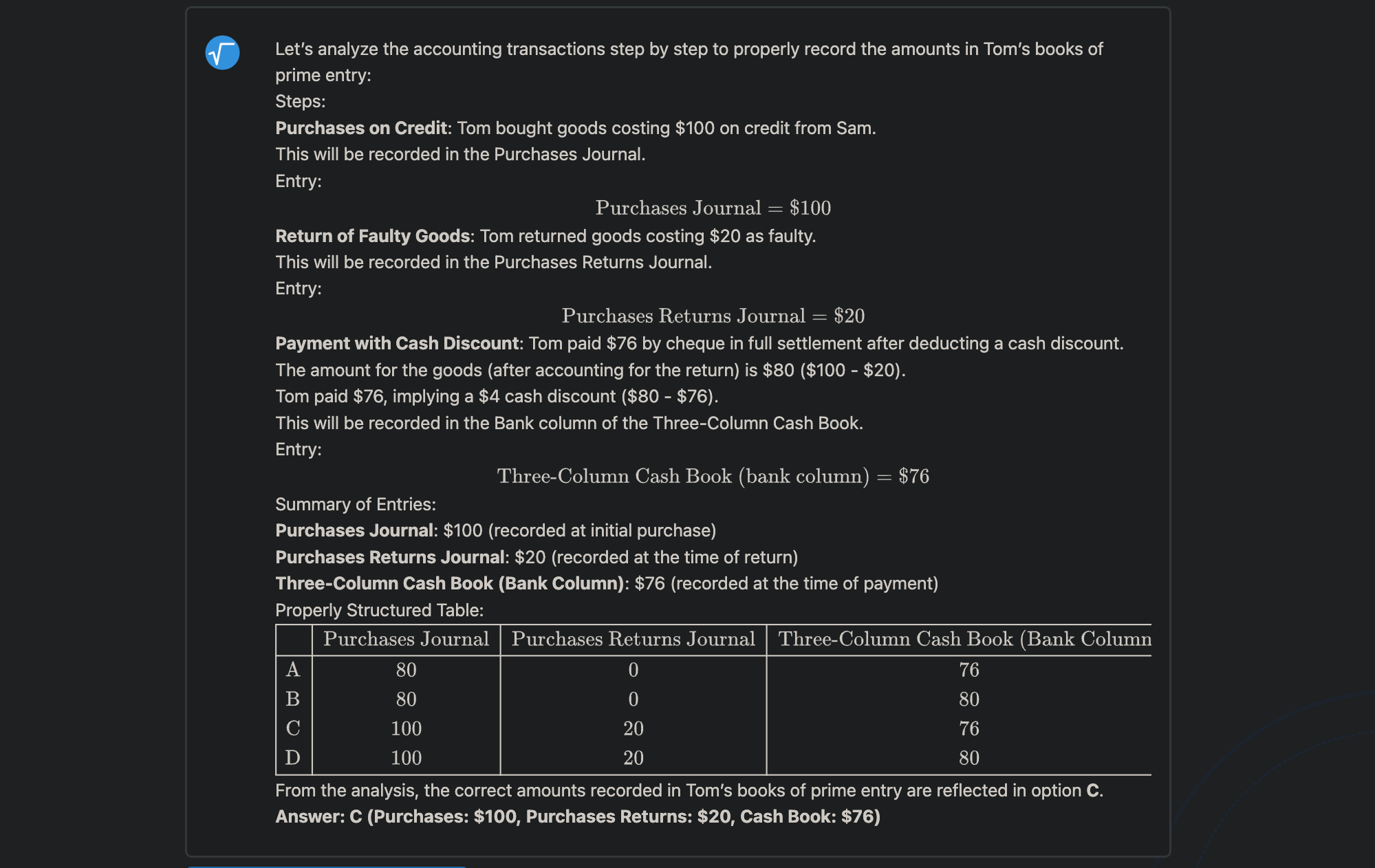
    While it’s straightforward to find videos on general topics, the likelihood of finding a video that answers my specific question is relatively low. That’s when AI tools come in handy; all you need to do is type in your question and the tool will generate a comprehensive solution in seconds. For instance, I struggled with a multiple-choice accounting question.

    After entering it into MathGPT, I received the answer I was seeking!

    MathGPT solving an accounting multiple choice questions

    Even when I find the exact question online, the solutions can often be convoluted with complex symbols and notations, which can be disheartening. However, the AI presents information differently.

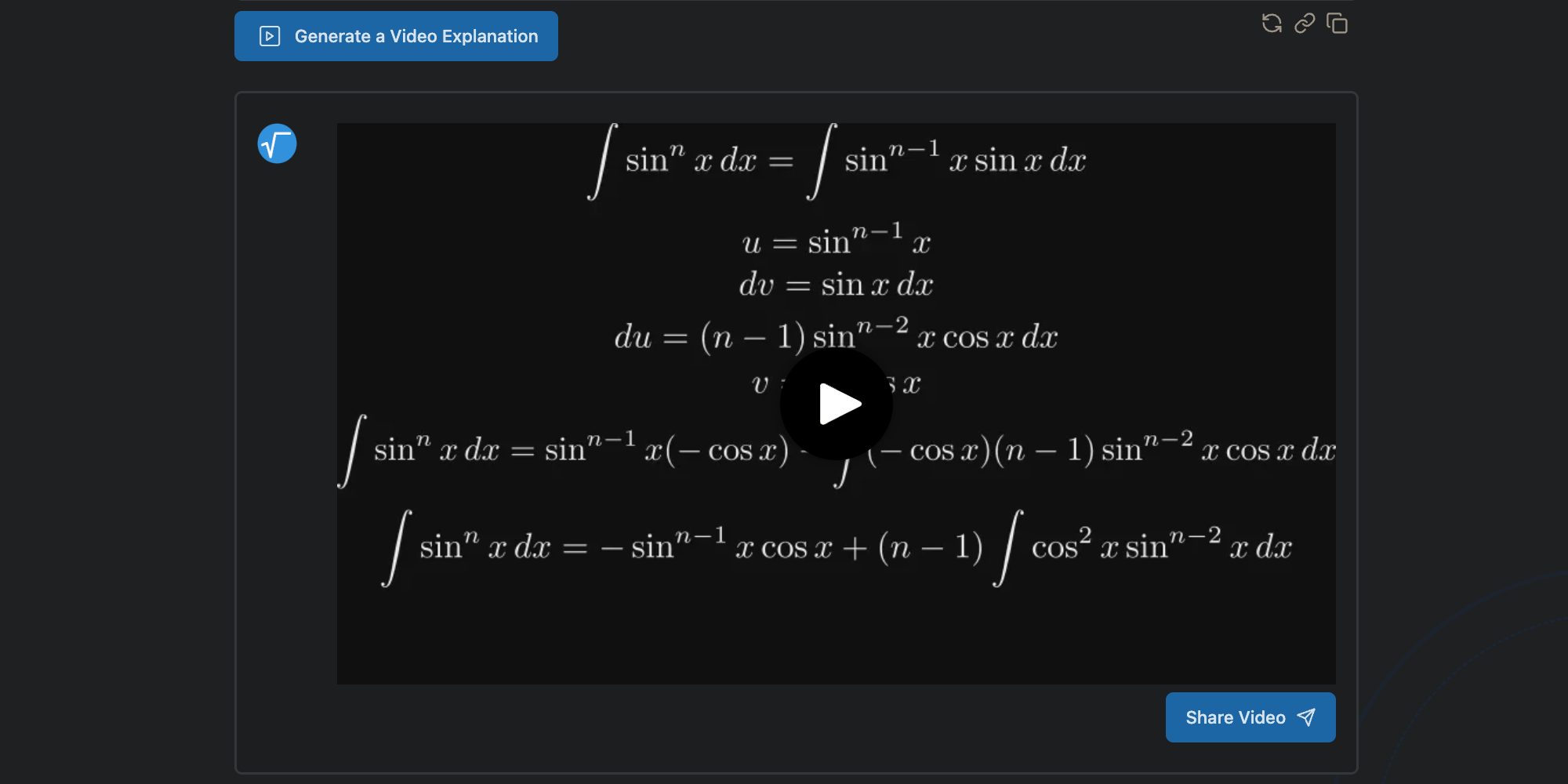
    One of MathGPT’s strengths is breaking down intricate problems into bite-sized steps. Additionally, you can click the Generate Video Explanation button to produce a script and a video that clarifies the solution in just a few minutes. Although the same solution is provided, the timing of the explanations on screen is notably beneficial for my understanding.

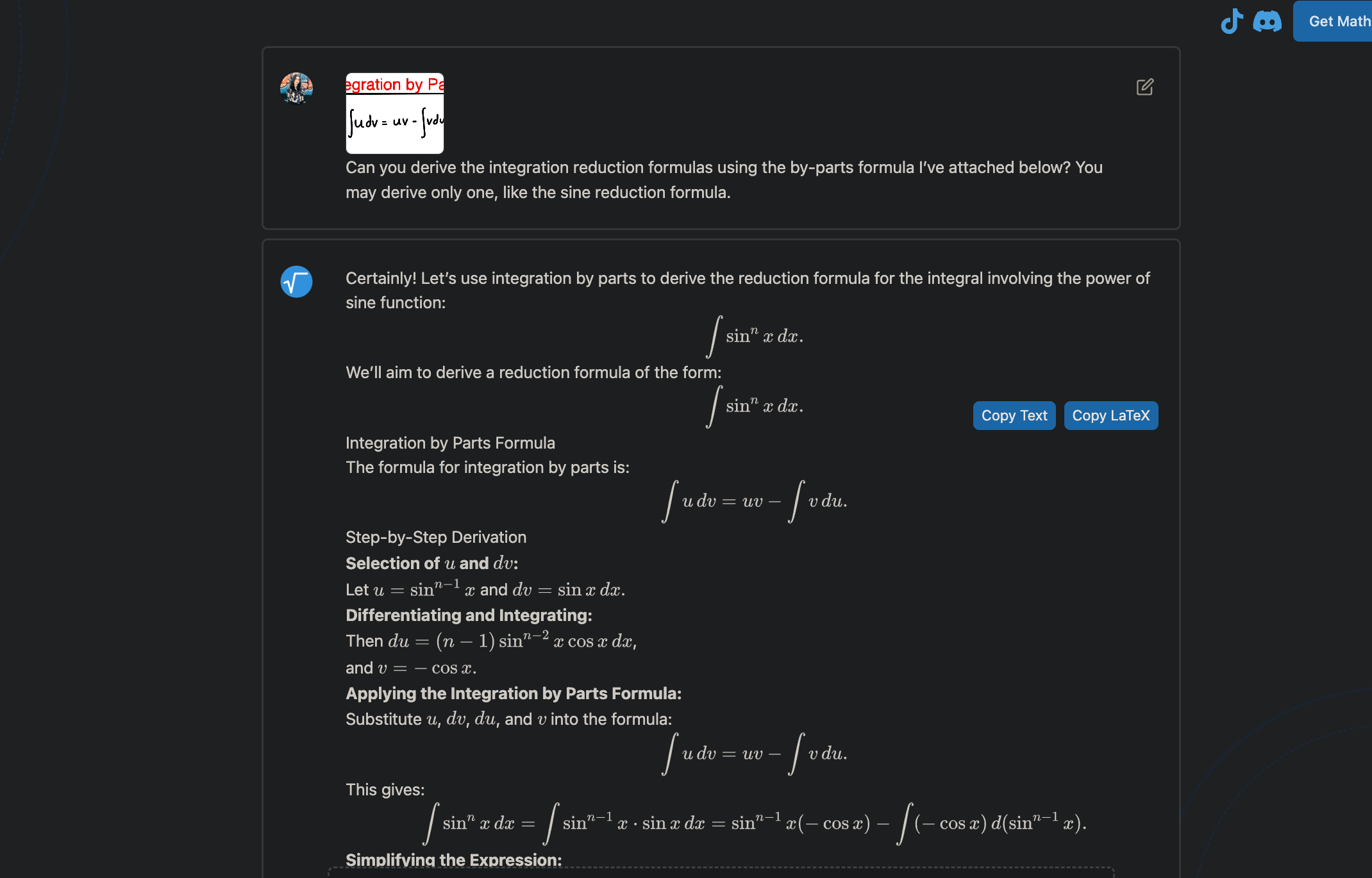
    What stands out the most about MathGPT is that the video solutions are customized to incorporate the methods you prefer. For instance, during my Calculus class, my professor solved a problem using a technique I hadn’t encountered before, leaving me confused. After class, I opted to use MathGPT to tackle the same problem, asking for a method I was already comfortable with.

    MathGPT deriving integration reduction formula

    In no time, MathGPT performed wonders, and I gained clarity through the generated video explanation! You can check out the video on this page.

    MathGPT generating video explaination for integration reduction formula derivation

    Generate Customized Practice Problems on Demand

    I’ve always been convinced that tackling practice problems is essential for mastering STEM subjects after grasping the concepts.

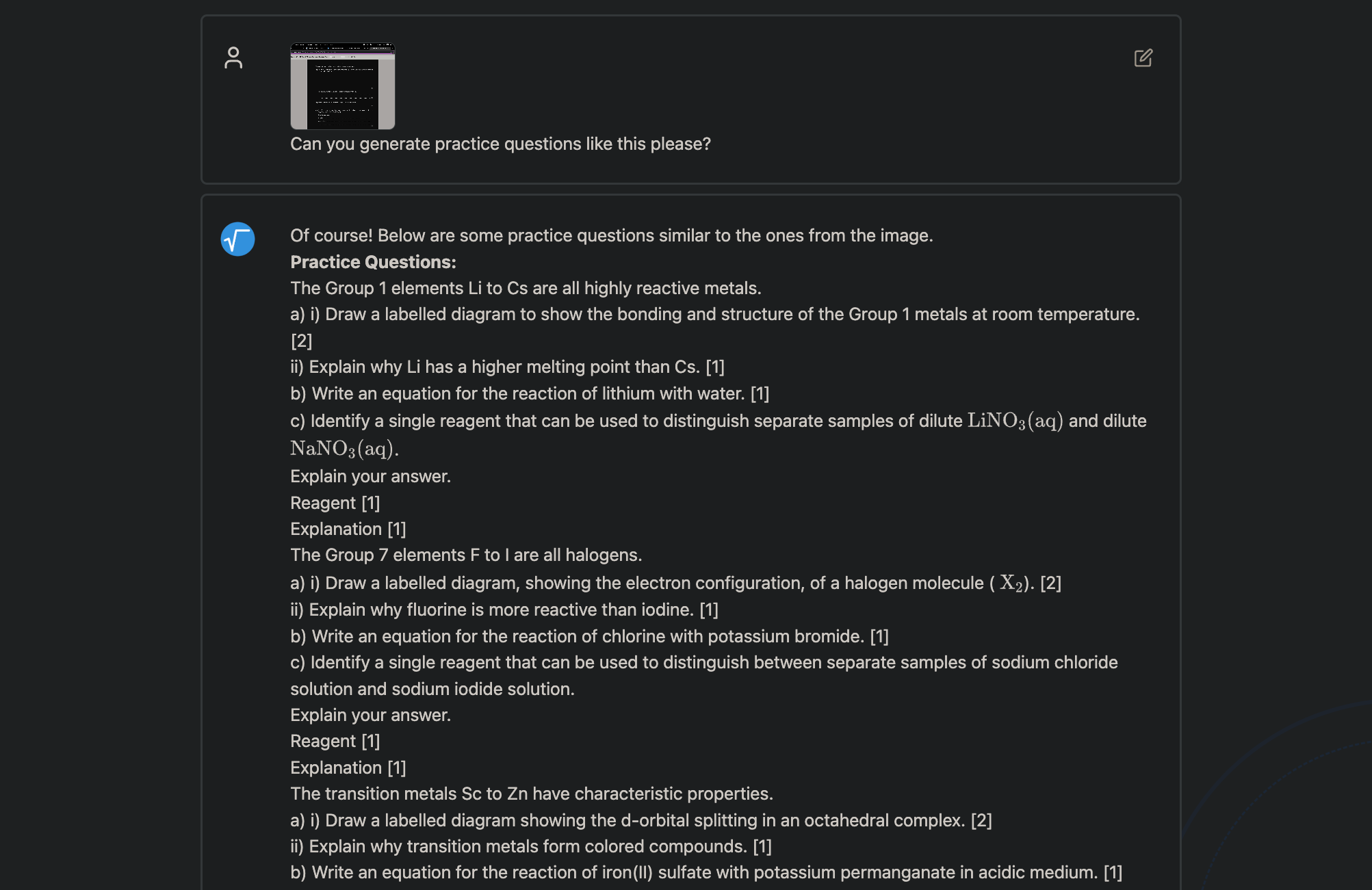
    While it’s possible to use the course textbook for practice, college textbooks often contain hundreds of questions, making it hard to locate the right ones to focus on. MathGPT has been instrumental in this regard. Since my exams regularly feature questions similar to my assignments, I typically upload a few assignment questions and ask MathGPT to create analogous problems, either matching or exceeding the difficulty.

    MathGPT generating Chemistry practice questions

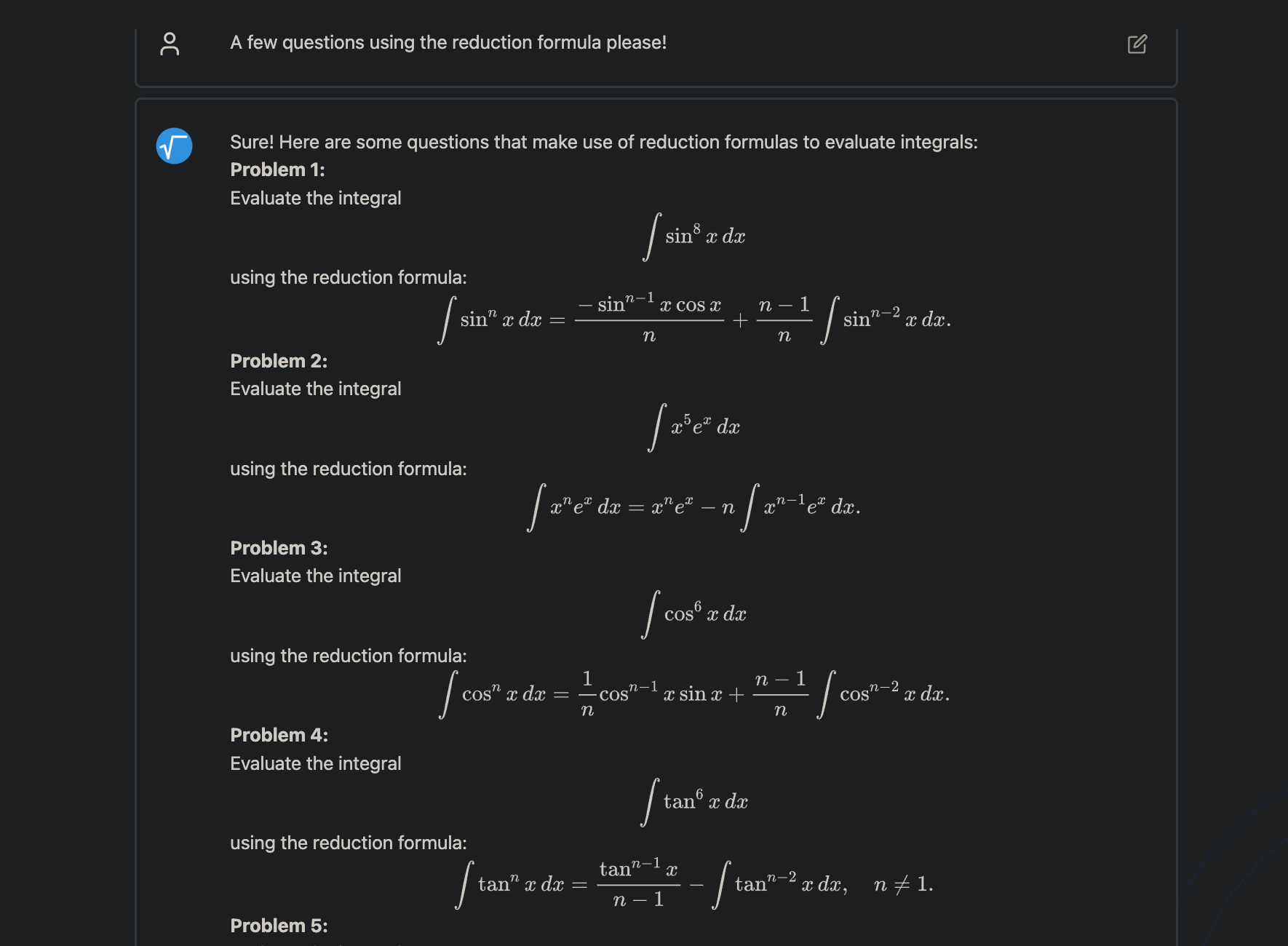
    Moreover, when I ask MathGPT to clarify a concept or tackle a question, I also request it to produce similar questions immediately after to make sure I thoroughly grasped the material.

    MathGPT creating integration questions that use the reduction formula

    This approach saves me the hassle of poring over endless questions and allows me to concentrate on the topics I find most challenging. If I ever find myself stuck, I simply ask MathGPT for a solution!

    Let AI Review Your Solutions

    We’ve all made minor errors, like miscalculating a simple multiplication. In such cases, I often find myself staring blankly at my answer, attempting to figure out where I went wrong. This can be incredibly frustrating, particularly with lengthy problems where I grasp the concept yet falter due to a small mistake.

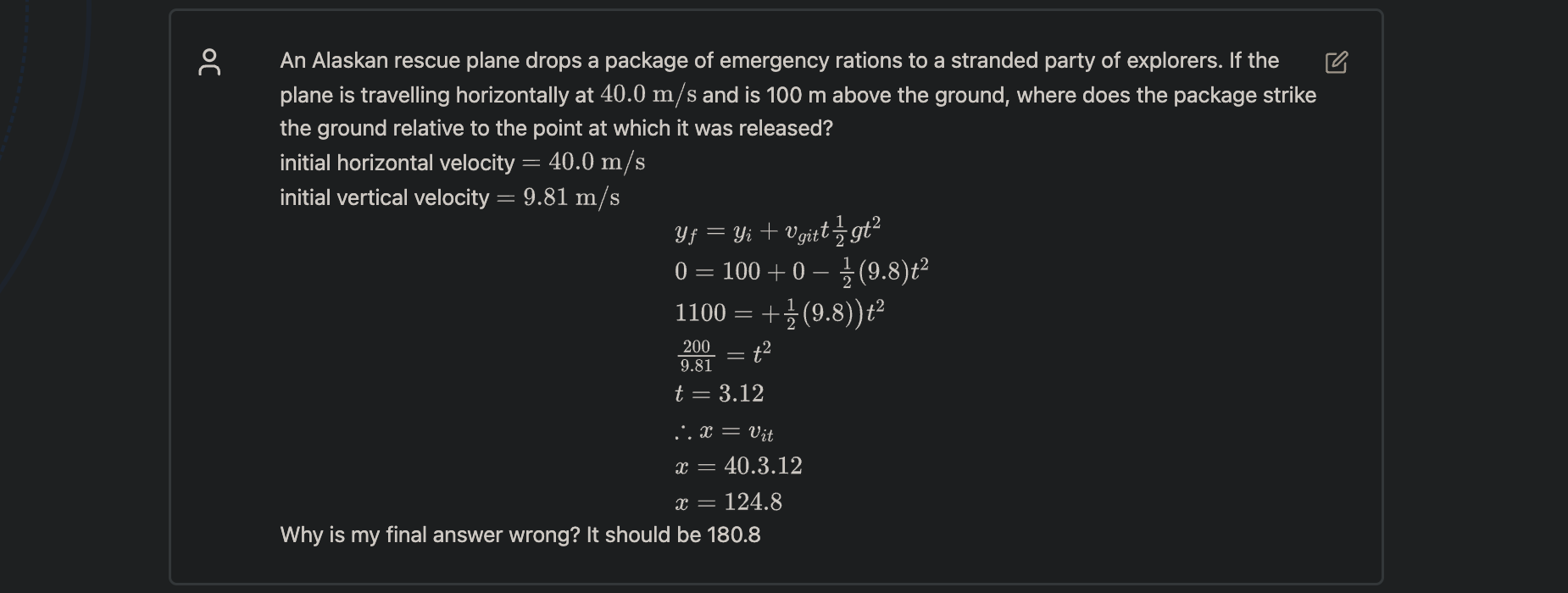
    MathGPT can also assist in verifying your answers and spotting inaccuracies. For example, I submitted a kinematics physics question along with my calculations to MathGPT, asking it to check my conclusion since I’d arrived at the wrong answer.

    Asking MathGPT to check my work

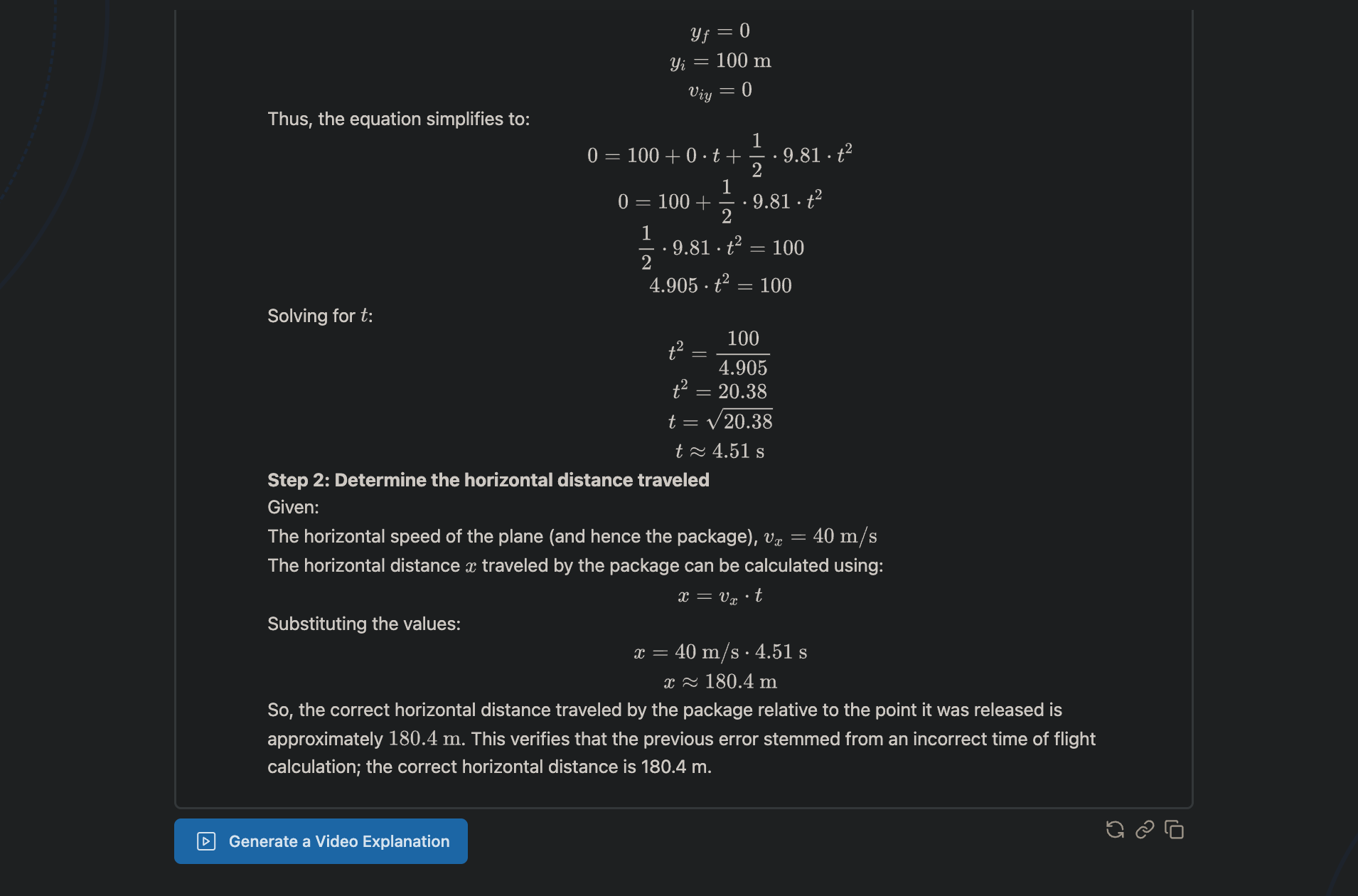
    The AI managed to solve the exercise and highlighted that my mistake was due to a miscalculation of the time of flight caused by incorrect division when I was rushing.

    MathGPT identifying the error I made in my Physics question

    This not only saves me a lot of time that I could allocate to more challenging problems, but it also reinforces my understanding of the underlying concepts.

    MathGPT has swiftly become an indispensable tool in my daily routine. It’s by far the best AI resource for solving math problems and solidifying your understanding. Plus, since it’s not just limited to math, I highly recommend checking out the site if you’re a student.