الوسم: year-over-year change

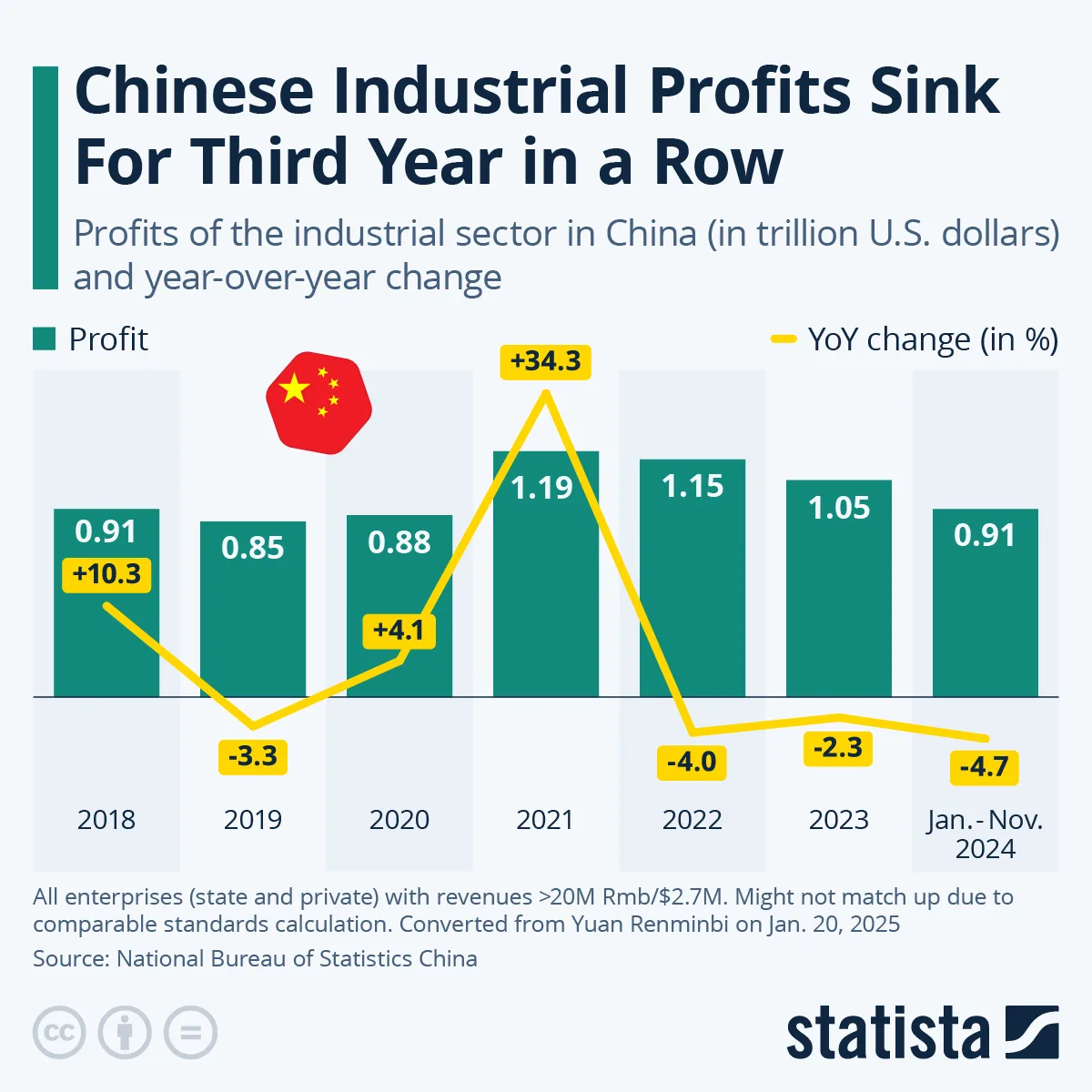
  • China’s Industrial Profits Fall 4.7% for Third Consecutive Year

    China’s Industrial Profits Fall 4.7% for Third Consecutive Year

    Overview of Chinese Industrial Profits

    In recent years, the Chinese industrial sector has faced significant challenges, resulting in a notable decline in corporate profits. For the third consecutive year, industrial profits in China have experienced a downturn, signaling an ongoing struggle within the nation’s economic landscape.

    Recent Profit Trends

    According to the latest reports, overall industrial profits in China fell to approximately $912 billion, representing a decrease of 4.7% between January and November of 2024. This figure includes both state-owned enterprises and private-sector companies boasting annual revenues exceeding 20 million Yuan Renminbi (approximately $2.7 million).

    Factors Contributing to Profit Declines

    Near Deflation Conditions

    One of the critical factors impacting the declines in industrial profits is the near-deflationary environment. This economic condition has sent shockwaves through various sectors, creating volatile market dynamics that have led to decreased consumer spending. The weak domestic demand exacerbates already challenging circumstances for businesses trying to maintain profitability.

    Weak Domestic Demand

    The overall sluggishness in domestic demand has pressured many Chinese companies, pushing them into a difficult financial position. While exports remain a strong point, the domestic market has shown signs of stagnation, leading to adjustments in production and pricing strategies from manufacturers.

    Producer Prices and Market Dynamics

    Signs of Oversupply

    The recent sinking of producer prices is indicative of a broader problem within the industrial sector: oversupply. As manufacturers face the reality of excess goods in the market, they are compelled to lower prices to stimulate sales, both domestically and internationally. This trend poses a significant challenge for maintaining profit margins.

    Revenue Growth vs. Profit Declines

    Although corporate revenues are still growing, the pace has become alarmingly slow. In fact, the growth of revenues followed a similar trend observed in 2023. Disappointingly, statistics revealed that 45% of publicly listed companies in China reported falling revenues, while 40% faced declines in profits, and 23% encountered outright losses.

    Comparative Analysis of State vs. Private Enterprises

    A closer look at the performance of state-owned versus private enterprises reveals further complexities in the ongoing economic situation.

    Struggles of State-Owned Enterprises

    State-owned companies have emerged as the most challenged group within the industrial landscape. Year-on-year profits from these enterprises dropped by 8.4% between January and November 2024. This decline raises questions about the stability and operational efficiency of entities that previously enjoyed robust state support.

    Private and Foreign Companies

    In contrast, private and foreign companies appear to have fared slightly better during this period, with only a 1% decrease in profits. This relative resilience highlights a differentiation in performance between various sectors of the economy, indicating that private enterprises may be better positioned to adapt to current market conditions.

    Conclusion

    As the Chinese industrial sector continues to grapple with falling profits, weak demand, and pricing pressures, the economic landscape remains fraught with uncertainty. The divergent fortunes of state-owned and private enterprises underscore the complexity of these challenges and point to a future that requires careful navigation for all sectors involved.

  • Inflation Rises 2.9% as Shelter Costs Soar 4.3% Year-over-Year

    Inflation Rises 2.9% as Shelter Costs Soar 4.3% Year-over-Year

    Inflation Trends: An Ongoing Challenge

    Overview of Recent Inflation Data

    As we enter what is poised to be a significant political period in the United States, recent inflation data brings to light the complexities of the current economic landscape. Released by the Bureau of Labor Statistics, the latest Consumer Price Index report indicates a noteworthy increase of 2.9 percent in inflation over the past year, notably rising for the third consecutive month. This uptick comes shortly before the inauguration of Donald Trump for his second term, highlighting a continuing battle against inflation that remains critical for policymakers and citizens alike.

    The Core Inflation Rate Dynamics

    While the overall inflation rate has captured headlines, core inflation figures have also shown intriguing trends. The core inflation rate, which filters out the volatility attributed to food and energy prices, has been recorded at 3.2 percent in December. This figure represents the first decline in core inflation since July, adding layers of complexity to the inflation narrative. Understanding these core metrics is essential, as they provide insight into persistent underlying inflationary pressures that transcend seasonal or cyclical fluctuations.

    The Impact of Housing Costs on Inflation

    One significant factor contributing to the rising inflation figures is the cost of shelter. As a major component of the Consumer Price Index, housing costs continue to exert upward pressure on overall inflation. Recent reports indicate that rents surged by 4.3 percent and owner-equivalent rents by 4.8 percent in December alone. This marks the 56th consecutive month of increasing shelter costs, underscoring how vital housing expenses have become in determining inflationary trends.

    Without the contributions of shelter costs, inflation would have remained at or below the Federal Reserve’s target level of 2 percent for the majority of the past 19 months. This sharp contrast illustrates how housing, despite various economic shifts, has emerged as the most obstinate driver of inflationary concerns.

    Federal Reserve’s Response to Inflation

    In light of the recent inflation metrics, the Federal Reserve’s forthcoming decisions are watched closely by analysts and investors alike. Based on the latest insights, there appears to be a strong consensus that the Fed will pause any further rate cuts at its upcoming January meeting, following a series of cuts totaling 100 basis points in late 2023. The CME FedWatch Tool suggests a remarkable 97 percent likelihood that rates will remain unchanged in January, with a 74 percent chance of similar inaction at the March meeting.

    The anticipation of maintaining rates during these pivotal meetings signals the Fed’s cautious approach amid a backdrop of variable economic indicators. Observers have noted a potential timeline for future cuts to commence in June, which will heavily depend on the economic policy decisions made by the incoming Trump administration. Proposed policies, including the potential for increased tariffs and stringent immigration measures, could exacerbate inflationary pressures further complicating the economic outlook.

    Historical Context of Inflation

    To comprehend the trajectory of inflation today, it’s essential to reflect on its recent historical context. In spring 2021, alarming inflation rates were primarily attributed to the “base effect,” a phenomenon resulting from the steep price decreases experienced at the pandemic’s onset. With demand plummeting, year-over-year comparisons revealed artificially inflated inflation figures. However, by the end of 2021, the inflation narrative shifted dramatically, fueled largely by external shocks such as geopolitical tensions stemming from Russia’s invasion of Ukraine. This conflict has caused unprecedented spikes in both food and energy prices, leading to sustained inflationary challenges.

    As the conflict in Ukraine persists, inflating pressures are now measured against already elevated price levels, complicating the path toward stabilizing inflation. The slow progress observed in reducing inflation in the latter part of 2023 illustrates the entangled nature of these economic conditions, drawing from a complex interplay of both local and global factors.

    Conclusion

    [Content omitted as per the instruction for no conclusion]

  • India’s GDP Growth Falls to 5.4% Amid Economic Challenges

    India’s GDP Growth Falls to 5.4% Amid Economic Challenges

    India’s Economic Landscape: Analyzing Recent Growth Trends

    India’s economic journey has been nothing short of remarkable over recent years. However, recent data reveals a concerning trend that could shape the country’s economic future. This blog delves into the nuances of India’s GDP growth, examining the factors contributing to its slowdown and what it means for the nation going forward.

    Quarterly GDP Growth: A Shift in Momentum

    Year-Over-Year Performance

    After displaying robust year-over-year growth in 2023, India’s economic expansion faced significant challenges in 2024. From June to September 2024, the country recorded a GDP growth rate of only 5.4%. This figure marks a critical downturn, representing the lowest quarterly growth since the last quarter of 2022. It stands in stark contrast to projections by economists, who had anticipated a growth rate of 6.5%.

    The Analysts’ Predictions

    Underwhelming Projections

    Economists surveyed by Reuters predicted a more optimistic growth trajectory. Their forecasts suggested that India’s economic momentum would continue into 2024, buoyed by various sectors. However, the actual results fell short of these expectations, highlighting potential vulnerabilities in the national economy.

    Moreover, Reserve Bank of India officials estimated a slightly higher growth of 6.8%, indicating a divergence between institutional predictions and reality.

    Exploring the Causes of Slowdown

    Urban Consumption Challenges

    A key factor explaining this economic deceleration is a notable decline in urban consumption, which has reached a two-year low. The rise in food prices has significantly impacted consumer spending, making it more challenging for the average Indian to maintain previous consumption levels. As urban areas grapple with inflated costs, the ripple effects can be felt throughout different sectors, including retail and services.

    Manufacturing and Utility Outputs

    Another contributing dynamic comes from performance within the manufacturing and utility sectors. According to an analysis by Trading Economics, outputs from these industries have not met previous quarter benchmarks, limiting overall economic growth. The interdependence of various sectors means that weaknesses in manufacturing, often a cornerstone of economic stability, have far-reaching consequences.

    Comparative Economic Rankings

    India Vs. Other Emerging Markets

    Despite these challenges, India remains in a favorable position on the global economic stage. The International Monetary Fund (IMF) recently projected India’s GDP growth for 2024 to be at an impressive seven percent. This rate positions India as a leader among emerging markets, even surpassing growth forecasts for major competitors such as China.

    Long-Term Projections

    While the immediate data reveals a worrying slowdown, projections suggest that India could still emerge as one of the world’s fastest-growing economies in the coming years. This perspective is vital for potential investors and policymakers who wish to navigate the uncertainties of an evolving economic landscape.

    Conclusion

    While the statistics paint a cautious picture of India’s economic health, the broader prospects remain encouraging. An analysis of both current difficulties and future potential underscores the complexity of India’s economic environment. As we dissect these trends, continued monitoring of key economic indicators will be crucial in understanding the opportunities and challenges that lie ahead.

    The unfolding narrative of India’s economy will undoubtedly continue to attract interest as stakeholders navigate both the immediate hurdles and the longer-term aspirations of one of the world’s largest emerging markets.