الوسم: embassy

  • US resumes sending diplomatic staff to Middle East posts

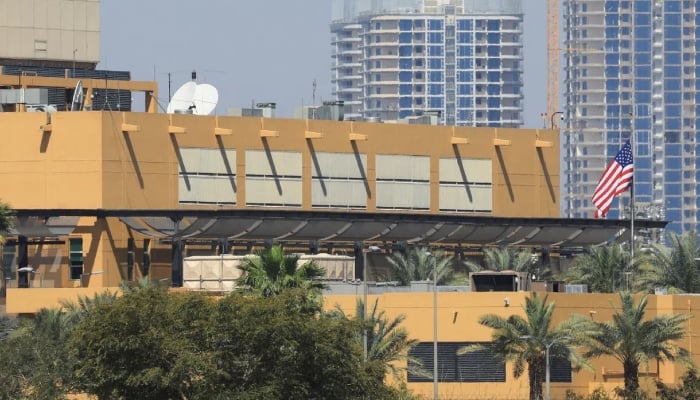
    The US flag flying at the American embassy in Baghdad, Iraq, on March 17, 2026. — Reuters
    The US flag flying at the American embassy in Baghdad, Iraq, on March 17, 2026. — Reuters

    • Posts in Lebanon, Israel, Saudi Arabia, and Baghdad are among those to be restaffed.
    • Some embassies will initially operate at no more than 85% of their authorized staffing levels.
    • Family members will also be allowed to return to Riyadh.

    WASHINGTON: The Trump administration is beginning to redeploy personnel to several diplomatic missions in the Middle East that had been evacuated or scaled back due to tensions with Iran, according to two sources familiar with the matter who spoke to Reuters.

    The affected posts include those in Lebanon, Israel, Saudi Arabia, and Baghdad, Iraq. Additionally, family members will be permitted to return to the U.S. embassy in Riyadh, the sources said.

    This move indicates that Washington perceives a reduced risk of conflict with Iran in the near future, even though some embassies will initially operate below full capacity.

    Specifically, some embassies will initially function at a maximum of 85% of their authorized staffing levels, the sources added.

    The return of certain staff members could begin as early as this week, one of the sources noted.

    The U.S. withdrew staff from various embassies across the Middle East after joint U.S.-Israeli strikes against Iran commenced on February 28. Some embassies in Gulf Arab nations such as Saudi Arabia and Kuwait came under fire from Iran, prompting temporary closures.

    Since then, heavy fighting has decreased, although a U.S. naval blockade of Iranian ports remains in place. The Strait of Hormuz, a critical route for oil and goods transportation, remains closed, with diplomatic efforts to resolve the conflict stalled.

    A State Department spokesperson told Reuters via email that the department continually assesses the security situation at its diplomatic missions worldwide.

    “Based on our latest evaluation, we are adjusting staffing levels at specific posts in the Middle East to ensure we can further our foreign policy goals while prioritizing the safety and security of our personnel,” the spokesperson said.

    The New York Times earlier reported a phased return of diplomats and the relaxation of emergency measures, citing an internal document. It stated that embassies in Jordan, Oman, Kuwait, and Qatar are also expected to increase staffing levels.

    Ultimately, U.S. embassies in Israel, Jordan, and Oman are set to return to full staffing. Meanwhile, missions in the United Arab Emirates, Saudi Arabia, Qatar, and Lebanon will initially be capped at 85%, while posts in Iraq, Kuwait, and Bahrain will be limited to 75%, the report added.

  • Starmer tries to dodge blame for Mandelson appointment in UK

    Starmer tries to dodge blame for Mandelson appointment in UK

    British Prime Minister Keir Starmer blamed foreign ministry officials Monday for the appointment of a U.S. ambassador, asserting they withheld crucial information about Labour veteran Peter Mandelson that could have prevented his hiring.

    Under pressure to resign amid the scandal, Starmer has defended his involvement in the appointment, insisting he was unaware that officials had been advised not to grant security clearance to Mandelson. He expressed regret over choosing Mandelson, whom he dismissed last September after details surfaced about his connections to the late U.S. sex offender Jeffrey Epstein. This controversy has revived questions about Starmer’s judgment, especially after the government revealed last week that it had only recently discovered Mandelson had failed a security vetting procedure.

    On Monday, Starmer voiced frustration that officials from the foreign ministry had failed to disclose that, in January 2025, they had ignored advice and granted Mandelson “developed vetting” clearance—a top-secret access status—without informing him.

    “It’s hard to believe that all along, officials in the foreign office chose to hide this information from our most senior leaders,” Starmer told Parliament. “That’s not the way most people expect our politics, government, or accountability to function.”

    He emphasized that he would not have appointed Mandelson if he had known about the security concerns, adding that he has taken steps to prevent similar issues in the future by restricting the foreign office’s ability to override vetting advice.

    Mandelson’s appointment, initially praised as strategic due to his extensive trade experience and potential to sway the incoming U.S. administration under Trump, has instead become a political headache for Starmer. Trump even weighed in via Truth Social, calling the appointment a “really bad pick” and criticizing Starmer’s judgment.

    Starmer acknowledged that if he had been aware his team had advised against Mandelson’s clearance, he wouldn’t have gone forward, and insisted he was not intentionally misleading Parliament. Previously, his official spokesperson stated that Starmer had no knowledge of the security concerns when discussing Mandelson’s appointment.

    Following last week’s disclosures, which revealed that the foreign office had overridden warnings against Mandelson’s appointment, Starmer dismissed Olly Robbins—Britain’s top foreign ministry official—who authorized the vetting approval. Robbins, who has not yet issued a public statement, reportedly followed the standard protocol allowing the foreign office to overrule security advice.

    Opposition critics accuse Starmer of dishonesty and incompetence, suggesting his position is no longer tenable. With the local elections just three weeks away—during which Labour risks significant losses—the scandal has intensified scrutiny over Starmer’s leadership, though no senior Labour members have called for him to step down.

    Conservative opposition leader Kemi Badenoch criticized Starmer’s handling of the crisis, saying, “Leadership is about owning mistakes. Instead of accepting responsibility, he’s thrown his staff and officials under the bus.”

  • US pulls non-essential staff from Beirut embassy over Iran tensions

    US pulls non-essential staff from Beirut embassy over Iran tensions

    The US military is increasing its presence in the Middle East amid escalating tensions with Iran. Disagreements persist between Iran and the US over nuclear negotiations. Iran maintains that it has no ambitions to develop nuclear weapons and prefers diplomatic solutions.

    The State Department is evacuating non-essential personnel and their eligible family members from the US embassy in Beirut due to rising concerns about the possibility of military conflict with Iran. A senior official stated, “We constantly evaluate the security situation, and based on our recent review, we’ve decided it’s safest to limit our presence to essential staff.” The embassy continues to operate with core personnel, though this temporary measure aims to protect personnel while maintaining operational capabilities and assistance to American citizens.

    Reports indicate that 50 individuals have been evacuated, with 32 embassy staff members and their families departing from Beirut on Monday. The recent buildup of US military forces, coupled with President Donald Trump’s warning that “really bad things will happen” if Iran’s nuclear issue isn’t resolved, underscores increased regional tensions. Iran has also threatened to attack US military bases in retaliation.

    An internal State Department memo referenced the possibility of employees in emergency roles opting to leave, advising that alternative arrangements be made if necessary. Lebanon has historically been a target of US interests during its civil war from 1975 to 1990, with notable attacks such as the 1983 suicide bombing that killed 241 US Marines and another attack on the US embassy that resulted in 49 deaths.

    Meanwhile, US Secretary of State Marco Rubio is planning to visit Israel on Saturday to meet with Prime Minister Benjamin Netanyahu. Although the trip is still on, officials caution that schedules might change. The US demands that Iran abandon its nuclear program, which Iran denies, asserting it has no intention of developing nuclear weapons. The US views Iran’s uranium enrichment activities as a possible pathway to building nuclear arms.

    Iran’s Foreign Minister Abbas Araqchi expects to meet with US Special Envoy Steve Witkoff in Geneva on Thursday and remains optimistic about a diplomatic resolution. Despite this, both nations remain deeply divided, especially over the relief of US sanctions and the scope of negotiations. According to a senior Iranian official, prospects for a peaceful settlement are waning, and fears of a military confrontation are rising, with reports of rapid movement toward conflict as diplomatic talks stagnate.

    On Sunday, Witkoff expressed curiosity about Iran’s reluctance to accept demands to limit its nuclear activities. That would mark the second US and Israeli military strikes against Iran within a year, following an attack last June targeting Iranian military and nuclear infrastructure.

  • Taliban Names First Afghan Ambassador to India

    Taliban Names First Afghan Ambassador to India

    Kabul has designated Noor Ahmad Noor as the new chargé d’affaires at the Indian embassy. He is a senior official from Afghanistan’s Taliban foreign ministry and has already engaged in meetings with Indian officials, according to the embassy.

    The Afghan mission posted on X that both countries stressed the importance of strengthening their bilateral ties. The discussion covered topics like political and economic cooperation, expanding trade, streamlining visa procedures, and addressing the concerns of Afghan traders, students, and residents in India.

    While India has not officially recognized the Taliban government, this move indicates a growing interest in diplomatic engagement, possibly aimed at leveraging tensions between Islamabad and Kabul. The Afghan embassy shared a photo of Noor with Indian Foreign Ministry official Anand Prakash, highlighting the ongoing interactions.

    Despite ideological differences, India is trying to capitalize on the changing regional dynamics, even as Pakistan and India recently experienced their worst military clash in decades in May 2025. Additionally, Islamabad has faced border skirmishes with Kabul and has responded to terrorist attacks supported by Taliban forces on Pakistani posts.

    This appointment marks a significant step for the Taliban, which is working to regain control over Afghanistan’s diplomatic missions to enhance its international legitimacy. In October, India declared plans to upgrade its technical mission in Afghanistan to a full-fledged embassy. Russia remains the only country to officially recognize the Taliban-led government.

  • UK’s Palestinian Embassy Officially Opens

    UK’s Palestinian Embassy Officially Opens

    The Palestinian embassy in London was officially opened during a brief ceremony on Monday, celebrated by its ambassador as a significant milestone in UK-Palestinian relations.

    “Today, we come together to mark a historic event—the opening of the Palestinian State’s embassy in the UK, now with full diplomatic privileges,” stated Ambassador Husam Zomlot in a speech outside what was formerly known as the Palestinian Mission to the UK in West London.

    This upgrade from mission to embassy came after the UK announced in September 2025 that it would recognize the State of Palestine, joining several other nations like Australia and Canada during a period of heightened global concern over the humanitarian crisis in Gaza.

    Clad in a traditional black and white keffiyeh scarf, Zomlot emphasized that this development is “not just a name change” but signals a “shift in approach” toward Palestinian statehood.

    “Starting the new year with this milestone symbolizes a profound step forward in British-Palestinian relations and reflects the long journey of the Palestinian people toward freedom and self-determination,” Zomlot said before unveiling the new plaque at the embassy.

    He added, “Today is a day of hope and resilience—a reminder to the world that peace is not only achievable but inevitable when rooted in justice, dignity, equality, and mutual recognition.”

    The British Foreign Office did not immediately respond to inquiries about whether the UK plans to establish a British embassy in Palestinian territories.

    Following Zomlot’s remarks, UK diplomat Alistair Harrison spoke at a podium flanked by Palestinian and British flags, describing the event as “a moment of hope.”

    “This is the start of a transformational chapter in our bilateral relationship,” he said. “I wish the ambassador and his team a very successful stay here at your new embassy. Congratulations.”

    Meanwhile, a fragile ceasefire has been maintained since October, following a devastating Israeli military operation in response to Hamas’s unprecedented attack on October 7, 2023.

  • US Withdraws Visas of Indian Business Leaders Over Fentanyl Ties

    US Withdraws Visas of Indian Business Leaders Over Fentanyl Ties

    The U.S. embassy in New Delhi announced on Thursday that it has revoked and denied visas to certain Indian business executives and corporate leaders due to their alleged involvement in trafficking fentanyl precursors. The statement clarified that these individuals are Indian nationals, though their identities were not disclosed.

    Fentanyl precursors are the fundamental chemicals used to produce fentanyl, which has become a leading cause of overdose deaths in the United States.

    The embassy emphasized that Indian officials are collaborating closely with U.S. authorities to address the ongoing challenge of drug trafficking.

    India’s foreign ministry has not responded immediately to a Reuters request for comment regarding the U.S. visa actions.

    U.S. President Donald Trump, whose previous tariffs of 50% on Indian imports strained bilateral relations, has also imposed additional tariffs on imports from China, Mexico, and Canada. He has stated these measures aim to curb the flow of fentanyl into the U.S.

    In a Congressional briefing this week, Trump identified India as one of 23 major transit or manufacturing countries for illegal drugs, though he noted that listing a country does not necessarily reflect its government’s efforts in combating drug trafficking.

  • US, Russia Delegations Gather in Istanbul for Diplomatic Talks

    US, Russia Delegations Gather in Istanbul for Diplomatic Talks

    A vehicle transporting the American delegation arrives at the Russian Consulate for a second meeting aimed at stabilizing embassy operations, in Istanbul, Turkey, April 10, 2025. — Reuters

    ISTANBUL: On Thursday, U.S. and Russian delegations convened in Istanbul to discuss normalizing the operations of their diplomatic missions, following escalating tensions stemming from the Ukraine conflict, the most significant clash between Moscow and the West since the height of the Cold War.

    Leading the discussions are Russia’s newly appointed ambassador to the U.S., Alexander Darchiev, and U.S. Deputy Assistant Secretary of State Sonata Coulter, as confirmed by Russia’s foreign ministry.

    The primary aim, as stated by both Moscow and Washington, is to reinstate diplomatic functions that have been hampered by years of confrontations, accusations of intimidation, and complications regarding frozen diplomatic assets. This has strained relations between the two nuclear powers.

    “Ukraine is completely off the table,” State Department spokesperson Tammy Bruce emphasized on Tuesday.

    “These discussions focus exclusively on our embassy operations and not on normalizing the overall bilateral relationship, which can only transpire once there is peace in Ukraine,” she continued.

    In recent years, both Moscow and Washington have expressed frustration over challenges in securing credentials for their diplomats, significantly hindering the effectiveness of their embassies.

    Russia has noted that Western sanctions have complicated even the payment of diplomats, while U.S. officials report restrictions on their movements within Russia. Each side has documented instances of intimidation.

    A significant point of contention is diplomatic property.

    The U.S. government has placed restrictions on six Russian properties, including the Killenworth estate in Long Island, the Pioneer Point “dacha” in Maryland, as well as the Russian consulates located in San Francisco and Seattle, along with trade missions in Washington and New York.