
Select Language:
The Most Catastrophic Events in History, Ranked by Loss of Life
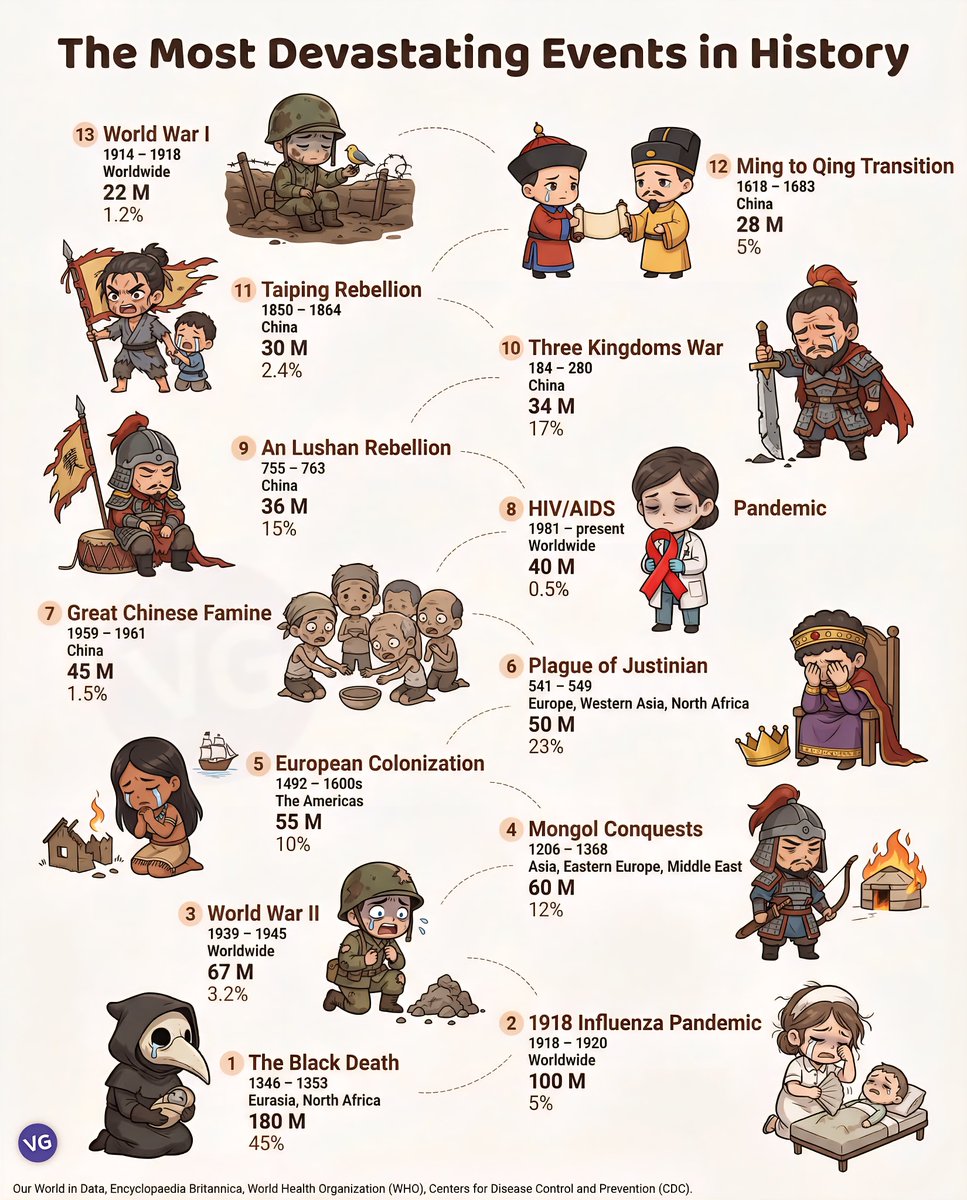
1. The Black Death (1347-1351)
The terrifying spread of the bubonic plague during the Middle Ages claimed approximately 180 million lives across Europe, Asia, and Africa. Originating in Central Asia, the disease devastated populations, wiping out about one-third of Europe’s population and causing profound social and economic upheaval. Medieval cities were especially hard hit, with entire communities decimated as rat-infested ships and trade routes fueled the pandemic’s relentless progression.
2. 1918 Influenza Pandemic (The Spanish Flu)
A century ago, a highly contagious flu virus swept the globe, infecting about one-third of the world’s population and resulting in roughly 100 million deaths. The 1918 influenza pandemic was characterized by its rapid transmission and severe symptoms, disproportionately affecting young adults and pregnant women. The ongoing chaos of World War I likely facilitated its spread, leading to one of the deadliest health crises in modern history.
3. World War II (1939-1945)
This global conflict caused unparalleled devastation, with an estimated 67 million lives lost worldwide. From Europe to Asia and Africa, the war’s atrocities included the Holocaust, atomic bombings of Hiroshima and Nagasaki, and widespread civilian casualties. Its aftermath redrew international borders and reshaped global politics, leaving a legacy of destruction that still influences geopolitical relations today.
4. Mongol Conquests (1206-1368)
Led by Genghis Khan and his successors, the Mongol invasions resulted in the deaths of about 60 million people. Stretching across Asia, Eastern Europe, and the Middle East, these conquests reshaped territories through brutal warfare and forced migrations. The Mongol armies facilitated cultural exchanges but at a staggering human cost, leaving scars in histories of the regions they affected.
5. European Colonization of the Americas (15th-17th Century)
As Europeans expanded their empires across the New World, epidemics like smallpox, measles, and influenza decimated indigenous populations. An estimated 55 million Native Americans died due to disease and violence, profoundly altering the demographics and cultures of the continent. Colonization also involved systemic exploitation and upheaval for countless indigenous communities.
6. The Justinian Plague (541-542)
This devastating outbreak of bubonic plague originated in the Eastern Roman Empire, claiming roughly 50 million lives over two centuries. It contributed to the decline of the Byzantine Empire and caused economic turmoil, with recurring outbreaks disrupting trade and stability across Europe, Asia, and North Africa.
7. The Great Chinese Famine (1959-1961)
Caused by a combination of social upheaval, poor policy decisions, and natural conditions, the Great Chinese Famine resulted in approximately 45 million deaths. The famine led to widespread hunger, social unrest, and a significant decline in life expectancy during the early years of the People’s Republic.
8. The HIV/AIDS Pandemic (1980s-Present)
Since its recognition, HIV/AIDS has claimed over 40 million lives globally. Despite advances in treatment and awareness, the disease continues to impact millions, especially in sub-Saharan Africa. The pandemic has challenged public health systems, prompted social stigma, and spurred ongoing efforts for prevention and care.
9. The An Lushan Rebellion (755-763)
This major Chinese civil war resulted in about 36 million deaths, profoundly weakening the Tang Dynasty. The conflict caused famine, chaos, and a decline in imperial authority, leaving long-term scars on Chinese history and governance.
10. The Three Kingdoms War (220-280)
A prolonged period of warfare in China led to approximately 34 million deaths. Nightmarish battles between rival states created widespread suffering and instability, ultimately setting the stage for dynastic changes and cultural shifts in Chinese history.
11. The Taiping Rebellion (1850-1864)
This massive civil war in Qing China resulted in around 30 million deaths. Driven by religious and political upheaval, the conflict devastated the population, destabilized the empire, and led to significant social reforms in the country.
12. The Ming to Qing Transition (1644-1683)
This period marked a dynastic struggle that caused about 28 million deaths. Warfare, social upheaval, and invasions from Manchu forces led to widespread destruction and upheaval as China transitioned between two major dynasties.
13. World War I (1914-1918)
Although shorter in duration, this global war resulted in about 22 million deaths. The conflict introduced new warfare technologies, caused widespread devastation in Europe, and served as a prelude to future conflicts, shaping the 20th century significantly.
Sources: Our World in Data, Encyclopaedia Britannica, WHO, CDC
Prepared by the Editor, 2025
 ChatGPT
 Perplexity
 Gemini AI
 Grok AI