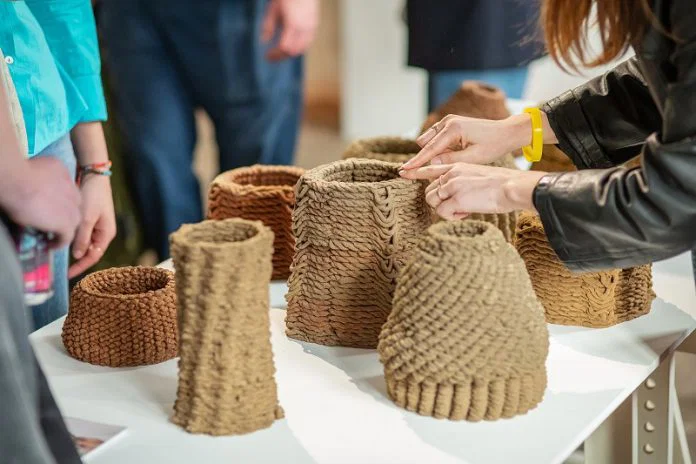
A common ingredient in ice cream might hold the key to transforming everyday dirt into eco-friendly building materials. Researchers at the University of Colorado Boulder have found that sodium alginate, a substance derived from seaweed and commonly used to improve food texture, can make natural materials like clay and sand much easier to 3D print into durable structures. This breakthrough could potentially cut down on construction waste and reduce the environmental footprint of building projects.
Humans have utilized earth as a primary building material for thousands of years. Traditional structures such as adobe homes were crafted from clay, sand, and other natural elements. Many animals also use earth-based construction: termites build towering mounds, wasps create complex nests, and honeycomb worms form reef-like structures along coastlines. These creatures don’t rely on cement; instead, they depend on natural biopolymers—substances acting like glue—to bind soil particles together.
Inspired by these natural architects, the research team wanted to discover which biopolymers could help turn soil into a suitable material for modern 3D printing. They tested five food-grade biopolymers. Some are already used in products like salad dressings to prevent ingredients from separating, while others come from seaweed or are produced through sugar fermentation.
One of these substances, locust bean gum, tightly bonded soil particles, creating a strong material. However, it also made the mixture too thick and difficult to extrude through a 3D printer. Sodium alginate, on the other hand, behaved differently. Instead of acting like glue, it altered the electrical charges on clay particles, causing them to repel each other—similar to like poles of magnets pushing apart.
This charge-based effect allowed soil particles to stay evenly suspended in the mixture while flowing smoothly through the printer nozzle. The result was a material that could be printed quickly and more easily. Remarkably, only a tiny amount of sodium alginate—about 0.12%—was necessary. When added to soil from a Colorado granite quarry, the mixture became both stronger and more printable. It could withstand roughly 25% more pressure than untreated soil and was about 33% faster to print.
Using this new formulation, the team crafted a thin wall only 8 millimeters thick that remained stable even when tilted at a 60-degree angle—steeper than the Leaning Tower of Pisa. The researchers highlight that earthen building materials offer additional advantages: earth naturally helps regulate indoor humidity, absorbs some pollutants from the air, and provides insulation, keeping buildings cooler in summer and warmer in winter.
Moreover, construction projects often produce large amounts of excavated soil while digging foundations, basements, or parking lots, much of which ends up in landfills. The new approach could enable builders to reuse soil directly on-site, reducing waste and promoting sustainability. Since clay and sand are among the most plentiful natural resources, this seaweed-derived additive could pave the way for more sustainable, environmentally friendly construction worldwide.